From sole finance hire to $100M+ ARR: Building a finance org that scales
With Chris Brubaker, SVP of Finance at Postscript

Postscript is an SMS marketing platform that empowers e-commerce brands to develop relationships and drive sales at scale through text messaging.
Chris Brubaker, now SVP of Finance, joined as the first finance hire after the company raised its Series B round led by Greylock — and has built a super-efficient yet super-effective finance function from scratch to support 10X growth to $100M and beyond.
We're not adding headcount just to pull reports or maintain infrastructure. We can lean on Aleph to do that and focus on hiring for value — where we can drive decision-making.


The challenge
When Chris arrived, there was no finance function to speak of — no models, no reporting infrastructure — it was just an outsourced accounting firm that had left the books in sub-optimal shape.
His first job was to understand how the business actually worked: how revenue was generated, what drove costs, and how to build a forecast that leadership could trust.
As a usage-based company, Postscript's financials were unusually complex. Variable COGS tied to message delivery costs, a dense matrix of pricing by region and phone type, and multiple data systems that never talked to each other made consolidation a constant battle.
Running any analysis meant manually exporting data from Salesforce, Snowflake, and their accounting system, then pasting and reconciling everything in spreadsheets, every cycle.
There was no version control on the budget, no single source of truth for reports, and no clean way to collaborate with RevOps or BI teams who were working from their own numbers.
An alternative FP&A tool was brought in to address some of these pains, but after months of implementation, it still couldn't properly connect to and reconcile cross-system data. The team cut its losses.
The turning point
Chris came to Aleph in 2022 when he was still early in his journey. The attraction was simple: eliminate the download-and-paste cycle and create a reliable, refreshable data layer that could serve as the foundation for everything else.
The experience from day one was completely different.
Integrations with Snowflake, Salesforce, and QuickBooks (back then and Rillet now) were live in under a day, compared to months of failed attempts with the prior vendor.
Chris remembers his first Aleph “aha” moment was when he realized he could create custom tables from other tables, letting the team weave together headcount from Rippling, financials from their ERP, and CRM data from Salesforce into a single, consistent structure — with consistent naming that carried through every report.
Implementing Aleph was insanely fast. We did all of our quarter-end reporting with Aleph less than 3 weeks after signing.
How Postscript’s finance team operates today
The work didn't change, but how they do it did:
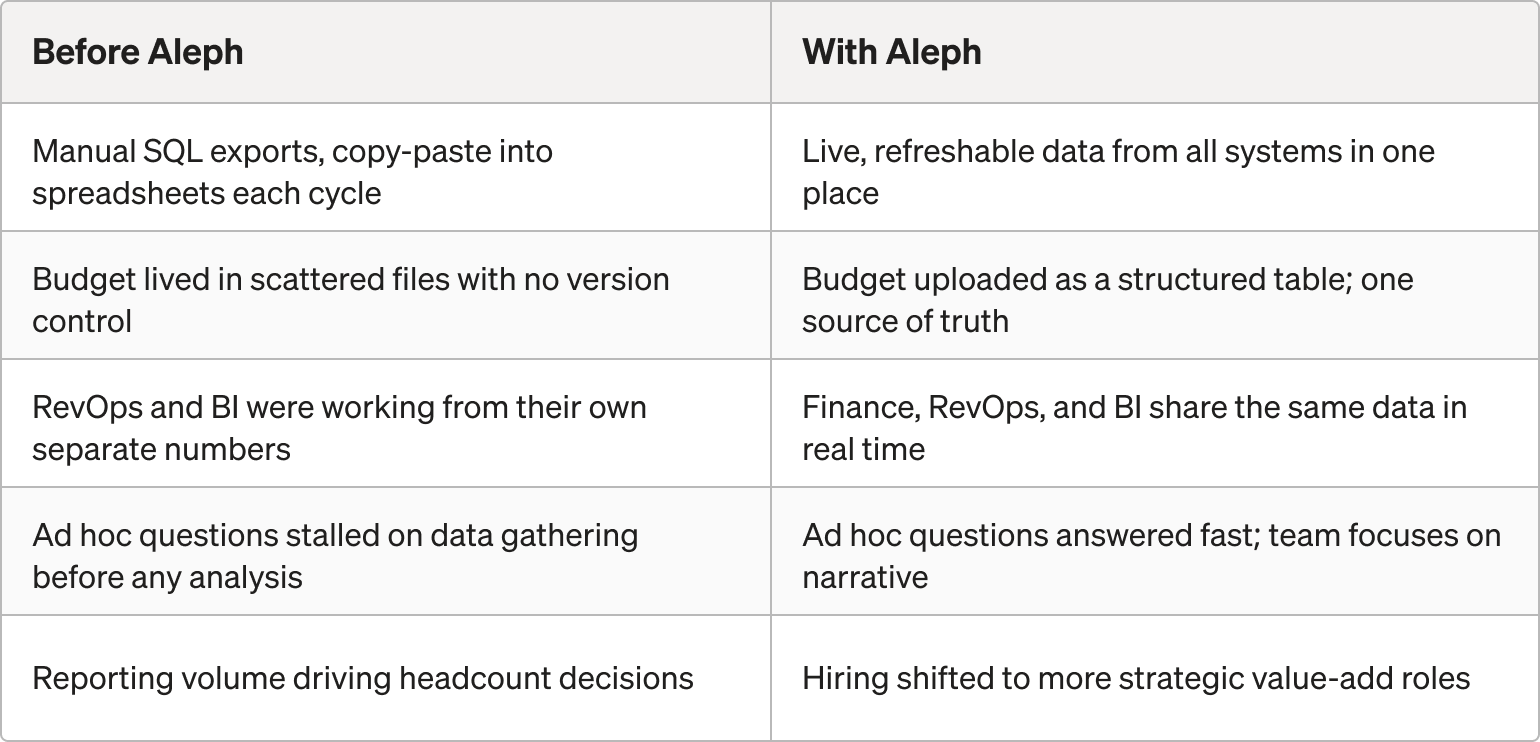
Over four years, Aleph has grown alongside Postscript's finance function. What started as a reporting tool expanded to cover budgeting and scenario modeling — and then expanded again cross-functionally, becoming the connective layer between finance, RevOps, and the BI team.
Budget vs. actuals by department now turns in under a day. Business owners track their own numbers. Chris's mantra — "don't hire until you absolutely must" — has been extended further by having the right software in place.
Being able to bring additional departments into Aleph as the single source of truth — and the ease of use to push that data across a variety of use cases — has helped us keep decision speed up and make sure we're always talking about the same things.
Chris describes the relationship with Aleph not as a one-time implementation but as an ongoing partnership. One that has evolved as Postscript has grown 10X, hitting and passing 100M ARR. The Aleph team regularly surfaces new use cases, flags workflow inefficiencies, and keeps Postscript informed on the roadmap.
"Not only is it quick to get set up — it's sort of like an ongoing onboarding process where we are continually learning new ways to get the most out of the software," said Chris.
What's next: AI-native finance
What excites Chris the most isn’t what’s been done, but where Aleph is heading. The manual-to-strategic shift the team has been making is now being accelerated by AI features that remove the last remaining bottlenecks between raw data and real insight.
Conversational querying lets the team ask questions in plain language and get answers without writing formulas or building new tables.
AI agents and co-pilots compress work that used to take hours into minutes, giving their team back time for stakeholder communication and strategic support.
The ability to speed up the creation of dashboards and reports using plain language queries can now be automated. We get back to doing the thing that matters: stakeholder communication and decision-making support.