Optimizing Your Budgeting Process: Lessons from 250 Finance Leaders
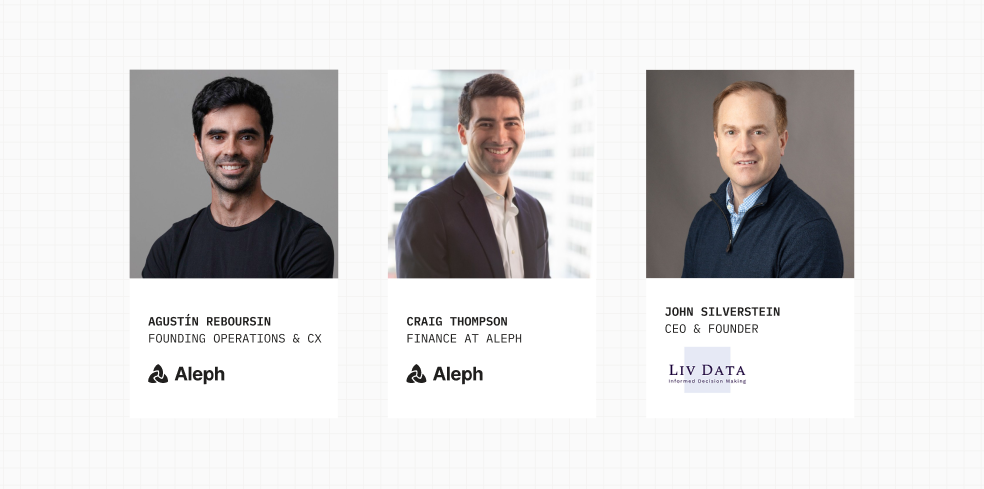
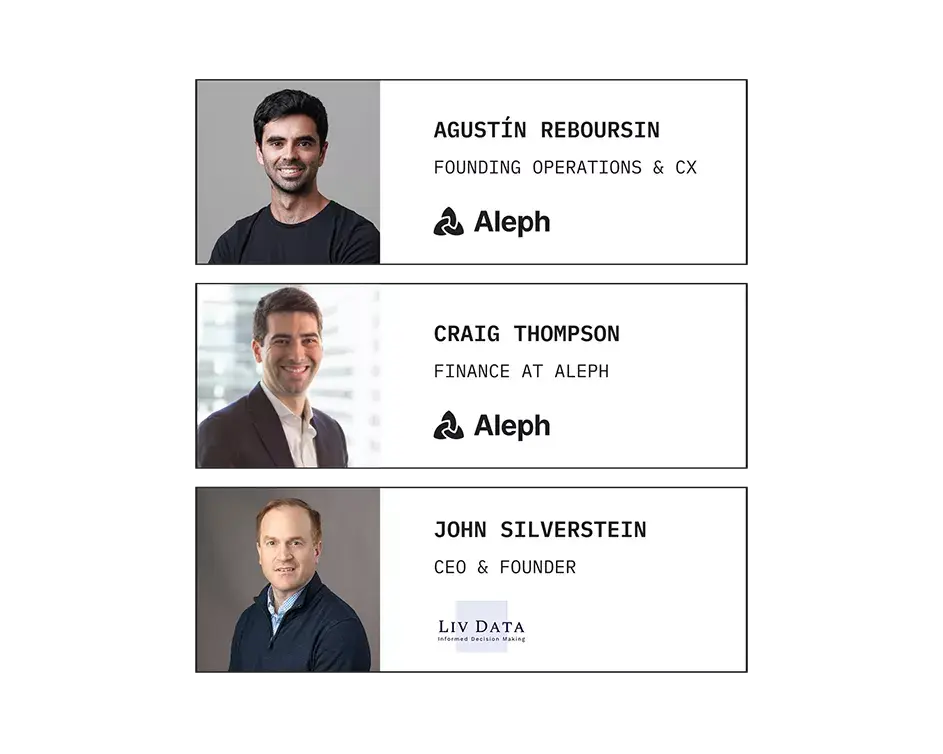
Agustín Reboursin, Craig Thompson, and John Silverstein share how modern finance teams are streamlining their budgeting process to plan faster, collaborate better, and adapt with confidence.

Inside the journey
Budgeting season is here — and for many finance teams, it still feels like a grind.
In this webinar, Agustín Reboursin and Craig Thompson from Aleph join John Silverstein, CEO & Founder of Liv Data, to unpack how modern finance teams are rethinking their budgeting process for speed, accuracy, and collaboration.
You’ll learn what it takes to build a more agile, connected budgeting cycle — one that eliminates manual work, reduces revisions, and drives better cross-functional alignment. Backed by insights from 250 finance leaders, they’ll share proven strategies and tools that make the process smoother from kickoff to board approval.
Hosted by Aleph, this one-hour session is designed to give you actionable ideas you can apply immediately — whether you’re leading next year’s planning process, improving team collaboration, or modernizing your FP&A stack.
Join the session to learn:
- How to shorten your budgeting cycle without sacrificing accuracy
- Why hybrid planning beats traditional top-down or bottoms-up approaches
- Practical ways to improve collaboration and input collection across teams
- How to connect your spreadsheets to a live, auditable planning model
- Common pitfalls that slow down budgeting — and how to fix them fast
- Real examples of how finance leaders are using Aleph to streamline planning
Plus, much more.
Watch the webinar replay!
Register to hear Agustín Reboursin, Craig Thompson, and John Silverstein share how modern finance teams are optimizing their budgeting process. Learn how to blend structure, technology, and collaboration to plan faster, adapt smarter, and drive better results.
Chapters
- 00:00 · Welcome and audience check-in
- 09:08 · Budgeting approaches and strategies
- 15:38 · Tools and technologies for budgeting
- 22:57 · Kickoff strategies for budget cycles
- 30:18 · Finance as a business partner
- 39:56 · The role of AI in budgeting
- 42:18 · Collaborative budgeting with Aleph
- 54:16 · Collaboration between accounting and FP&A
Read the transcript
00:06 Alright. Excited to kick this off and get this going. Yep. Alright. A few seconds for the people to join. We'd love to hear from, folks in the chat where you're where you're calling in from geographically. Think John, she would have between the three of us. We have a few different places. Yep. Just use the chat. Let us know where you're writing from. If you're a client, I'd love to know to meet you here. You can the idea is to make this interactive. You guys can write in the chat questions, comments. You can debate there. K. We have Florida, Texas, Missouri, Denver, New York. Wow.
01:11 I've learned that as well. Amazing. Oh, Gary. Gary. How are you doing, Gaby? From Mexico. SF and we see more more Mexico people, Mexico clients. Amazing. Okay. Good. Let's get started. Let's pull the slides here. Got it. So alright. Good. So thanks everyone for joining. Excited for this. Welcome to our budgeting webinar. We're gonna spend one hour discussing about budgeting. It's more about best practices, insights. We're gonna share some outcomes for survey that we did with many finance leaders. We're gonna do a demo with Aleph. So, hopefully, this hour brings a very positive ROI for you guys for your next cycle, either you are. In the middle of cycle or you're starting it in the upcoming weeks.
02:29 So so, yeah, thank you for joining. Let's do some quick intros on our end. My name is Agustin. I go by Chiboo, and I'm the head of customer experience at Aleph. So if you are an Aleph client, we might have worked a lot together. I've been here for five years working with everything related to post sales, implementations, professional services, customer success, and support. And before joining the team in my previous life, I worked for eight years in finance. So at some point, I Being on the both sides suffering all the pains from the adult budgeting cycle as a finance person, but then also helping teams to improve their processes from the other side. And I'm located in Buenos Aires, Argentina. So we have people all around the world. Yeah, Craig, I'll let you introduce yourself. Amazing, Arthene, thank you so much. My name is Greg Thompson, similar to Chiboo as our clients know you, a lot of folks who are existing customers of Aleph it should be a familiar face, but similar story.
03:50 Spent several years working in finance and investment banking and private equity investing. I've been in Aleph about two years at this point and do a mix of our own internal finance. And then I spent a lot of time demoing the product, showing people kind of how we use it internally. With that, John, excited for you to introduce yourself as well. Yeah. Excited to be here. John Silverstein. I'm calling in from New York. I'm the CEO and founder of Lyft Data, where we go to clients, end to end accounting and finance operations, and we do that with the tech first approach. We've used Aleph, a few clients now as well. So it's been great to be part of, and I spent twenty years in from near Fortune fifty, at GE, P and G, Gillette, at a company called SoftCard that became Google Pay and Apple Pay, and most recently at a company called XR, ExtremeReach, which does linear TV advertising. So I've been in different stages and different types of industries and things like that, and happy to be here.
05:02 Alright. Thank you, John, and thank you, Craig. So let's jump into agenda for four different topics to cover. First of all, we're gonna share the outcomes for a survey that we did about budgeting across like, we have many finance leaders. They are they share their insights and how they are doing their cycles. After that, we're gonna have a q and a session with John without those outcomes and, you talk about best practices and recommendations. Those two points are gonna be more product agnostic. So we're gonna chat more about the process itself. Then Craig is gonna cover on a less demo on how you guys can use our platform to hopefully have some best practices there with templates and the product, and we're gonna leave some, like Ten, fifteen minutes at the end to do a q and a. So feel free to just, write in there in the chat, and then we can we can address those.
06:14 Alright. Having said that, let's chat a bit about the survey. We had the survey three months ago. This is the sample. We have more than two hundred respondents from different industries. Half of them were, companies between a thousand and five thousand employees. Half of them smaller companies up to a thousand. And as you can see here mostly senior people or senior finance executives, like directors or managers have answered this. These are like, few outcomes that we that we got. Overall, I think that this is clear, expected, but it's like finance, owning and leading the process, but then collaborating with department leads. And this is, important where successful budgeting cycle is where finance successfully collaborates with different stakeholders like department leads, top management. Executives. So this is kind of happening across all different people that answer the survey.
07:25 And, of course this is where, alignment needs to happen. This is more about timing, so I encourage you to, think about how much time it took you in the last time you run the cycle for completing it. And what we found here is that, typically, it's like three months or four months is the average time for these titles. If you are spending less than three months on doing this, congrats. You're being very, very efficient on it. If you're spending more than three, four months, what we found is that it's not that you are getting a better output or a more detailed, you know Patchet, It's either like, there's a lot of back and forth to lock the numbers, or maybe there was something in the kickoff that you guys can improve. We, by the way, have a survey here that we're doing, a poll so you can vote there So we can see how much it's taking for you.
08:36 It seems that, three months is the number. You Some people are doing it in two, so that's amazing. For the ones who's taking four or five, hopefully, you guys can get something good out of this hour. Having said that yeah, typically, teams start the process three two or three months before the year, the fiscal year starts, which is aligned with the average timeline. But when teams start their annual planning, there are three different approach that that you can use, like the tops down, the bottoms up, or the hybrid. And it seems that almost like fifty percent of the sample are starting their budgeting with a tops down approach. Tops down is basically leadership sets ups sets up nonnegotiable targets. And then based on the number department leads should work on this. So at some point, you already get the number, but then the back and forth might be more on the power leads on how they can achieve a number. Bottoms up is a way where it's basically department needs to submit, finance consolidates, and then that number gets to leadership.
09:57 And then you can have a like, some back and forth there. But what we found more more interesting, and then we're gonna discuss this when we join, is this hybrid approach where it's kind of a mix between them. It's like the best of both worlds where leadership doesn't set up a determined target. It's more about assumptions slash that people can use to build their budget. And then based on that the role of finance is reconciling both sides to get to the final number. In terms of when to engage department leads for collaboration, It seems like most of the respondents to me within the first month, And, a few of them immediately, and they're after first month. Our take here is the more anticipation or the more time you give to the department leads, the better. There's something here with We like project management where you need to identify what is a critical path to achieve your outcomes. And it seems that most of the energy or the time is spent, like, You know, with the department leads building their budget, but then like iterating with them. So the sooner you get them to work, like the maybe the less situations you'll have after you have your first draft.
11:28 This one is interesting where we have two questions. Like, how do you think that you're like, how collaborative is your budgeting exercise? And almost ninety five percent of the respondents said that this is highly collaborative. But then we asked, like, You know, how challenging is that? And pretty much everyone said that, they always or they sometimes find a challenge. So this is you know, by design, it's collaborative, and then by design, it's challenging. You can, vote in the poll there. Let's see let's see what numbers we have Definitely collaborative. I do agree. If you are not doing it collaboratively yeah. I'm not sure how much back and forth you have through something like that. But yeah. This one is this is interesting. I would say that, this depends, in every company. But as you have to collaborate with different teams, there are teams that or departments that might be kind of more more difficult to collaborate with.
12:42 Based on our survey, it seems that iQIYI is the is the most challenging. I would say that maybe here's a, big part of the OpEx budget is is under or requires input from them, like subscriptions, headcount, etcetera. So that might explain it. I think that the tech here is that there's always a more difficult department or stakeholder to collaborate with, so it's important to identify it so you can You know, do more hand holding, be more hands on, and make sure that you don't have any frictions in terms of timelines or deliverables. This is more about what kind of input you get from stakeholders. And here, it seems that the most important one are revenue projections. So, your either sales. You know, ARR, quantities, price, etcetera. And at some point, this is this is maybe the most important one to start with based on the projections every team can build their head comp planning. They can build their OpEx assumptions, and they can come with a number.
14:01 So this is, of course, essential. The worst thing that can happen here is that you have different departments using different revenue assumptions or different projections. Like, that'll definitely lead to back and forth. At some point, this has happened to me when doing an at Procter and Gamble in the beginning of my career, it was terrible where different departments use different assumptions. So this was this was a mess. So this might seem obvious, but this is super important. Done. Then in terms of frequency or cadence, we think that here is not a wrong or right answer. What we can see is that based on our sample people are doing their cycle once per year where they just lock that number for all the year or they just lock the number and make some minor tweaks there, some changes. So that, I think, that is it's good if your business is stable and you don't have made changes.
15:11 But, if you are growing, if your company is growing a lot or more business units the headcount is growing, It might be worth to revisit this a bit. There's always a trade off where it's how updated you wanna have these or how accurate you wanna have your updated scenarios versus all the burden that it brings to not only finance, but all the all the department leads. And last but not least, we also ask about tools. And we feel that the most used tool is R spreadsheets like Excel or Google Sheets, which are around seventy, eighty percent. So this is where Excel is, great for collaboration, for consolidation. Google Sheets is great for getting inputs from different department leads, and, department leads can use a spreadsheet. They know how to use them so they are They, there's not a friction there. Also the flexibility where you can update assumptions very easily, and you can keep models as well. So, yeah, it seems that spreadsheets keep being keeping important for this.
16:32 Alright. Having said that, John, let's discuss about this. Yeah, wanna get your thoughts on the on the main outcomes of the survey, and, hopefully, you can, help everyone here with some insights based on your experience. So I'll start shooting some questions, and we can debate those. Alright. So first one is on the approach. So based on our survey almost half of the teams are starting that top down approach. On our end, we feel that the hybrid might be better. But, yeah, what's your take on this one? What has worked better, your experience? Yeah. It does vary. I think the survey was interesting too because it goes it's based on what we see in the market most of the time. But it's a combination, and it depends on your maturity and where you're at from a company too on whether you can even do a bottoms up on your maturity of data and everything, and the tools and stuff if you but you need to understand the expectations.
17:52 So if you don't have a tops down, you end up building a bottoms up that may not have the right assumptions and things. So it's very it makes sense to do a hybrid approach as a best practice. So you have both you're aiming for the same things and you have the right alignment. And something we didn't cover too is often starting this with that strategic plan so you know where your goalposts are both short and long term. So you get that, hybrid approach. You can't do a detailed budget for every year. So you need the tops down first. It usually comes through that strategic plan, and then you start building up on the strategy to achieve those goals. Perfect. So There's something like, at some point, what you wanna avoid here are infinite iterations. Right? So how would you describe the hybrid approach? What's the, level of detail or the level of certainty that you need from leadership in order to start working on it? Like, how flexible this is Yeah. Ideally, like and I think my entire career, companies have talked about going to rolling forecasts and these other things and doing it more frequently.
19:06 So but you can see from the survey that we only do it once a year typically, and it's a three month process. So it's taking a quarter of your year. So to make sure that you don't have as many iterations, if you're always involved and that you're making sure everyone knows the numbers and knows the strategic plan and knows what you're driving for and you're seeing your results and how you are, it becomes a lot easier to go through it and you'll have less iterations. Also, if you do this hybrid approach and you understand what the board's asking or what everybody the expectations are from the CEO or what your customers and things like that, then you understand the tops down, and then you can start building up from the bottoms up and really go out even to your sales team and then have them go to customers and understand their plans depending on the type of the business.
20:02 So you can you're gonna have much less iterations if you're all on the same page is the key. That that makes a lot of sense. In my experience, this has been the best as well where they're, expectations, but then, basically, it's on every team to make sure that you have a plan on that. Then basically part of healthy discussion All of these cycles are you know, there's a plan, so show me how you can get there. If you feel that there are risks, how where you cannot make it what are the mitigations that you can apply on Yeah. And there's a there's an order to it too on how you do it, and I think we'll go there. But the biggest thing too is, like you alluded to earlier, is the revenue assumptions. You could end up with different revenue assumptions and things like that that go to, other parts of the organization or marketing or, your IT spend and things like that. If you have if you're all operating under different revenue summaries, it won't work as well. So it's critical, again, that you all are on the same page of what that tops down and what you're doing, and then you build that up from both the bottoms up from a revenue structure and from a cost structure, and you do it in the right order so you understand the inputs.
21:28 Do you see a difference here, John, in terms of company size? Like, if you are a serious start up versus a large firm what how would you approach this? Yeah. It depends on the size of the firm, industries because some firm, working with a company right now that's, very seasonal, and they're planning in cycles because they have to do manufacturing and things too. That's gonna take a lot longer, and they actually have a really long runway. When I worked in telecom, they're doing huge projects that are ten billion doll billions and billions of dollars, and they're going out ten years. So it really varies by industry, size of the firm, small startups. You might only know a week from now, two weeks from now, to be honest. So it's a lot more assumptions based versus having real data and information to go in and try to make an assumption for the year, and you may not have a robust pipeline yet. So you then you need to do those iterations and things a little bit more. So that's where you get the variation. Perfect. I'm taking a look at the polls results, and eighty percent of the people who voted agree on this. So I think that, I personally agree that this is, a best practice.
22:48 But, yeah, this is good. Having said that, say that we have people that are starting their cycle in the upcoming weeks or months. What are the recommendations here to, avoid infiltrations. Like, how would you plan for it? Who would you involve? Like, what material would you give to the department list? How do you think about this? Yeah. And again, all these and I think that's the answer to the question. It does depend on your industry size, where your maturity of your organization and things like that. But ideally, everyone's involved all the time that you don't almost don't need a kickoff because they know where they're at. But if you're kicking off and as you saw from the survey, it's a annual process. So you generally have to kick off and deliver and make sure you're all aligned on the expectations. Ideally, you already have the tops down or some idea. You're discussing that in the kickoff of what the tops down approach would be. And it could be and you might have multiple kickoffs, to make sure everyone's aligned between board because not everyone's on the board if there's different expectations that need to be, to deliver to the different parts of the organization, They you wanna have some information before you do a kickoff, ideally.
24:07 So there are questions, and you have a productive kickoff on, and are able to answer the questions based on actual data and information. So ideally, they're already sent out and familiar with some sort of template or where they're at financially for the prior year or the first nine months if you're starting in September or whenever it is, that you're giving you're at least knowing where you're at. Ideally, everyone knows where they're at all the time and things, but you really need to make sure and align and make sure that everybody understands where the business is at and where it's going and make sure that you have, ideally, the strategic plan and then go into the overall process on how you're gonna deliver and then measure and hold people accountable to the budget throughout the year. Whether that's additional forecasting and things like that, you have to make sure that you have the process to that your budget's not just an annual process. It's a process to drive the organization. That that that makes a lot of sense. I'm thinking more about, like, more more recommendations on your end. When you're more about when or how to involve the department leads. When would you involve them?
25:29 And, like, what tools what is the start up the start up pack that you would give them? Like, is that, templates, assumptions? You know, would you have meetings with them? Would you have working sessions? Would you work async? Yeah. And it's a mixed approach again on and it depends on the size of your organization and all that and what your current cadence is, but you need to bring everybody in for that kickoff and figure out who needs to be in and give given what. So there's a planning aspect before that in understanding who owns what. And I noticed in the survey that ownership, and we'll talk about it more, but ownership, the numbers in the budget are owned by finance, and that's where that handoff and the kickoff kinda needs to happen as well is to make sure who's accountable for what and which drivers and things and what needs to be planned and in which order, which I talked about a little bit before, is if there's a if revenue drives your expenses and you're gonna plan headcount and things like that around it, you need revenue first. If you need volume to determine revenue, you need volumes first.
26:36 Right? Like, you have to go back and then you have to figure out timeline sign off and everything that's involved in the actual budget planning. And it's at which levels do you need the data and information do you wanna make decisions on and hold people accountable. If it's name by name, account by account, and all that stuff, then you need to make sure that they have the right information. You also need to make sure that You what I found too is that sometimes how you actually report information and what you're asking isn't aligned. So you need to make sure you're actually your accounting and everything is aligned to how you wanna drive and measure the business beforehand. And you might need to put that in place a year in advance so you actually have the data and things to do that or that you're able to do some mappings and things like that to actually do some data cleansing to make sure that you have the information you need to based on that strategy and everything that you are measuring the business to make decisions ultimately. Amazing. Amazing.
27:46 And that this is this leads us to a next question, John, which is more around collaboration. So So why do you think that, in the survey, ninety percent of the respondents said that they need to collaborate. Sixty, seventy percent of them said that this is kind of challenging. Why and how we can avoid that? There's a lot of reasons why it can be difficult, and it's different by organization on the why. It can be that the team is new. It's it can be siloed. It can be different issues within the organization. It's also based on the survey, it's an annual process. So it's you're taking people away from their day jobs to go out and do this and it needs to be productive. So you can't expect everyone. It's hard to do a budget and to go through the process and the pitches and the decks and the data and information just once a year and still continue to make sure you're marketing, you're selling, you're delivering on your sales, you're executing, and all that stuff.
28:55 So it can take you off your strategy for the current year if you're not careful. So that's it's difficult because of that. It's difficult because of personalities, not being on the same page necessarily with your strategy. Maybe there's change that needs to happen in the org that hasn't happened yet, or you're in the midst of it, all those things affect how you collaborate. And but, ultimately, you all have to be on the same team, and you should be doing this all the time and making sure that you know where you're at and where you're going. And that's the process. If you're if you're constantly talking about it, then it's easier. If you're in a stable business too and it doesn't change that much, it's easy to collaborate and it doesn't require as much collaboration between the departments. So there are differences depending on where you're at in your maturity and the type of business. But It's always hard to get everyone to work together, perfectly in any team. And it can be personality differences or it can actually be based on your just your current state of your business. Yeah. That that that makes sense.
30:06 I would say that based on my experience, this is, of course, it's one of the most important times during the year for the finance or the FBNA teams. And I thought that this is where you can really understand who's great at doing finance or FP and A and who isn't. Like, the best performers that I have seen are the ones that, they take this very, very seriously. And they act, as real business partners. It's a matter of attitude as well where, basically your job here is to help people to understand their numbers, help them to understand how they are spending, how they're gonna spend, how the different initiatives of the company are gonna affect them, and work with them together on building the number. Of course, like the department list will be the ones that will be accounted for submitting, But this is where finance can be, it doesn't they need to be a bad cop or like, hey. Like, this is a deadline. You should send this, and, this is the number. It's where it's an amazing opportunity for finance to work together with the teams. Otherwise, at some point, I feel that, if you don't do that finance just, consolidates different spreadsheets. So it's not like value out of there.
31:28 Like, anyone could do that. So this is where, best performers come. They understand the business. They, work as an ally with department. So Yeah. A really important thing there is that you're an ally. So if you're helping all the other business leaders by giving them information to present their business case to go spend more money or to invest in something or those types of things, they're gonna work with finance much better. And they're gonna go to you. You won't even have to go chase them. They're going to go to you to go and try to set their plan in place and make sure that it's part of the strategy for the following year. Amazing. I feel like in the end, of course people that are not financing to spend time on this, they have multiple priorities and this, that this might be seen as a burden. But eventually, the more quality time they dedicate to this, the easier it will be during the years to then run budget versus actuals, understand how they're spending, make sure that they are on budget, they, avoid any issue in the future.
32:38 So I feel like this is this is super important. This is when you see who the best finance teams are in the way that they collaborate Come. Yep. Yep. There was one section or something that comes to mind is that in terms of how much time this takes the average was two, three months, which I feel that, it makes sense with like, even when I work with, like, Aleph clients and we discuss our timelines, three months is the target. But some clients are taking four or five months on getting to a locked version of the of the budget. I feel that it's more about back and forth than just, getting better numbers or better stuff. So what's your take here? How you can avoid having, the b one, b two, b two final, b two final, and get to a number that as less iterations as possible. Yeah. It goes back to what we talked about earlier, making sure that you have those top down expectations and you're understanding what you're building to and what you're trying what those assumptions should be in your bottoms up approach.
33:53 That avoids the iterations. It also depends on the involvement of the board and what your business is going through. So you wanna make sure that you are all on the same page on potential m and a activity, things like that too on that strategy, everything involved in the business. And is there shifts in dynamics in markets, interest rates, things like that that you can also for understand. I think, you can also Maybe deliver some more information or have in that kickoff a little bit more involvement or make sure that you are presenting, status and things on the business and stuff in your board meeting prior to when you're kicking off your budget. Because sometimes the board meeting's not until, one or two months even after the year end. That you're actually approved. It's happening later. So it becomes a iterations in between because your budget process goes on and on and on too long. So if you can shorten the cycle too, that's very helpful. Yeah. I my point here is that there are some healthy iterations where there is some healthy back and forth as part of the process where, No. Assumptions are challenged. Like, your plan, is challenged.
35:14 And I think it's good because in the end you're just trying to understand the future and what are the right decisions for the company to take. So that's fine. In the end, if the if the iterations are because of lack of initial alignment, I do agree that this is where the hybrid approach should prevent this. And there's this cross assumptions between departments and things that have to be accounted for. And when you do that bottoms up, sometimes it just doesn't equal the top. And if you have that discussion, a lot of companies, what they do and what we see is they end up they do a bottoms up, and they throw the bottoms up out. And they end up just tops down, and they plug it. Right? That is the worst outcome you can have, and you can't meet expectations or measure the organization on it for the next year. So that's one of the disasters that you wanna avoid of budgeting. Yeah. In the end, if that ends up happening, it was kind of a you know, you lost your time working on it. Right. Last question for you, John, before we jump into the demo with Craig. It's more around tooling, models, and templates.
36:25 So based on the survey, spreadsheets are keeping important, but, yeah, I wanna take your thoughts on this. Yeah. And this is shifting pretty drastically right now, I think, on the tools and models and templates that you use because you now have, and everyone talks about it, AI. But you can get a lot of data insights and information, metrics, and all those. You can get things from both external, internal almost instantly and get some of those assumptions and scenarios even built out by AI. So that I think there's a big shift happening as we're speaking right now on what tooling and models and templates we should do. And this your templates, ideally, you have templates that can go out that can get the assumptions, but ideally they're prefilled with things because of history or based on those assumptions or inputs that you already have. And there's a review process to understand, does it make sense and how you go through it. The tooling there's a lot of tools that work, for budgeting.
37:35 Right? There's a lot out there from a space, and it depends where you're at. As you saw from the survey, most people are still using Excel and Google Sheets. So I but that doesn't work if you're doing iterations and all that stuff. So ideally, you need a tool that can you can push those models or something into to control the iterations and automate some of the calculations and things to try to reduce the number of formula errors and things like that. So it depends. There's also tools out there that are hard to implement, take a long time, and they're already in place and stuff. You're not gonna go and break them, right? There's things that work and that goes by your size and maturity of your organization. And there's things you can implement and get in place almost immediately now versus going through a six month cycle. And a lot of companies don't have a tool because they think it takes too long or it's too expensive and too long. So there's tools at different levels of budgets and things like that too that are out there. So it's hard to say which one's the best. It depends. And that's probably the best answer on what's the best.
38:49 And it's, you wanna pick something that makes sense for your business and for where you're at and where you're going. And if you're not mature, you probably wanna use something like Aleph or something like that, that you can go in and really change and move those Excel models and start controlling them immediately versus going through something that might take a twelve month period. It's kind of a waste of time because you don't know what's gonna happen in two years. It's hard enough to budget for the year. And I've seen a lot of tools out there that are on the shelf and they're back into Excel because they implemented it and everything changed after they implemented it or they didn't have the right expectations upfront, and then it's too late, and you're stuck with the tool for potentially three, four, or five years depending on the deal you signed. And that can be cause you to not have a good budget process for years. So it's critical that you select the tool based on your needs. Yeah. I agree that here the answer is it depends. At some point, while we're in your first the first part of your answer, AI, you we should definitely do a new webinar for discussing how AI can help here because, of course, it's changing everything. In terms of tooling, of course it depends on many, many different variables.
40:15 What is important on our end is more about standardizations and, templates where you just work on a tool or you work on spreadsheets sheets Excel in a way that you know, don't lose time just trying to consolidate stuff. So that's the most important thing product wise. I feel that that's the perfect segue for and for the sake of the time as well. To move to our demo with Craig. John, anything else to add before jumping into that? No. The big thing is is it's a exciting time with all the these tools and processes, and it's changing the way you can do it. So that's it's exciting on what's out there to go in and control these processes. Amazing. I do agree there. So so thank you, John, for the insights there and for the recommendations. It's great to have you here. And I'm now gonna pass it to Craig. Craig has been has built his career. Like, thousands of models has been through this a lot, with a laugh on in his previous experience.
41:31 So, yeah, he's gonna share a bit about how you can collaborate with Aleph and how this can this can work with our platform. So I'll pass it to you, Craig. Amazing. Thank you so much. And I know we have a pretty mixed audience today. I think it's actually relatively evenly split. It looks like just from a glance of existing Aleph customers and other folks who might be joining, learning, about Aleph for the first time. And so I think I'll try to keep this to a wide audience and try to kind of show a little bit of we've talked about The kind of goals and what everyone wants to achieve with a great budgeting process. We've talked about all of the difficulties of kind of achieving that, all of the logistical hurdles, all of the collaborative hurdles. And so We just wanted to show kind of like a short example or a couple of examples of what this can look like with Aleph and then leave plenty of time for questions at the end. So as I'm going through this, feel free to put questions in the chat. We'll try to leave at least five to ten minutes to address a lot of them before we sign off today. But at a high level, I think a big part of the collaborative burden here and the insight delivery burden here is around the fact that just people like to work in different spaces, and there's different mediums that are best for different sort of use cases.
42:55 So I think table stakes, we can all agree in all of this is when you're building this sort of collaborative budgeting environment, you need some way of combining data that got built, where, the modelers think, which typically tends to be in a spreadsheet with actuals and kind of system of record data from all of those places where that might live and produce it in a place that makes sense for everyone. And I think, that's been a big reason why we've seen a rise in adoption of, like, Google Sheets versus Excel is people kind of yearning for more of that collaborative component, little bit more automations. But we talk to finance folks all the time. Like, you're looking at three, I think I'd go so far as to say who would prefer, to work in Excel all else equal, if we're just working alone than Google Sheets. And so a big part of the collaborative experience and the collaborative budgeting experience with Aleph is being able to separate out whether you're budgeting on a department by department basis, by geography, by line of business, the idea that every kind of budget owner can have their sheet where their information lives.
44:11 So that might be, one department leader that's operating in Google Sheets, twelve other department leaders in different Google Sheets. You could have folks who are using Excel, a mix of both. And a big part of the goal with Aleph is not only streamlining and automating how those sheets produce insights for those budget owners and how you as finance can really be the superhero in the story, but also combining and storing all of that into a single location. From there, you might need to combine this into a budget versus actuals framework with your ERP. You might be, a private equity backed business that is regularly doing tuck in acquisitions, and you might at any given time have multiple different kind of accounting systems at any one time we need to do consolidations. So the vision with the left is all of this living in one place. And, with that, Lucas, I might take over screen share and just show a little bit about what all this looks like with Aleph. So sharing my screen here.
45:17 I think, some of this will be review for the, for the customer the existing left customers in the room. But for other folks, I think the goal for us is really, first, being one single source of truth for all of your data, wherever that data lives, helping clean and map that data. So when you do your budgeting, it's not gonna look exactly like how kind of like your chart of accounts looks. And that's where one of the things you might wanna do, if you close a new month and have new data, is you might need to basically say, hey. There are two new accounts that got created last month. We somehow need a way to map those accounts, the transactions by vendor that went into those accounts so that it, works cohesively with the budgeting process. I think this is a great use case for AI, by the way, where you can kind of give your Aleph ecosystem a standing prompt about how these should be mapped, and then have the AI do the work for you and auto propose how your management accounts should look with these accounts built out. You can see here it's kind of following that prompt based logic.
46:28 I can now review it and override it if I think that oh, this should be something else, but I'm gonna accept and save these, and now I have my mappings are set up. All of my data is in here and mapped. From there, you can have each of your you can basically direct each of your individual budget owners to go to the place where they develop insights that could be in one of our dashboards. It could be an Excel file or a Google Sheet. And the idea is they would have basically a very simple tab where they can do something like say, hey. We're rolling this forward a month, and we're gonna have a new as of date. We might be tracking for which department, this file is for, and then having also multiple scenario management. So we might be wanna review when we bring in this new month, how did they do versus the budget, the original twenty five budget? And then when we reforecast, maybe load how they do versus the current version. So from there, it's just a few easy clicks to refresh all of this. So we have a new month of data. We have a new month of budget and actuals, and we can now use this kind of system to easily go in and review.
47:41 Hey. Help me track kind of reasons for differences. Where are we overspending, where are we underspending, and identify a lot of those changes. Then the last step is, being able to now automate this reforecast. So here, we've rolled this forward from August to September. If I can come in and repull data. So now we'll pull actuals in this column instead of the old budget forecasts, and then you can go in and review these forecasts for the rest of the year. From there, it's just an easy click to push the data, load your reforecast only for this kind of current version where you're pushing out back to Aleph, and it really is meant to be kind of like one ecosystem where in a few clicks, we can review changes, edit the budget, push the budget, and then you can see a few seconds ago having that kind of individual information get loaded to Aleph.
48:38 And then, of course, the last step is being able to have a nice dashboard experience where you can review all of this and deliver insights to potentially similar stakeholders, potentially different stakeholders. And at the end of the day, they shouldn't need to choose between, the elegant dashboard interface and the spreadsheet interface. The last couple of things I'd highlight here before, moving over to q and a is, one, this kind of, like, AI variance analysis generating commentary in a budget versus actuals or in a month over month flux context to surface kind of like key underlying reasons driving variances, as well as this is actually a AI commentary summarizing all of the data that you see kind of in this dashboard where we're, bringing in different kind of vendor level differences, other differences, and having this commentary basically listening to a standing prompt about how you like things to run, where you can select which of those blocks are kind of relevant for the AI summary, and then you can even give it some context and instructions on how you want this a look.
49:51 So with that, I'm going to pause and turn it over for q and a. But for any folks who found this sort of interesting and wanna learn more about Aleph for collaborative budgeting, some of the AI workflows that we've developed, Would definitely welcome anyone to reach out After the recording. Amazing. Amazing. Here, we do have the q and a. So, Craig, this might be for you to answer. Yeah. Does this work across multisegments from an AI segment perspective? It's a great question, and the answer is yes. So this will work across any dimension of how you run your business, whether or not it's in your kind of fundamental system of record. So you your ERP might have business unit, but it might not have product line mapped in the same way that you would do it. And the short answer is all of those kind of like AI insights, but also allocations all work just as well across all those dimensions.
51:06 A follow-up on that one from Tommy's. He take into account how some accounts may be available to only some departments? Ah, great question. So I might resume screen share a little bit because I now wanna cover a very important part of all of this, which is permissions and controlling who can see, different things and not see other things. So a big part of the idea here is for all of the data that we're uploading. One is we wanna orient people to the right numbers, and two, we wanna make sure they can only see the information that's relevant for them. So first, you can set up unlimited access groups for each of your departments, different personnel levels, different types of access, and you can set permissions for those. And by the way, permissions isn't just relevant for can you see information for a particular department leads direct reports or something like that. You also even wanna have this concept of unifying scenarios and what scenarios can see because you don't want people accidentally pushing data to the wrong scenario. You don't want people getting focused on old scenarios.
52:16 And so the way we actually recommend doing permissions here tends to be that all of your kind of budget collaborators have standing edit access to what we'll call current version of the budget, which will be kind of like a working version. And from here, being able to say, hey. We're ready to finalize. You know, in this case, it might be our, ten plus two reforecast and basically doing a save as from current version where this new version is now view access to all of these other collaborators, and we've kind of locked down that scenario so it's not getting retroactively edited. Perfect. Thank you. Thank you, Tom, for the questions. Thank you, Craig, for the answers. If I were to summarize this, I feel that the value is you keep the flexibility that you have in Excel or in Google Sheets. So you build models that you just build them with basic Excel knowledge, or you can make them as advanced as you want. But you have, like, Aleph on top with these layers, which are on permissions, like syncing data, version control, all these all the history of, submissions, like store scenarios.
53:30 And now we're also adding this AI layer that eventually will help you to automate how you analyze your VBA, which could eventually be very useful for not only for finance, but also for other, department leads when reviewing their actuals. So Thank you. Thank you, Craig. Thank you, Tom. We do have two other questions. Might be more related to what you to what you brought, John. First one is more about accounting and how they can partner with FPNA. You know, accounting and FPNA, typically, they partner in many, many things. But what's your take there, John? Yeah. It's critical. I posted a little bit of the answer so I can talk to it. But the, key a county should be reviewing the budget. And as FP and A has questions, there should be some review of how you're gonna account for certain things, particularly if you're making decisions around rev rec or things like that that might be different, or maybe there's even accounting rules changing and things like that.
54:44 So they need to have a seat at the table just like FP and A, and there needs to be a review too because they have the amortization schedules and things like that. And if you're doing a three statement model, the accounting team generally knows the balance sheet a little bit better and manages it than a lot of your FP and A teams. Yeah. I agree there. The main thing that came to mind is, prepaids. So this is something that typically, FP and A, when they budget these, they need to have a lot of input from accounting in order to, then have a smoother BBA process and have apples to Right. To apples. Perfect. Amazing. The other question here is, maybe the biggest challenges that you see between seats or, seriously, startups to seriously scale ups. So what changes there, John? What's the what's the main challenge to tackle? This brings me back to when I was at, SoftCard. You had nothing. It wasn't even an industry that existed. No one's ever tapped their phone, and there was no pricing model.
55:58 So, series a, when you're getting to those early stages, it can be challenging. It's more the story and a lot of more assumptions. And then it starts shifting into how do you hold accountable to expense until you're revenue generating and things like that. So it definitely shifts, and there's a difference. A's A, you're trying to figure out how long you can survive before you need more cash too. Right? It's a little bit different often in those cycles. Amazing. Thank you. Thank you, John. Craig, another demo question. So how do you connect the sub drivers in the model across scenarios with Aleph? Is it seen mostly on the financial general ledger information? Can it be more comprehensive? Yeah. It's a it's a great question. So the way that we actually combine that kinda budget versus actual work is something we do inside of Aleph. It's something that your customer success team helps set up for you when you onboard.
57:07 For the tech savvy folks here, it's basically just SQL code that joins information across different systems. And the way that we do it is not always on a GL account. Usually, it's like the way you budget and think about the business doesn't map to your GL. So it's much more how do we map your GL to how you think about the business. And even though that kind of categorization doesn't live in your accounting system, we're still able to use those kind of qualitative matching at that level when we build that kind of, like, SQL table that combines everything. Perfect. Amazing. Thank you. Thank you, Craig. This one, we can ask John since John was a an Aleph client about how much time you're saving after implementing Aleth. Yeah. That's always a difficult question too to measure. So that's a challenge, but I can tell you we did a massive restructuring at my the client that obviously is mentioning, that is we saved we went from first of all, we were a four week close process.
58:27 So we got that down to less than two weeks. The other piece is is that we are doing it with we had many people on the FP and A team, and we went down to just a few. So there's a lot of savings there. And then it continued to iterate. As we've continued to use Aleph, it got more and more mature, and the AI tools and commentary and things like that have started to come in. So those things have all made it easier to go through our, close process and do budget versus actuals and do commentary. So if when you put all that in place, you're saving probably seventy to eighty percent, and it depends where you're coming from. You may have already had a system in place. Right? Like, we were kinda building from the ground up and had to have something in place pretty quickly and owned by two private equity. So and over thirty entities and SAP, NetSuite, multiple ERPs. So it was an iteration. It took some time for us to actually get everything going. But, ultimately, it's a Teams is basically a third of the size of what it used to be. Perfect. Thank you. Thank you, John.
59:41 One thing there to add is that there's some, of course productivity gains as John discussed. There are also some other benefits which are More on making sure that you can keep using spreadsheets, but you get a more robust process where you can track versions spot anything weird with the version control or all these in the history. So these are aren't pro productivity gains, like many guardrails to the process Yeah. And avoid having an infinite back and forth where you just receive spreadsheets, you consolidate them, and you do that manually. Yeah. Initially, we created the Excel sheets, and then we went to, Like, calcs and SQL tables in Aleph. So it's fully automated, so it took zero time. I see. Alright. I know that we are on time. There were like a few other questions, but I see that that you, Craig and John answered them in the public chat there. So so, yeah, first of all, we appreciate you joining the this webinar. Thank you for the participation.
60:55 Thank you for your questions. Hopefully, as I mentioned in the introduction, this brings a positive ROI for your future budgeting cycles. So, yeah, thank you for joining. Thank you, John and Craig, as well for the time and for the insights then. So thank you, everyone. Thank you, everyone. And we'll see it. Right?