

Get FP&A best practices, research reports, and more delivered to your inbox.
{callout}
TL;DR
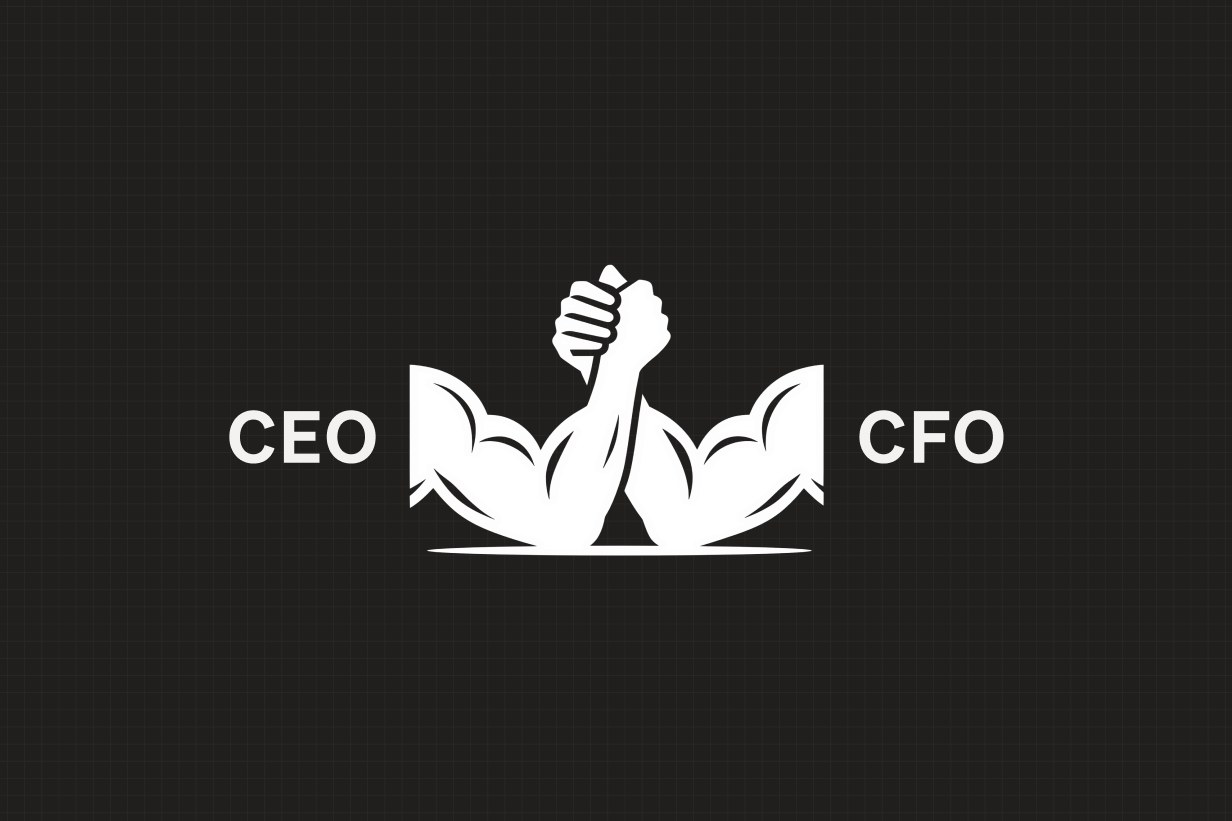
The CFO and CEO mindset differs across four key dimensions:
- Time horizon: CEOs think in decades. CFOs think in 1 to 5 years.
- Functional focus: CEOs gravitate to product, customers, and people. CFOs own the functions CEOs avoid.
- Attitude: CEOs are optimists by nature. CFOs check that optimism without extinguishing it.
- Decision velocity: CEOs move fast on instinct. CFOs slow down where the cost of being wrong is high.
{/callout}
I've watched CFOs walk into founder-led companies and try to mirror the CEO. Same energy, same instincts, same bias toward speed.
It rarely works.
Within a year, the company has two people doing the same job and no one watching the things that actually keep the business alive.
The CFO playbook gets a lot of attention: budgeting frameworks, tech stack, org structure, hiring sequence. But one of the most important questions tends to get glossed over: what's the right CFO mindset?
Not what to do. How to think.
For a business to thrive (especially scaling, founder-led ones) the CEO and CFO need to think differently. Overlapping mindsets are often mistaken for alignment when it actually means blind spots.
Four dimensions matter most:
- Time horizon
- Functional focus
- Attitude
- Decision velocity
1. Time horizon
The best founder-CEOs have a long-range vision for their business. Jeff Bezos didn’t build Amazon to be an online bookstore. Reed Hastings didn’t start Netflix to rent DVDs. Both had much broader ambitions: Amazon as the everything store, and Netflix as a global streaming platform.
To reach these lofty goals, founders pour all their energy into building. That focus is appropriate. But it also creates blind spots in the short term.
A strong CFO balances that moonshot thinking with a nearer-term focus, usually the next 1 to 5 years. That starts with staying on top of cash: ensuring the company has sufficient liquidity by managing AR and AP, understanding seasonality, and meeting monthly loan covenants.
Beyond survival, the CFO’s job in the medium term is to make sure the business can keep investing in growth. That requires a clear view of future cash flow and a planning process that holds up as reality changes. (For more on that, see our post on why budgets stumble out of the gates.)
2. Functional focus
Founder-CEOs naturally gravitate toward certain functions. Most care deeply about the product. Many also focus heavily on customers (service and success) and employees (hiring, culture, development).
But there’s an opportunity cost here. A founder’s areas of obsession come at the direct expense of other functions.
An effective CFO fills the gaps. The functions founders tend to underweight—legal, compliance, accounting, investor relations—are exactly where the CFO needs to lean in.
FP&A sits somewhere in the middle. Most founders care about it selectively—in the early stages, they care almost exclusively about revenue or ARR. Their mindset is: “I’ll worry about optimizing later. Right now I’m focused on growth.”
And that’s not entirely wrong. Amazon took eight years to reach profitability.
But the CFO’s job is to pressure-test that path. In other words, to make sure the CEO’s growth strategy puts the company on a path to profitability within a time frame the market will accept.
Whether the company can get there comes down to two things:
- Business dynamics: the size of the addressable market, the underlying unit economics, pricing power, and the realistic trajectory of costs at scale.
- Capital dynamics: the company’s ability to raise capital, how much, and how often.
A good CFO keeps both of these top of mind.
On the business side, the question is what profitability actually looks like at scale, and how the company will track progress toward it. That usually means setting specific targets for gross margin, contribution margin, and EBITDA margin, and watching them consistently. On the capital side, it means having an honest read on the fundraising environment and what it implies for runway.
A good CFO also audits ROI wherever possible. CEO’s often overlook ROI because it’s not something you can read off a financial statement. A meaningful share of spend never shows up cleanly in the P&L. Capitalized costs are the most obvious example.
The CFO’s job is to surface that reality and make sure the business is allocating capital with eyes wide open.
3. Attitude
Most successful founder-CEOs are, at their core, optimists.
They see possibility where others see risk. They focus on opportunities more than threats. A failed product launch is valuable feedback, not a dead end. That mindset is what gets a company off the ground and what keeps it going when things get hard.
A company’s investors often share this mindset and amplify it. Venture capitalists use a power-law framework: they expect most investments to fail, a few to return modestly, and a very small number to produce outsized outcomes. That math naturally favors large bets and high risk tolerance. The VC and the founder can reinforce each other’s optimism in ways that are sometimes counterproductive.
The CFO’s job is to check that optimism without extinguishing it. Sometimes that means saying the quiet part out loud:
- This plan assumes capital we may not be able to raise
- These unit economics don’t support the scale we’re targeting
- This timeline only works if everything breaks our way
You’re not trying to be a wet blanket, but rather call out overly-rosy visions of the future.
4. Decision velocity
Most founder-CEOs are comfortable going with their gut and making calls with incomplete information. Quick, decisive actions keep a startup moving in the right direction, and a bias towards speed is usually the right one to have.
CFOs should act as a counterweight to that speed-at-all-costs mindset. Their thinking should be more deliberate by design, but not so heavy that it slows the business down.
A good CFO develops judgment about which decisions need rigor and which just need to happen. Hiring your next sales rep doesn’t need a three-week financial review. Signing a multi-year office lease probably does. Entering a new market, changing pricing, committing to a large vendor contract…these are the moments where slowing down pays off.
Too much process, and the business stalls. Too little, and small mistakes compound into big ones. Founders tend to err on the side of speed, and a good CFO knows when to step in and add just enough friction to keep things on track.
CFOs should complement CEOs, not mirror them
The best CEO-CFO partnerships have a certain amount of productive friction built into the relationship. The CEO has a vision they want to bring to life. The CFO figures out how long it will take, and at what cost. This push-and-pull should leave the business in a better place than if either perspective dominated.
The wrong takeaway here is that the CFO’s job is to be the fun killer, the anchor on the CEO’s ambitious vision. The CFO is there to help bring that vision to life within the all-too-real world constraints.
It’s a really hard job, but an invaluable one.
If you’re building out the finance function for a fast-growing company, Aleph’s budgeting ebook is a useful starting point on the planning side.
And if you want to keep the conversation going, you can find me on LinkedIn or read more at karlongroup.com/blog.
Get FP&A best practices, research reports, and more delivered to your inbox.