Budgeting Without the Friction: A Better Process, and the AI That Runs It With You
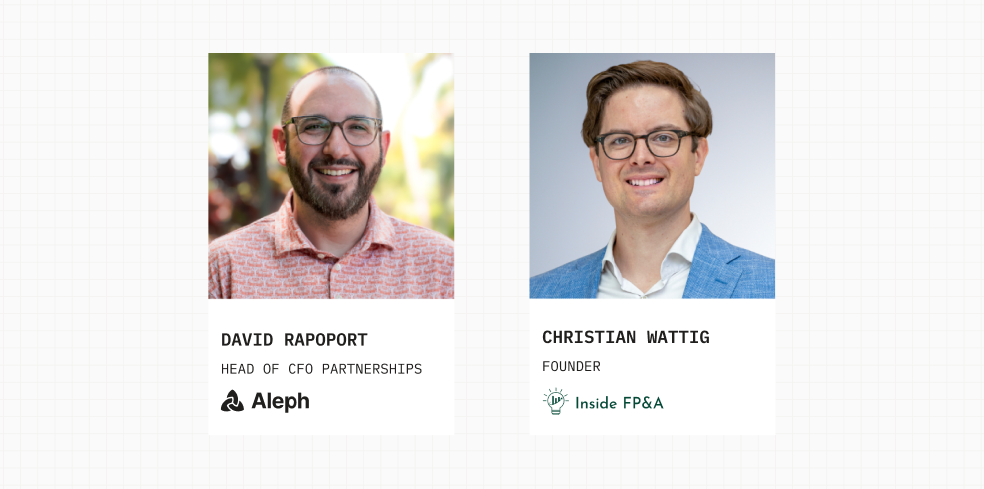
Christian Wattig (Inside FP&A) and David Rapoport (Aleph) on running the annual budget without the Q4 pileup, and what agentic AI can now take off your plate.


Inside the session
The annual budget is where the real strategic thinking happens, and it is also the thing finance teams dread most. It takes too long, it involves too many people, it is out of date before it is finished. The pain is not inevitable. It comes from three fixable things: bad process, bad tech, and a misunderstanding of what the budget is supposed to accomplish.
Christian Wattig (Founder, Inside FP&A) has led 12 annual budgeting processes at P&G, Unilever and Squarespace. He owns the bulk of the session, walking the five phases of a budget cycle (Pre Kick-Off, Joint Planning, Consolidation, Iteration, Final Alignment) and the specific mistake finance teams make at each one. The advice is tactical and works regardless of what software you run. David Rapoport (Head of CFO Partnerships, Aleph) closes with short demos of agentic AI inside the process, and takes questions live.
Built for FP&A leads, controllers and CFOs heading into their annual budget cycle, plus anyone who spent last Q4 chasing department heads for numbers.
Join in on the discussion to learn:
- Why the annual budget should stay a project instead of dissolving into a continuous process
- The five phases of a budget cycle and the mistake that derails each one
- How to plan the plan before kick-off so iterations do not multiply later
- What to do when the numbers come back and nobody recognizes their own inputs
- How to run consolidation without a two-week manual stitching exercise
- Where AI shifts from generating outputs to orchestrating a multi-week, multi-person workflow
- What it looks like when the system tracks assumptions, dependencies, deadlines and who still owes what
Plus, much more...
Watch the webinar
Register to see how finance teams are running the annual budget without the Q4 pileup, with Christian Wattig of Inside FP&A.
Chapters
- 00:00 · Introductions and agenda
- 05:33 · Why annual budgeting still matters
- 11:52 · Five phases and the pre-kickoff
- 18:29 · Finance's role: top-down vs bottom-up plans
- 26:20 · Driver-based budgeting
- 33:22 · Zero-based budgeting
- 39:28 · Staggered deadlines for the iteration phase
- 43:34 · Live demo: consolidation and AI scenarios in Aleph
Read the transcript
00:01 Hi, everyone. Welcome to today's webinar. We're excited to have you all here. I'm David from Aleph, and I'll be our moderator here today. We're going to give everyone just a couple of minutes to filter in. We're really excited to have you all. But while we're waiting for everyone to join and get settled, let's feel free. Let's use the chat. Let's figure out where everyone's calling in from. Drop it in the chat. I think we have a pretty large group of folks with us today. And our challenge is always, can we see if we have full global coverage? I think we're gonna do it in just the first couple of messages. Wow. We've got Philippines and Colombia, Toronto, Trinidad And Tobago. We got The U UAE. We are all over the place. I'm here in Austin, Texas. Christian, you're in New York. Right? I'm in New York City. Yeah. In Brooklyn. Awesome. Well, we're excited to have everyone here. We'll get started in just about a minute. We got Hawaii, Vietnam, UK, we are truly all over the globe. This is really exciting to have you all here today. We'll give everyone just one more minute to get started, get settled, And then we'll dive right into the content.
01:13 We've got some really exciting content that Christian's going to deliver for us today. So about thirty more seconds, I'll kick us off, and then we will go ahead and get started. But again, if you're just joining us, drop in the chat where you're dialing in from. We're gonna put these all on a map later and figure out where everyone's dialing in from. But excited to have you all here. Michael, I see you're in Austin. I'm also here. I know we sent a couple of LinkedIn messages back and forth. So excited to have so many folks here. We're about two minutes past. So why don't we go ahead and get started again, if you're just joining, no problems. Get settled. Get excited for all the content that Christian's about to deliver today. I'm David Rapoport. I lead the CFO partnership channel here at Aleph. We're really excited to have everyone here for the webinar focused on budgeting without friction. I'll do a quick intro of myself and Christian, then we'll dive right into the content. But the whole purpose of today is Christian's gonna talk a lot about the annual budgeting cycle, how AI is starting to change that process, and how an annual budgeting process can unlock real strategic thinking across a business without it taking a massive toll on finance teams that are doing the work.
02:30 We're excited to have you all here just for quick introductions, and then I'll turn it over to Christian. My name is David Rapoport. I lead the CFO partnership channel here at Aleph. I've spent my whole career in early stage startup finance, and I know that normally September is budgeting season. I've led strategic planning also at Stripe, and so I know that process very well from start to finish. But I'm really excited for all the content Christian has, developed for us today and all of its his years of experience in FP and A. He's gonna lead us in about thirty to forty minutes of content and some slides and talking through annual budgeting. And then I'm gonna come back on and I'm actually gonna show some real practical applications using Aleph to show you all the ideas that, we can ultimately use to help streamline some of the annual budgeting processes. So without further ado, I'm gonna turn it over to Christian. Really excited to have you all here. Christian, thanks so much for doing the session for us today. Why don't you give the folks a little bit of a background about yourself, and then we'll launch a poll just so we can see where everyone's kind of at on the budgeting spectrum. Thanks so much, David. Thank you for having me. And yeah, budgeting is one of my absolute favorite topics to talk about as I hope will come across.
03:43 So for those of you who don't know me yet, I'm sharing my screen that should be visible now, right David? Yes. Screen checking. Awesome. Yeah. Thank you. So my name is Christian Matyik and I spent over a decade in FP and A leadership roles first in consumer goods at Procter and Gamble. That's where I got started at Unilever. I led several finance teams there. And then I transitioned to tech and had the chance to lead an FP and A team at Squarespace. It's a website builder company when we took the company public. Now it was fantastic learning experience for me, because my job was to get the CFO ready to tell the financial story of the business publicly for the first time. And during that time, also learned that a lot of what I learned from my mentors and consumer goods transferred over, right? How to make a forecasting process actually useful for decision making. How to run an annual budgeting process that challenges thinking. How to build a financial model that's robust and optimized for fast situation. And most of all, how to be effective beyond spreadsheet, right?
04:58 Outside of the spreadsheet, because I do think especially as AI is taking over a lot of the manual work, the spreadsheet work, we'll talk about that more later. What you do outside of the spreadsheet becomes even more important and the expectations to what you're doing there are raising. We're touching a lot of that on that today. During the time working in tech, I also realized that I was really what I enjoy most is teaching. And so now I'm a corporate trainer. I've led training sessions for Google, for Merck, for Lowe's and a few others here. That's what I enjoy doing most. So let me dive into the budgeting topic. And with that, I want to first pick it up where probably a lot of you are. That's not everyone, annual budgeting is not everyone's favorite thing to do in the world, right? It takes too much time is what are you often hear? It doesn't help me run the business. It's out of date before it's even finished too many iterations, right?
06:04 If you have done any budgeting already chances are you've heard this from your business partners. Actually, what do you have on the screen here is based on a survey that PwC ran a few years back about what are people's impressions of budgeting. The thing is a lot of these come up for one of two reasons, either because people misunderstand what budgeting is really about, or the process isn't run effectively. And what I hope you will take away in this session is how to address each of them, either by clarifying what budgeting should and shouldn't be, or by running a better process also with better tools. We'll touch on that as well of course. But let me ask you this and I want this session to be interactive. So why do many companies have annual budgeting? Please type it in chat because you just heard that there are lot of, there are some cons right of annual budgeting, but still almost every company I'm working with does annual budgeting. So why do you think companies do that? I'll give you a moment to respond.
07:30 I'm already seeing some responses come in. Patrick says planning and control. I'm set to set targets. David says gotta have a plan. Eric says make a commitment to stakeholders. Kimberly says expectations. You have to anchor to something to set a goal for short term planning and control, align resources with priorities, aids in the planning process, general frame to plan ahead, plan the work the plan. Okay. Some of it is going in the same direction as I want to take it. Consider this quote, plans are nothing but planning is everything. It's one of my favorite quotes. It's from Eisenhower, former US president. And what it means is that the value you get from the budget is not the P and L, the balance sheet, the cash flow that falls out at the end, right? It's not that document because that can be outdated quickly, right? But the most value comes from the planning process itself If it's managed right. What I mean with that is that it's the process of forcing leaders across the business to take a step back from busy day to day, to take a step back from firefighting and slow down and consider what's working, what's not working.
08:51 What should we do the same the next year? And what should we do differently? And finance has to lead that conversation. Finally has to ask the right questions, the challenging questions to tease that out. That's where the value of budgeting comes from. And that's also why, by the way, sometimes you read on LinkedIn, Oh, we should abandon annual budgeting. We should instead do an always on planning process, rolling forecasts and just get rid of planning altogether. I don't agree with that, right? Because as soon as you stop doing the annual budgeting process and you try to replace it with a monthly forecast update or even a quarterly rolling forecast update, you lose that time and attention from the cross functional team. Because as soon as you try to get everyone to stop what they're doing, to really think, okay, how can we do things differently? How can we challenge the status quo? You won't get that buy in. You won't get that support every month or every quarter. It has to be a project that's managed like a project.
10:00 And once a year, maybe twice a year, that's how it works. You know, a lot of companies do a strategic plan sometime in spring and then do the annual budget in the end of the year and they are connected, right? That's how you can do it twice, but it doesn't really replace the forecast. In fact, it has to go in parallel because the purpose of the budget and somebody said that also in the chat, really it's a commitment, right? It's about what the company is communicates to stakeholders they're able to do. They think they'll be able to do by the end of the year in terms of revenue and profit and how they plan to get there. That's why it doesn't change. And that's why it's okay that the budget doesn't change. Now, before I go deeper into this, I actually want to ask you another question. And I think we have a poll prepared for that. And that's around, okay, how long does the annual budgeting process take for you? Can we fire off that poll, Lucas? Okay, there we go. You should be able to see the poll question now. So I'm really curious to see how long do you expect this budgeting cycle to take?
11:12 I assume a lot of you are in the beginning. Is it one month, two months, three months, four months? Interesting. Seeing a clear picture emerge here. Very few people say it takes one month, only 3%. A lot of people say two months, three months, some even four months. Unfortunately, almost nobody said five plus, but actually it's not zero, right? So there are people here on this call where the budgeting cycle can take longer than five months. Yeah, so what I just said, right? Budgeting is important. Yes, but at the same time, it shouldn't take forever because it comes on top of an already busy plate for you, for the finance team, but then of course also for the business leaders. And so it has to be managed well. So let's double click about, okay, how do you run the budgeting process effectively? Every budgeting process has five phases. You might not call them that way, but I've led 12 annual budgeting processes across, know, Procter and Gamble, Unilever, Squarespace.
12:24 And they always have these five phases. So you start off with the pre kickoff conversation. So that's where you slow down and you talk about, okay, how are we going to approach this? Let's plan the plan. I'll go deeper into this in a minute. Then you have to join planning session. It's mostly about asking the right questions at the right time as you will see. Then you have a consolidation phase. What's the bottom line? This is all about speed, right? If it takes you a week to consolidate what comes back from departments and figure out what the profit is. Then by that time the business has moved on, there have updated assumptions and then you're just chasing your tail. So that has to be fast. Then there's an iteration phase because yeah, in my running annual budgeting processes for twelve years, it has never happened even once that the first draft, the first version of what comes back from departments aligns with leadership expectations. So there is an iteration phase that is going to be a going back and forth. And then there's of course the final alignment phase where we have to come together, pencils down.
13:35 We agree on how, what we want to move forward with. So let's start with the pre kickoff. The first thing here I always recommend is don't rush into sending out a timeline and who does what and all that. Look backwards and look at the previous year's budgeting process in terms of process, what worked, what didn't work, actual results. So how helpful was it to help you learn from comparing actual results to budget, right? That's one of the biggest value adds of the budgeting process. If it's done well, that it's a good yardstick to measure performance. And then what did you learn from that? And then you create the planning roadmap. You look at the timeline, deliverables, ownership structure. When it comes to ownership structure, I'm a fan of RACI. I'll type it in the chat here. It's an acronym. It stands for responsible, accountable, consulted and informed. And basically the idea is that you want to avoid having too many cooks in the kitchen when it comes to budgeting, right?
14:43 You want to avoid that you have a lot of people who think they have a say in what should be included and what shouldn't be included in the budget that don't really have a say, right? And so that's really important to clarify and communicate upfront. And then you implement process improvements and specifically you want to focus on speed Because like I said, really budgeting shouldn't take three months. And we'll look at how you can get there. Accuracy of course, and then trackability. Trackability means that the assumptions you put in the budget should be measurable in the sense that you should be able to figure out whether these things actually come true. So to give you an example, when I was at Squarespace is known to do Super Bowl commercials every year. I think they've done it for the last six or seven years. And yeah, there was always a big discussion inside of the company, especially in the finance team, isn't really worth it. Because super bowl commercials are really expensive. You only have thirty seconds. Usually brands don't even like, it's really just about brand recognition, high level, roughly what the brand is all about.
16:00 You can't really communicate much. And so that's something that is not easy to measure, right? How well does it actually do? We ended up figuring it out through a lot of data science work, but it's important that when you put the budget together, you already start thinking about how am I going to measure whether what I'm putting in actually works or doesn't work because otherwise you won't really be able to learn. Okay. And then there are two traps I want you to avoid, and that are important to plan for at the beginning of the budgeting process. The first trap is the ivory tower trap. That's where finance sends a template, departments fill it out, finance consolidates, makes pretty slides, leadership approves, and a few weeks later, everyone forgets about it, right? A lot of companies manage budgeting like that, but if that's your role, right? The person and the company who just puts together templates, consolidates whatever comes back, make slides, goes home, right? That's not adding a lot of value.
17:12 That's admin work, right? And that's also by the way, what can be easily replaced by software. And we'll talk about that later. The other trap is kind of the other extreme is where you are a scorekeeper. So that's where you just look at what people send back and then you evaluate, okay. So that's the opposite of this essentially. That's where finance, sorry, that's where finance does it alone, right? That's where you look at your actuals, you open up your spreadsheet and you think, I can, I don't even need all these inputs from the other departments? I can just do it on my own. The problem then is that you it's too thin. Right? You're losing the buy in from the different departments because it's not their numbers. Right? And if they can't recognize the numbers, they won't help you reconcile the numbers later. They won't help you in variance analysis. And in that case, you won't be able to really learn anything from the variance analysis.
18:29 You don't want it to be an ivory tower exercise. You don't wanna be a scorekeeper. So then the question is, what is finance's job? And I would like you to think about this for a moment. If it's not send out the templates, consolidate what's back, comes back. It's also not do it all on your own by looking at actuals and taking it from there. What is your role or what should be your role? Any ideas? And this is especially important in the age of AI. To help surface the value of the business, drive actionable insights. Thank you, Peter. Eric says, understand inputs, challenge assumptions. Andres says, seat with cross functional team. Okay. David says help connect the overall strategic plan to departmental execution. Yeah, you're all going in the right direction. So the way I'm summarizing it is your job is to lead joint planning, which means your job is to, the business's job is to build the bottom up plans. FP and A builds the top down plan of finance. And then together you compare, you discuss variances and you pressure test the assumptions.
19:50 And your role is to act as a challenger. Your role is to not just take what comes back from department at face value, but to ask the questions that help your business partners think outside the box that help your business partners get to what's working and especially what's not working because they will volunteer what's working well. You know, you don't have to ask a lot of questions about that, but sometimes it takes relationships and influence and careful questioning to get to what's actually not working or what might stop working soon. And that's what you do here. Now in order to get there, right? In order to get there, you need to be able to build a good top down plan. And that's what we'll talk about now because we'll talk about that now. But the first we go there, I want to make sure that we're really clear about what's the top down versus the bottom up. Because I've mentioned these terms a few times. Some of you will know them, but I want to make sure we're all on the same page here before we go deeper. So the top down starts with an end result in mind. It's usually put together by leadership, by finance, and it's about expectation setting.
21:09 And it shouldn't ideally, it shouldn't just be in a vacuum ideally ties back to a strategic plan. As I mentioned, a lot of companies do a strategic five year plan early in the year, and it's on business driver level. So that's crucial. So not just by P and L item, but by decision, right? By, are we going to launch a new product? Are we going to hire more salespeople? Are we going to change our pricing? Because if it's just on the P and L level, it's disconnected from what's actually going on in the business. And then it's more wishful thinking than an actual real top down plan. So you need to understand what are the different drivers? What are the different tactics strategies that we're going to change in the next year? And you want to consider internal and external factors. External factors get sometimes don't get enough time and really care when it comes to top down planning. But what I mean with external factors is what do we think our competitor will do?
22:18 What do we think our competitor will do in response to us launching this new feature or new product or whatever it is? What will inflation do, job market, etcetera? So that's top down planning. Then bottom up means starts from scratch and the output is the sum of several sub plans. That's where you ask the departments and you ask, okay, how much money do you think you need? And what do you think you can achieve with that investment? It's about execution against the given strategy. And it's ideally on project level, but that depends on the company size. And the idea is to evaluate uncertainty and enable contingency planning. That's where you come in again in finance, right? The bottom up plan, you have a huge role to play because you're helping figuring out where's uncertainty, where are risks and opportunities. So that's top down and bottom up planning. Then the question is, why should you prepare both? Why should you have a top down and a bottom up plan? That's the next question I'm posing to you.
23:38 What do you think? Okay. To see if they tie, get buying from business unit leads, executive board alignment with ops, understand why there are variances and resolve them, use of checks and balances to surface any misalignment. Yeah. So the thing is when finance leadership puts together a top down, the business puts together a bottom up, they don't match. They never match, right? In twelve years doing this, I've never seen them match. But that's okay, right? Because there are some inherent human psychology forces at play here, right? So if I'm asking a head of marketing like, Hey, how much money do you need? And how many leads do you think you can get with that money next year?
24:47 They will go in high on the money and low on the leads. Why? Because they want to manage expectations and they want to exceed expectations. Right? They want to communicate, they can do so much, but then they want to be able to do more. And that's why bottom ups tend to be leaning very conservative. Right? High on the money ask, low on what can be done with that. Top downs are often leaning the other way towards aggressive. Why? Because they're put together by finance, by leadership who are maybe a bit removed from the day to day business and often lean more ambitious. But it's okay that that gap exists because if you do a detailed top down and then there's a bottom up that's different, that's a fantastic conversation starter. It's much better to go to a head of marketing and say, hey, I put together a top down plan for leads. Here are my assumptions. It comes at the rise of the different number than your bottom up. Can we have a conversation about where my assumptions were off?
25:55 Right? That's a very different conversation than if you didn't do a top down, you go to the head of marketing and you say, your number looks a little high on the money side and low on the leads. Completely different reaction, different level of conversation. So it's a fantastic way to get to figure out where's the stretch, where are the risks and opportunities. Okay. Now I want to double click on those top down approaches. And I want to discuss two different ways of approaching this because it's super important that you do this at the right level of detail. The first approach is called driver based budgeting. And, I could explain what it looks, but I'll actually share an example with you because I think that would make it easiest. So here I have a driver based plan. This is very similar to what we looked at when I worked in SaaS. And let's say, we have twenty five subscriptions, 3,400,000. And our goal is to estimate subscriptions in 2026. And then here in the middle, I have drivers. So I have things that impact how many subscriptions we sell.
27:11 So we are doing an initiative to improve our brand recognition, right? Like a super bowl ad for example. There's also an advertising budget increase. There's inflation, which goes the other way, a new promo strategy where we thought that, hey, if we're doing all these promotions, we're just advancing purchasing net, it doesn't really help us grow that much. So we're cutting them back, which in the short term will reduce the additional subscription. Then there's also do nothing different scenario where if we're not improving the product, which this doesn't currently have, our conversions will drop eventually. And then you have a conversation about the different, how these things translate to subscriptions. And then of course you can translate that easily to dollars later on. What this enables you to do then is also to easily create a scenario plan where you say, okay, let's actually look for a range for each of these. Let's look at from two, right? What would be conservative? What would be aggressive? And then if this number, the balance scenario that you had before, if that doesn't meet expectations, right?
28:27 Then you can have a conversation with leadership, with the board about, okay, where are we confident with going to the aggressive scenario? Maybe you have some reason to believe that based on your data science insights that Super Bowl ad will actually do really well this year. And then you can lean to the aggressive side, but maybe not so with your regular advertising budget increase, because you've scaled that a lot in previous years. So that's how you can have a very nuanced conversation about the risk that your company is willing to take. That's one of the reasons I'm a big fan of driver based planning, but there are others as well. Let's talk about the advantages and disadvantages here. So advantages of doing the top down plan that way is that you focus your analysis and discussion on what actually matters. Because P and L lines don't matter. What matters is what people do about moving revenue up and profitability up, right?
29:33 You want to be able to tie it back to something that somebody in the company actually that they actually do. And if you do a driver based planning well, then you don't have a list of 50 items here because that's hard to track, hard to manage, lose focus if you do that. You need to figure out what are the five, seven, maybe 10 drivers that really move the needle. And that exercise alone and figure out what are our big bets? What are our biggest drivers? That alone is helpful with decision making with leadership, with steering the company. It enables scenario planning and talked about that already. And it remains useful throughout the year. What I mean with that is you do this once, right? You spend some time do this during the annual budgeting process. And then every month, every quarter, when you refresh your forecast, you pull this up and you say, Oh, actually we just got new data from our social media campaigns. And actually this advertising budget increase, unfortunately it's converting more towards the conservative end of the range. And then you can update that and you don't necessarily need to refresh every driver every month, just where you have news.
30:46 And that way, you can keep it updated and it actually doesn't take a lot of time doing that. And it helps you quantify and fine tune the level of risk you're willing to take by having those conversations about when do we go with the aggressive versus the conservative scenario. But there are also downsides of doing it like this. It requires business understanding first and foremost, right? If you're new to the company or if your finance team mostly had bit more of a back office role can be difficult to do that, or it can be time consuming. But I argue that getting closer to the business and getting closer to figuring out what's actually driving it, is worth the time spent. Time intensive, we talked about that. And then there's risk of error stacking. Because the thing is, this is often not a science. Sometimes there's art involved in figuring out how much this Super Bowl ad actually contributes to our bottom line. And if each of these lines has some guesswork involved, the more driver you have, drivers you have, the more your margin for error increases.
32:01 That's another reason why I'm always recommending to try to keep the number of drivers manageable. But overall, I think as you can see, it's a highly effective approach for revenue planning, especially because it brings the finance team closer the business. Few things that are important to make this successful. You want to make sure that your business drivers are not just P and L lines. It really needs to be connected to tactics and strategies, things that can be measured. You want to apply an eightytwenty approach where you figure out what are the 20% of all the things the business is doing, or is planning to do it different, are planning to do differently. What are the 20% of those that actually move the needle? And as I mentioned, just that analysis alone can add a lot of value. And it's about collaboration. So there are few finance leaders who are so close to the business that they can do this completely alone, right? You should be able to put a first draft together, but then you probably need to have some conversations with business leaders to find you your driver based plan, to make sure you're considering what's actually going on the ground.
33:22 All right. The other top down planning method that I wanted to walk you through is zero based budgeting. So because this is often misunderstood. Because there are, when people think about zero based budgeting and they ask people, hey, how would you explain zero based budgeting? Usually what I hear is you have to start from scratch. You have to assume you're starting your company anew and you have to evaluate each and every expense line item and challenge each and every expense, basically put them into a blank spreadsheet. That's maybe the original way of thinking about zero based budgeting, but it only really works for very simple companies that are very early, that don't have a lot of moving pieces. But it is possible to do a zero based budgeting even for very complex businesses. So I led the first zero based budgeting implementation for Unilever North America for the marketing budget, which was $1,200,000,000 in marketing expense across, I think it was 30 or 40 brands. So how do you do that? Well, let me show you again.
34:34 So imagine this is a pull from your ERP. So you don't start from scratch. You start with a pull of your data. Maybe you want to do it by a vendor, maybe even on the transactional level, depends on your complexity. And then you go through it and you look at, okay, first, the first thing you do is you assign document IDs. That's where you group expenses that belong together because they support the same decision. So bringing it back to our super bowl ad, if you want to create that ad, have to pay a writer. You have to pay a director. You have to pay an agency. You have to pay for the airing rights. And you have to probably pay an agency who manages all the moving pieces for you. So if you decide not to do a super bowl ad, then all of these would fall away, which is why they're together on one document. And then you look at them and you review them to say, okay, this is something I want to keep. This is something that needs further review still. This is something I want to renegotiate or remove. Okay, so this is how zero based budgeting works.
35:44 Let's take a look at the advantages. It avoids status quo bias. That's the number one, right? Because often the issues in companies is that people are just used to doing things a certain way, used to working with certain vendors, and they just keep doing that, right? Why? Because, well, my predecessor established that and I'm too busy to think about that. I have too many other things to focus on, right? And so you want to get people to consider why those decisions were made in the first place. It's especially effective to identify cost savings. So if the marching orders this year for you are, hey, we need to become more efficient. We need to become more lean. We need to trim fat. We need to figure out what are the expenses that aren't really helping us reach our financial goals. That's where zero based budgeting can be really helpful because you take a magnifying glass and look at everything. And it helps you discover the 20% of the expenses that drive 80% of the outcomes.
36:52 So it doesn't just help you cut costs. It also helps to figure out where do you, where can you put fuel in the fire, right? What are the things that are really working? Because what you're doing essentially here is you do a mini ROI analysis for every line item, because you determine whether to keep or remove based on how that line item affects your top line, right? How much that helps you drive revenue, but there are also disadvantages. The most obvious one is of course, this takes time, right? And we'll talk about in a moment how you can avoid this taking too much time. But it can also reward short term focus because things that have a payback period, in the next quarter, are much easier to justify than things that payback maybe in a year or two, right? But you don't want to cut all your long term expenses. You need to find the bright balance. So when should you use it? If complexity and time commitment is manageable, and if you can actually justify things.
38:02 Let me point to a few thing, a few pointers, especially also the question around participation, right? Cause the thing is this only works if department heads are willing to suggest things that can be cut in the budget. And nobody likes to do that, right? So how do you approach that? Well, first of all, I wouldn't recommend you do this for your entire company. Focus on one department where you know, there's some fat to trim. You need to get cross functional involvement and the way you get that is ring fence instead of cuts. So when I was at Unilever, we rolled this out and we realized quickly that the other marketing managers, they came up with a lot of reasons why they didn't have time to support finance in doing this, right? And ShopVeg was just not very supportive because they didn't want to cut their own budgets. And so what we said was, Hey, everything you identify in terms of things that can be removed as part of this exercise, we won't drop, just drop that to the bottom line. We put that into a separate budget, ring fence that, and then you can pitch your initiatives to earn it back, right?
39:14 A bit like a mini shark tank. And so some brand teams actually ended up having more money after this exercise than before, because they had good initiatives, good ideas where that can be used. So that's how we got around that issue that again, a psychology issue that people didn't want to cut their own budgets. Now, but this is not usually the most stressful part of the budget. The most stressful part of the budget is the iteration phase, right? So that's where get your top put together your top down, you get your bottom up, you compare the two, and you realize that they don't match. And as I mentioned in the beginning, it's not necessarily bad, but it means you have to go back to the drawing board. You have to tell people that there's some rework that has to be done. And so I want to share, an idea that helps you, that helped me make that less painful. But really what it comes down to is the interest of time, I'm going a little bit quicker through this, but really comes down to is you don't want to lose precious time during this phase, right? It has to move smoothly because if you've going back and forth, back and forth, then it just gets dragged out.
40:37 And what was planned for two months, all of a sudden becomes three, four, maybe even five months, right? Of a budgeting process. That's usually where the time gets lost in that back and forth ping pong of your estimate isn't good enough, submit a new one, still not good enough, submit a new one. So what do you do? You really need to look at this problem from a process and technology point of view. So first from a process point of view, I highly recommend you implement a staggered timeline. What do I mean with that? So the issue is that a lot of teams face is, let's say you have the board meeting in November. Let's say first week of November, you ask for the numbers by mid October, numbers come back in mid October and they're far off from where they need to be, right? And then you're running, you're juggling and you lose time, or maybe even have to reschedule the meeting. So what I recommend and what we've done at Unilever at every budget cycle is you have first pass deadline and the second pass deadline.
41:41 What that means is, okay, the board meeting is in November or in this case, in January, what I have on the screen here. And you do the first pass deadline much earlier to one or two, maybe even three months before that final deadline. And then you ask for the department heads to submit their numbers, to submit their bottom ups by that deadline. You consolidate, you review the numbers and you see, okay, where are we at? Now this only works if you consider the red lines here, leadership review. If you try to do this without getting very senior leaders to look at the first pass submission and to look at the second pass submissions, the department heads will ignore it, or they will just phone it in. But if their boss looks at it's a whole different story. So that's my recommendation. When we implemented this at Unilever, we were able to figure out already two months before the final deadline, where the issues are, where the fires are. And the second past deadline was still somewhat off, but better. And then for the final deadline, when we actually have to lock the budget, the top down and the bottom up finally were close enough to each other that we could call it, right?
42:56 That's the process side of things. But the problem is, especially when you run a process like that, you have to make sure that the technology doesn't hold you back. If you have 10 Excel spreadsheets flying around that you have to keep track of and run version control and spend a lot of time putting them together in the first place. This is not going to work because then finance is just chasing their tail, just staying in administrator mode without really be able to do what adds value, but just challenging the assumptions and really probing for, okay, how can we do things differently? And so that's why, I'm really curious to see David, how Aleph approaches this and how Aleph can kind of approach that technology side of things to make all of this less painful for everyone involved. Yeah. Thanks for sharing all that context in the process, Christian. I think so many of us on the call have probably gone through those cycles or were about to go through that cycle today. And for me, something you said earlier in the call around the role of finance and FP and A teams in a planning cycle is I think we all spend so much time being so focused on generating the reports, consolidating the information, and we don't get to play the strategic adviser to our business partners.
44:19 We don't get to take a moment to step back and actually digest the information that ultimately is coming out of those department level business reviews because we're just so focused on turning the models around and doing the slides for those leadership reviews. And for me, especially when you're working in a collaborative budgeting environment, that workload gets, exponentially harder if you're working across business units or team leads or you've got geographic matrices included. And so I'm gonna show some very practical applications of how Aleph is helping solve a collaborative budgeting process with an FP and A team. And so I'm gonna start with just one quick slide to kinda give everyone a little bit of an overview of where we're starting in this process. And this should probably be very similar to what people are running today. When you're running a budgeting cycle, you're spending a lot of time actually getting information out of your ERP. In this case, maybe it's NetSuite. It could be QuickBooks, whatever it is. You're pulling reports down, you're pivoting, you're generating individual department models. And for us, that's where the workload really starts to become exponentially harder time and time again.
45:30 You've now got, seven or nine different departments you're collaborating against. Getting the inputs back from the team every single month is hard. And so what we are gonna show right now is not only how can these reports actually be generated at the beginning of the budgeting process, but then how do you actually receive those inputs back from the individual teams without taking days or even a couple of days across your team members to actually put them all together across a scenario so that you can actually present those at the leadership review. So I'm gonna show what we've got connected here. I'm sharing just a demo environment where I'm gonna try and generate that first department level budget for the engineering team, for my team, for, my this budgeting cycle. What I've got here, I'm gonna pull directly from my ERP system. And for me, like you see, I've just clicked pull. It's going to take about thirty seconds to be able to pull a department level spend by vendor by month. To me, like this process in the manual format probably takes the better part of fifteen to twenty minutes to be able to generate them, log into the system, and now you can actually see with just a couple of clicks, I was able to get all the way down to the ledger information, what the account was, who the vendor was, and what my actuals were by month across that vendor so that my team can be focused on exactly how they're going to be able to input their budget for the upcoming year using historicals as an act as a an action item.
47:01 So, Christian, that probably resonates really closely to that zero based budgeting example you were showing a little bit earlier in your slides. Right? Yeah. Not just for zero based budgeting because the thing is you want to make it as easy as possible for your cross functional partners to look at the business, to make the projections, to see what's working, what's not working. So you want to make sure you give them the historical data at the right level of detail that they need. And if you have 10 business partners you're working with, it can take a lot of time. So it's cool to see that you can essentially do this as a press of a button with Aleph living in your spreadsheet, pulling from ERP and just creating it for you. Yeah, exactly. And, this is the time savings of like doing this once. And we understand, if you're working across nine, fifteen, 20 business units, 20 departments, whatever it is there's an upfront time investment there. But then we all know that the workload ultimately becomes when you see a folder that starts to look like this. I've got department budgets across all of my individual teams at the budget submission deadline. We know somebody's gonna be late. They're gonna, wait till the last minute to submit, and then somebody spends the better part of a weekend on the FP and A team starting to cobble all these together.
48:15 There's always questions. And so for us, how we're solving that at Aleph is we're actually in because we're embedding Aleph into the actual models and the templates that teams are using, whether that's in Excel or I'm showing Google Sheets here. What we actually do is we build things that we call automations where on a given timeline, on a given schedule, or when a budget is actually completed, we can suck all those information up from those individual sheets and actually start to do the consolidation for FP and A team members without them spending days and hours actually putting that all together. The part for me that was truly life changing when I saw this in a workflow is within Aleph, I can actually go back to my source information, open up exactly what was coming from my budget from that individual team. And I know, because in this case, we're using Google Sheets, I can see the full revision history, not only in the sheet, but also within the Aleph platform where I can see the last time an update was made or who changed a sell value. And I can't tell you how many times in my career I've spent time trying to chase that answer down of, well, where did this change and who did this change?
49:26 And so, Krishna, I'll pause there of tell me a little bit of how this would have changed your life at Unilever or Squarespace when you were running budgeting cycles. Yeah. You know, when I was promoted at Unilever to lead a marketing finance team, we were responsible for managing the forecast. And it turned out that we were managing that with 10 spreadsheets, that each sheet had 10 different sheets. And then they would go to the brand teams and they would submit the forecast back to us. And then usually a few days before the deadline, they're like, Oh, sorry, I just realized I forgot to put something in there. Can I send you another version, please? Like, okay, send another version. And then we had to do everything manually in Excel. And it was very challenging, took a lot of time. I was always terrified about what if something is wrong? What if we use the wrong formula? What if we forgot about this version or this consolidation? And so I also, we ended up moving to a tool and it just made, it just me sleep so much better.
50:36 It didn't just save time, make me sleep better knowing that there is no way there is a formula issue. There's something we can trace. And that's what the tool like Aleph unlocks. Yeah. I talk a lot to CFO partners all day. When I talk about the role of being FP and A professionals from being producers of data, to actually starting to be consumers of data and working with our business partners to actually start to be that strategic adviser for everyone during the planning cycle. We know at the end of the day everyone's still doing their day job. You still got monthly close and updated financials you need to do every single month, and the planning process feels like a yes and in these examples. But man, wouldn't it have been nice to be able to say, yes, I can do all these things and have confidence in the numbers that are coming in and not have this formula anxiety that I know all of us have had time and time again in our career? And this to me is kind of the early baseline of where FP and A teams can find efficiencies in their workflow and start to transition. And I'd be remiss if I didn't take a minute just to talk about AI. Now every CFO that we talk to is asking, well, how is AI coming into my forecasting cycle?
51:50 How is it impacting my workflow? And of course, we're gonna show it here just as a quick example. I ran through an example, Christian, as you kind of mentioned a little bit earlier, is everyone submits their first version of a forecast. There's always changes that come. It's the iteration. What does OpEx look like if we make a change? And so now what I'm showing is a little bit of a prompt that we used in Aleph with some dummy data a little bit earlier today of a classic version. Help me pull my OpEx by department, help me build my 2027 forecast scenario. And you can see, because we're using our MCP connector, the tool is connected live to our data. I'm able to get that breakout of those spreadsheet numbers that were living in Google Sheets that have been brought into Aleph and then ultimately being consolidated. But the real part to me is I can actually use COD, ChatGPT, whatever your LLM of choice is, to start to model out forecasting scenarios in this top down version where the CFO, maybe the board says, hey. We need to think about a plan where there's a 5% OpEx cut. What does that look like when we start to look through department level trims?
53:01 What does that mean across the board? And then ultimately, how do I regenerate those same spreadsheets we started this journey with a new target and a new go get number that the teams need to work backwards from? For me this is the versioning that would have taken days of an FP and A planning cycle when you normally have a very tight timeline to ultimately produce the number. And for me this is where teams are really starting to find scale and efficiency in their FP and A workflows where with just a couple of prompts to my LLM of choice, we could actually ultimately produce a brand new forecast scenario, push it back out to the teams, let them have a chance to digest that they've just got their budgets cut by 5%, and then start to be that adviser of how we're ultimately gonna execute on the plan. So that was just a very quick glimpse of how I think FP and A planning is changing. But, Christian, I'll pause there. Like, tell me how are you seeing other FP and A tools or FP and A teams use AI? Yeah, no, I mean, in addition to what you shared where I think this MCP connection is incredibly useful. So for those of you who are not familiar, MCP means you take whatever AI tool you're using, Copilot, Claw, JGPT, and then you connect that with another piece of software like Aleph, right? And then you can be very descriptive, very clear about what the AI is able to see, what it's not going to see, you can make it read only if you want.
54:29 So it is, you can fine tune the security level there. And then you can do a lot of things. But also what I'm really excited about is that it eliminates the learning curve for a lot of things. And that it allows other people who are not in finance, right? To use tools like Aleph maybe that they didn't get training on or someone who was new to the team, right? Because when you can ask the chatbot a normal language, Hey, what was my revenue in the last quarter? And how did that compare to the quarter before again? And what is that by customer? All of that. Then you don't need to be a power user in the tool. Anybody can do that. And then, this adds a lot of value beyond the finance team even. Yeah. No. That's really great. And thanks for explaining that. I know we're running up on time. We promised everyone an hour. If you have a quick question, feel free to drop it in the chat. I'll try and cherry pick one or two with our last couple of minutes. But while the questions are coming in, first, Christian, I just want to say thank you so much for leading our session today.
55:37 Thank you everyone who joined us. I know we're doing this in the middle of September. You are knee deep in planning season and appreciate you carving out an hour to be with us. As Lucas just dropped in the chat, we're doing a lot of really exciting things on the AI and FP and A side here at Aleph. If you're curious about learning more, we dropped a link where we just announced our agentic budgeting workflow, which I covered a little bit here today. We've got a link here at the top of the video as well to ultimately learn more about Aleph. I see that a question in the chat about sharing the slides. We're gonna share the call recording with everyone after this that includes all the slides and the screenshots that Christian shared. Feel free to add both Christian and myself on LinkedIn. Drop us a note. We love to talk about planning and FP and A workflows in general, especially in this new AI work flow, there's a lot of uncertainty and a lot of questions about how teams are evolving. And I know Christian and I both talk to teams day in and day out about what they're doing on the technology side to work better and smarter. But Christian, any last closing remarks just before we wrap and say thank you to the group?
56:47 No, I mean, hang in there, right? For a lot of you, it's the beginning of the planning season. Hang in there and just again, try to have those deep conversations with your business partners, try to learn how they're approaching things, what keeps them up at night, because that in the end is what will make you a better finance leader. Very, very well said. Well, again, thank you everyone for the time today. We'll send the call recording out. If you have a colleague that didn't get a chance to join us live, send the recording to them. Add Christian and I on LinkedIn, otherwise, we will see you all on our next webinar. Christian, thank you again. Lucas, thank you for all the support behind the scenes. We really appreciate it. And we will see you all soon.