Finance Team of One: What's Actually Possible with AI in 2026
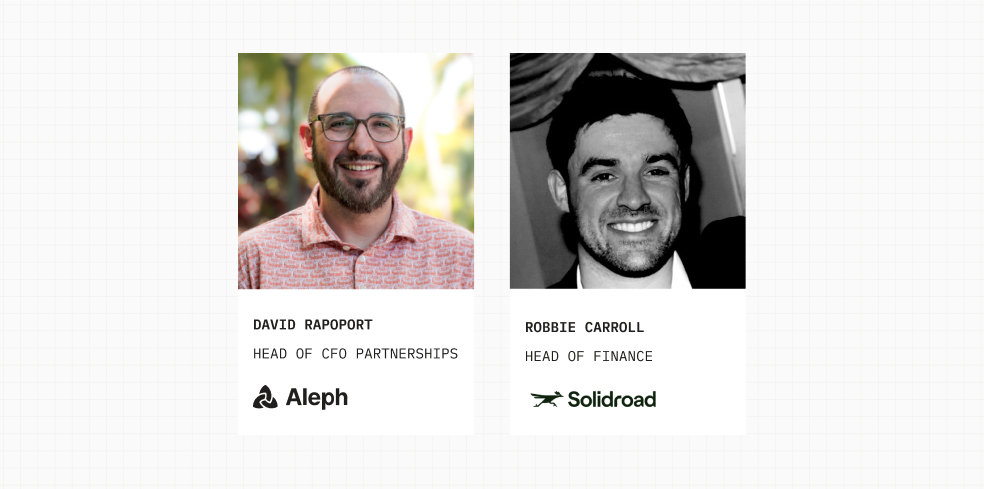
A fireside chat with Robbie Carroll, who runs Solidroad's entire finance function on his own, on the stack and the workflows that make it possible.

Inside the session
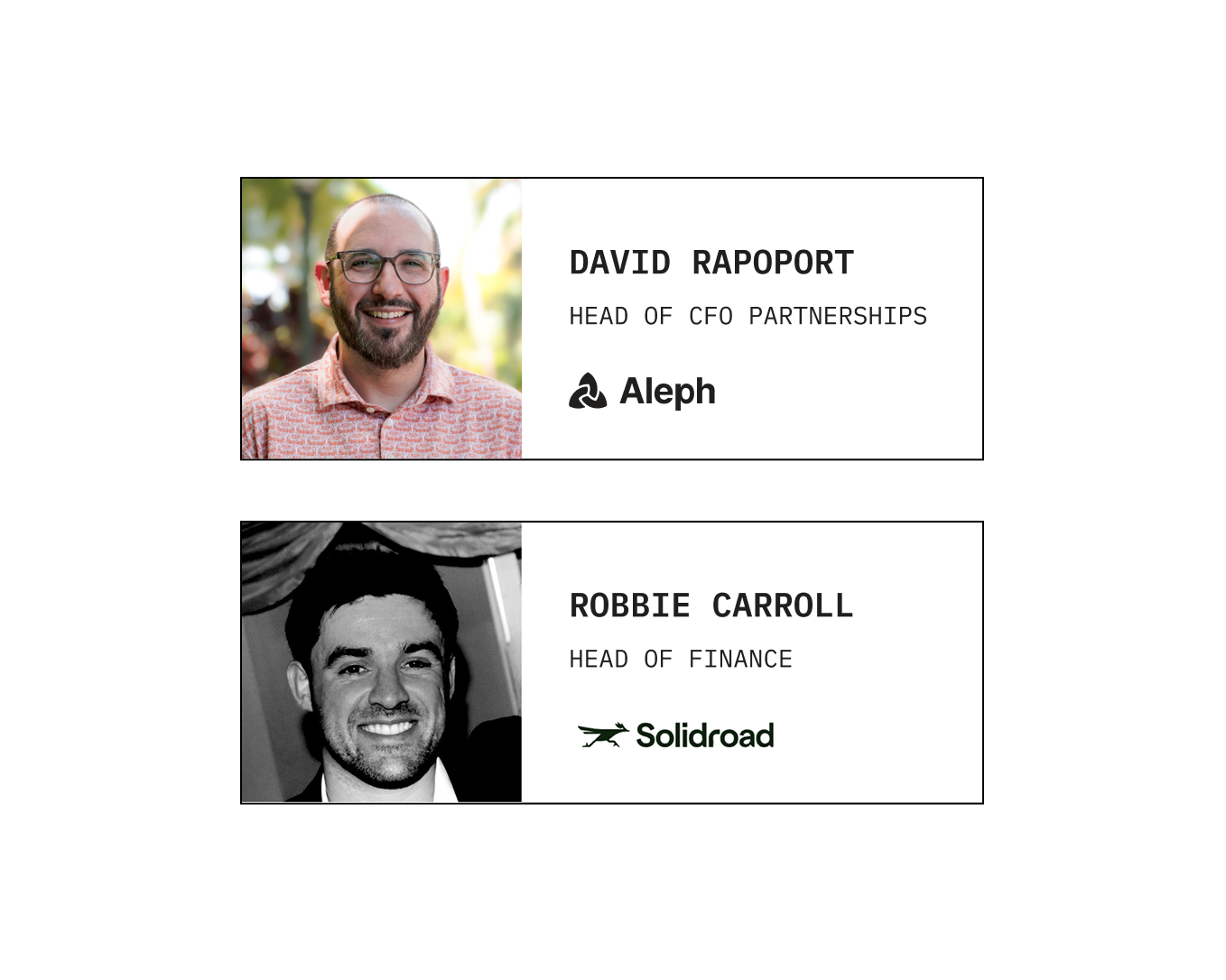
Two or three years ago, one person could not run the full finance function of a scaling startup. Now they can. Robbie Carroll is Solidroad's entire finance team: accounting, finance, and rev ops at a Series A AI company, one year into the role.
Robbie Carroll (Head of Finance, Solidroad) walks through exactly how he does it: the stack (Claude, Aleph, Xero, Mercury, Ramp, Wise, JPMorgan, Rippling), how he consolidated multiple bank accounts into a single source of truth he queries through Claude, what he tried that didn't work, and where AI genuinely replaces headcount versus where it still can't. David Rapoport (Head of CFO Partnerships, Aleph) runs the interview and takes audience questions in the last stretch. No product pitch, no demos, just the honest playbook of a finance team of one.
Designed for finance leaders at early-stage, VC-backed startups (Seed through Series B) who are the entire finance function, plus founders and CFOs deciding when their first finance hire actually needs a second.
Join in on the discussion to learn:
- The exact toolstack one person uses to run finance and rev ops at a Series A company
- How to consolidate multiple bank accounts into a single source of truth you can actually query
- How month-end, spend, and payroll run when there is nobody to hand them off to
- Where AI genuinely replaces headcount today, and where it still can't
- How to use Claude on top of your financial data for dashboards and reporting without a data team
- What to look for in tooling when implementation speed matters more than feature depth
- The signals that tell you a finance team of one needs to become a team of two
Plus, much more...
Watch the webinar
Register to see how one person runs the entire finance function at a Series A startup, with Robbie Carroll of Solidroad.
Chapters
- 00:00 · Welcome and guest introductions
- 05:31 · Startup journey from Y Combinator to Series A
- 10:20 · How AI changed payroll and burn reporting
- 15:45 · The finance tech stack: Xero, Aleph and Claude
- 22:50 · Live cash flow forecasting in Claude
- 29:57 · Trusting AI output and where it falls short
- 41:02 · Planning for 2027 and the next finance hire
Read the transcript
00:01 Hi everyone, welcome to today's webinar. I'm David from the Aleph team. We're going to give everyone just a second to kind of file in here. As you're joining, feel free to drop a note in the chat where you're dialing in from. We're excited to have you all here. We're also gonna launch a quick poll just as everyone joins to understand a little bit about, how big your finance team is. We'll check on those results in just a little bit, but we'll give everyone about a minute or so to file in. Again, drop in the chat where you're dialing in from. We're excited to have you all. We'll get started in just a minute. Hi, everyone. As those of you who just filing in, we're gonna get started in just a minute. Go ahead and, join the chat. Let us know where you're dialing in from. Answer our quick poll as we're getting dialed in. Okay. We've got folks from all over already. Oh, we've got Chile. I we've got Amsterdam. Robbie, where are you dialing in from?
01:09 I'm in San Francisco at the moment, but I'm actually catching a flight back to Dublin today for a few weeks. So, different time zone tomorrow. Nice. Well, we've got, I think I saw Manila in the chat. We've got some UK folks from Manchester. Wow, we got everyone dialing in. See Austin, Brad, I see you in Austin. I'm also here. Nice to have you guys all here. We'll give it about thirty more seconds. I see Paris. Thanks everyone for joining us today. We'll give it about thirty more seconds and we'll go ahead and get started with today's webinar. Okay. I think we're gonna go ahead and get started. Again, thank you everyone for joining. I'm David from the Aleph team. We're excited to have you all here with us today. We're gonna talk a little bit about the structure of what we're gonna accomplish, but with me is Robbie Carroll from SolidWorks team as the head of finance. And we're excited to have you all here today to talk about what's possible with the finance team of one. So if you were here for a different webinar, stick around. We want to have you here. Again, drop in the chat where you're dialing in from answer the quick poll about how big your finance team is today.
02:27 Robbie, somebody else from Ireland, just letting us know that they're here. But really excited to have everyone here today. We'll do some quick intros so you know who both Robbie and I are and what we're gonna accomplish today. But let's go ahead and get started. So I'm David Rackenport. I lead the CFO partnerships here at Aleph. Just like Robbie, I used to be a solo head of finance person myself. I've done that a couple of times, but I joined Aleph earlier this year to help lead our CFO partnerships as one of the channels that we run here at Aleph. And joining me today is Robbie Carroll, the head of finance at Solid Road. Robbie, just let's start. Just give us a little bit of context, your background, what has been your finance journey so far? And we'll give the folks a little bit of a talk about what we're gonna accomplish today. Yeah, for sure. Thanks for having me, first of all, and welcome everyone. Yes, my finance journey kicked off straight after college, think. Back in Ireland it's quite a common thing. You either go into tech and do sales or you go down the big four route and you do accounting and finance, and my dad was an accountant as well, so he pushed me in that direction and just said it'd be something that'd be useful for me.
03:44 To be honest with you, I hated it straight away. I was working in audit. I wasn't the biggest fan. I just felt it wasn't me at all, but I stuck it out. I did my three and a half years of ACA qualification, which is equivalent to the CPA in America, and the second I finished, I said I'm gonna do something different, and went and worked for Salesforce doing revenue operations. I spent about two years there, and then I went to Datadog, which I spent another two years there. So I kind of switched track a bit, still quite like numbers heavy but definitely a little bit away from the accounting and finance side of things, and then I was lucky enough for a friend of mine, Mark, who's the CEO of Solid Road, a good buddy from college. Over dinner one night, he was asking me about revenue operations and whether I could support him with a bit of revenue tracking and target setting and stuff like that for the team. And then fast forward six months, he asked me to join full time.
04:50 So yeah, that kind of brought me here. So I was out of the finance seat for probably four years and I always kind of said, if anyone asked me, oh would you do accounting? And I said, I'd say absolutely not. It wasn't for me, but here I am, and I'm really glad I did, you know. I was kind of the default, de facto finance person as we were scaling, and there was a lot of finance function stuff that needed to be done even since day one since I've been here. So banking, payroll, all that sort of stuff. And then I've slowly sort of migrated from sales to revenue operations into like a pretty much a sole finance person on the team. That's awesome. Yeah. We'll get into the changing responsibilities of the head of finance here in a little bit later. But, for folks who don't know, give us a little bit of context about Solid Road, how much funding, what series, how big is the company, kind of from when you joined to where the company is at today? Yeah, for sure. So when I joined the company, it was January twenty five. I've been doing a little bit of consulting work with Mark, as I said, and they got into Y Combinator. So what SolidRoute does is we're AI call center and customer support technology, so mainly around training humans and also doing your conversations and your customer data.
06:14 Not to go into it too much, but yeah, that's kind of our the bones of what we do. We did Y Combinator, is a startup accelerator program in January twenty five. When the lads got into Y Combinator Mark and Patrick, his co founder, that's when they asked me to come on full time. My first day at Solid Road was flying to San Francisco to assemble flat pack furniture in our self prescribed hacker house. So we were there for a couple months. And at that stage, was pure sales. We were, three product people, with two salespeople meeting the third one. So my role at the time was head of operations and mainly being that we thought that that sounded a bit more sales appropriate. But I was definitely doing a lot of finance stuff at the time, as well as building furniture, as I said. And, yeah, we raised our series a or our seats to seats funding off the back of that led by First Round Capital, a great investor of ours who've been we've worked very close with over the last couple of years.
07:20 And yeah, that would have been in March twenty five. And then twelve months later, almost to the day, we raised our Series A led by Head of Sofia and first round on Y Combinator as well, plus Sony Ventures. So that would have been our seed was six million, Series A twenty five million dollars, which we closed in March this year. Wow. Okay. Quite the journey. First day getting on a plane to San Francisco for Y Combinator. I will be curious if there are others here that have similar first day experiences. We'll ask more about that in just a second. But you know, the question I always like to ask head of finance folks is, and maybe your decision was a little skewed because you already contracted with Solid Road is, what did they tell you your job was going to be? And what did they tell you they wanted you to do? And now what is your job? How different is that from what they originally said to you? Yeah, for sure. Originally it was sold to me as a bit of an adventure. It was a case of, we had a bit of traction at the time. I think we had about four hundred thousand dollars an ARR and it wasn't to say we were accelerating.
08:35 It was still very risky. I remember speaking, I had no hesitation about it. I feel like had I had a good career but a fairly plain career, I was working in big four, then big tech and I said I'll take a risk here, but didn't really feel like a risk, just felt like an adventure. Originally I was told that I would take over all the finance functions, payroll, all the banking stuff, which wasn't huge at the time, it wasn't a huge lift, but just take that off Mark and Patrick's hands, all the cash flow reporting, stuff like that. And then he asked me could I do some sales as well, which I said, know, you can put me on calls, can't guarantee I'll do a good job, but yeah, closed one of our biggest customers. It's recently been eclipsed since then, but at the time it was our biggest customer. And yeah, I was working in sales for about six months while kind of managing all the finance stuff as well. So we had Patrick, who's our CTO and co founder. We had Alex, who's our head of engineering. So they were kind of on the product side. Then we had Jack doing customer support, and then myself and Mark doing all the sales.
09:47 We did a good job of it, was very scrappy but we kinda got to a stage where we realized we needed to hire some actual sales folks, so we made our two first proper sales hires in August and that's when I kinda moved entirely back to RevOps, finance, because we knew that we were scaling at that point and that this would require someone's full attention. Wow. Yeah. That's quite the journey. What a record of having the biggest customer that you've signed. I'm surprised they let you out of sales. Yeah. I was definitely a fluke to be fair. Fluke, beginner's luck. Yeah. You can call it whatever you want. Maybe it's just an inherent skill there. Talking about kind of your guys' journey, we'll get into your tech stack here in a second. We'll talk about all that. But, when you started in this role, what a year and a half ago, two years ago, like AI wasn't a thing. And how has your work shifted to from what you originally was doing? Like, give me a specific example of some workflow that is completely transformed from what you had to do on day one to what you're doing today now with AI, then we'll get into your stack and what you're doing with all that.
11:01 But give the audience a little bit of an idea of just like a pain point that you had. Yeah. I've got two kind of specific examples. One would have been payroll because we see use an accountant in practice in Dublin who would send us over our payroll, and then I would manually copy and paste from the gross to net file into a or upload a CSV to a bank statement. And then we kind of we got to about ten, twelve people, and I was like, this is not gonna scale. You know, we switched over to Rippling, which is a huge I know that's not really AI specific, but just technology in general, how seamless that integration was and how that manages our whole payroll process. It still requires some level of sort of looking at, but in general, it's pressing a button every month to approve and it kinda runs, which has which has just been a lifesaver for me. So shout out Rippling because we use them for both Dublin and the US as well, so it just makes it all, really, really useful. And the second thing would have been, so we, obviously a huge point of contention in a startup is gonna be burn. Whether you have twenty five million in the bank or two hundred thousand in the bank, you're gonna be focused on burn and looking at it every day and making sure that our founders are aware of the burn we're going through and making sure that if we're going to make it best that we're doing it logically and thinking about it.
12:25 And I think back even as recently as December this year, I was doing everything. We have Irish and US offices which we always kind of had. It was switching over even between visas which moved a lot of Irish people across, so a lot of Irish people on payroll, so we had an Irish entity which meant we had a euro bank account, then we had US bank accounts paying for all our revenues coming in, so all that sort of stuff. To do our cash burn analysis was just a bit of a nightmare because you're pulling CSVs, two CSVs down, and for example Mark who wants to know, Mark is our CEO, he wants to know what's our burn as of any day. He'll come up to me and say what's our burn today? What's our burn as of last week? I'm like, I'd have to pull a CSV to do it. I mean maybe that was because I was out of job a while but I was being safe and I wanted to know every number specifically. And up until we did our series A, that's how I was doing things and when I was doing our financial forecast for our series A in January, was doing it all in Google Sheets and I feel like investors want it in Google Sheets so that's fine, but it's crazy to think how far along even since February things have come.
13:40 Yeah. No. I remember one of my prior roles, we raised our series b and just I got locked out of our bank account because I was refreshing the bank balances so much waiting for the series b money to close that they thought it was like a hacker or a fraud person. And so that was a fun conversation. I've called the CEO. I was like, need you to log me back into the bank account so I can make sure our series b closed. But You're right. Like, the workflows have changed so much. I think that's kind of a good segue for us. We're gonna get into your tech stack here in just a second. But for the audience, we'd love to learn a little bit more about where AI is at in your finance workflow today. So Lucas is gonna put a chat back up on the screen. The other thing I'll say as well as while we're running this poll, if you guys have questions for Robbie or myself, feel free, drop them in the chat, drop them. Lucas will bring it in the q and a, and then we wanna make sure we're gonna reserve lots of time towards the end. So if we don't get to it right away, but when we come back, we'll make sure that we're gonna cover that towards the end as well. So, okay. Looks like we've got a pretty AI native group here. Almost half has like a couple of repeatable workflows. For those who said not using it yet or one off task, that's totally fine.
14:57 We're gonna talk a lot about kind of those specific workflows and some quick ideas on what Robbie has been able to do with his role. Robbie, I think we got a question in the chat. I think Michael asked who you're using for payroll. Yeah. Good question. We originally used Gusto, which is great for US, but Rippling is definitely more of a global payroll provider. I know Deal are good as well, but Rippling are who we use, and they've been great. They manage pretty much everything for us. They do the whole hiring workflow. They do all our payroll. And even in the in the US, they manage our health care through something called a PEO. So, yeah, been really, really impressed with them. And any issues in that their support team is great as well. Awesome. Well so let's take this as a chance to go deep into the, exact tech stack that you're running. So, Robbie, walk us through bank accounts, AR, AP. Like, give us the nitty gritty of what's underneath your stack of and how you're running SolidRoad. Yeah. For sure. I'll go from the top.
16:02 I think that the biggest one for us and the challenge we've had is because we're working off two different two continents is that like we have an Irish bank account and then we have a US bank account, which are kind of our two operational ones. We use Wise in Europe and we use Mercury, which is really good. It's kinda like a fintech bank similar to Revolut, which is like a really, really good workflows on it. It just works really well. You upload an invoice and it just kinda parses it all really well. We also use, we previously, or we use Ramp for employee expenses, so we recognize that we're competing with, some of the biggest companies in the world out here in San Francisco. So employee benefits are a big thing for us, so, yeah, making sure that everyone has their own corporate card if they need to go visit a customer or anything like that. And then we also have we have holding money, so like our kinda series a funds sit in, money market funds with JPMorgan, and we also use Stifel, which are a bank based out here. So just kind of obviously doomsday planning based on what's happened in San Francisco over the last couple of years. We've fed our money out. We also have Amex. So there's loads of different kind of bank accounts that are split and credit cards and there's a lot going on.
17:23 In terms of our financial reporting, we use Xero. That was kind of set up when I got here. I know there's a lot of newer tools out there that people would probably suggest, but I think that's kind of an old school one if you work with an accountant like we do. So I work with my alma mater for my accounting exams, I went back to BDO who had been great. So previously we had a setup of a US accountant and we had an Irish accountant and it was difficult to just manage that relationship because there's a lot going on with two entities. So I got BDO in who have obviously an international presence and we have this girl Isabelle who's been great. Isabelle and Mark, shout out to them who've been great. They do most of our bookkeeping first and can sort of manage the whole end to end relationship with tax on both sides, bookkeeping, transfer pricing, company secretarial, anything like that. I know they use Xero as well, so they're comfortable with that, so that worked out well. For me, I like modern tools, so I don't spend a huge amount of time with Xero. I know it works. It's bit of an older legacy system, which is great.
18:34 So and then, obviously, we're gonna get to the more modern stuff, is like the likes of yourselves, which is Aleph. So I've had huge amount of trouble. Like, so I see Xero as our financial reporting tool, and Aleph is almost like our cash reporting tool because it's quite difficult to do cash reporting because everything needs to be reconciled, and what you guys built for us was a cloud integration which is amazing, which meant that all our cash flow just feeds into Aleph and I can do all my reporting through there. And then obviously the big one for us is Claude, I was jealous last year when all the engineers talked about how much efficiency gains they've gotten from Claude Code and the sales team writing emails and doing whatnot with Cloud Code and building customer decks, I was always kinda like, well, what about me? I think I wrote a LinkedIn post not too long ago about like, yeah, was great, but it doesn't help me that much. I'm still doing stuff in Google Sheets. In the five months since then, things have completely changed. So connected to Claude, everything's connected to Aleph, everything's connected to Xero and all our bank accounts, and you can pretty much do anything now, which is amazing. Yeah. It really feels like you're running one of probably the most tech forward FP and A stacks.
19:59 And I hear what you said about kind of like cloud and it was definitely felt more for product and engineering folks. And Yeah. And I it's wild to think that cloud for Excel came out earlier this year. And, We got a couple of questions in the chat around your experience with Xero and some of the multi entity and organizations. Let's go into that for just a second. How much of the work are you doing logging into Xero, running reports, or and I don't even know this. Are you mainly leveraging Aleph for all of these things that you're not touching Xero as much because of the connections with the MCP server and everything? Yeah. To be honest, zero for me. Like, I like financial reporting is obviously a huge importance in terms of investors. We obviously have to have management accounts and year end accounts and obviously tax obligations, all that sort of stuff. But at the end of the day it's more of an obligation than it is a value add, and I think for us, Isabelle and BDO are managing all that stuff for us which is amazing, and I wanted something, so what do we really care about from a business perspective?
21:11 Lot of our revenue is annually upfront. So spending a lot of time in Xero, doing all the rev rec and stuff, it doesn't really matter. The day to day operations of the business, what's important is cash flow, what are we spending money on, what's coming in. And I feel like Xero is great for the financial reporting aspect, but for the actual cash flow stuff, which to be fundamentally honest is like what Mark and Patrick care about. Like whenever we talk, like they don't care about what our revenue recognition you know, like if we got paid by a customer twelve months ago, it's great, it's great, but we don't really care anymore. We're deferring that over the twelve months which is obviously what we're seeing in the financial statements, but that's not cash in the bank and it's all about just like kind of what's happening, the twelve inches in front of our face, what happened last month, what happened this month, what happened next month. And I think financial reporting it captures a lot of the stuff from three months ago which is great but it's just too late and you can't make decisions based on it. Having live cash flow reporting is so important at our stage, and I think any stage of a business, I think obviously bigger companies, they have loads of cash in the bank and financial reporting becomes the more important side of things because that's what they're putting out to the world for investors and shareholders and all that sort of stuff.
22:28 But for us it's cash flow. It's cash in cash out and you know, Xero just wasn't giving me that, so that's why I kinda had to look elsewhere, and that's why you guys came in. That's why Claude has been so important to me. Yeah. And so I saw a question from Eric kind of in the chat as well about how you're handling cash flow forecasting and reporting. I know you talked a little bit about the Plaid integration, what you're bringing in you updating cash daily? Are you like, are you pulling data from zero? Is it only from your billing system? Like, how do you actually do this cash flow analysis forecasting work? Yeah. So again, just to go back to last year, like, I see this once a month, pull CSVs from every bank account and I would summarize it. It used to take me a couple of hours and then have a conversation with Mark and Patrick. Like, this is our cash burn last month and at that point it's almost too late and we spent x amount, burned x amount last month and it's like okay great, how do we improve next month? But then as a startup you have stuff popping in everywhere, you new contractors coming in, you have new, we've got brand redesign or we're getting a new office, and it all kinda happens on the fly and you have to be very reactive.
23:46 So now how I work it is I have a live artifact in Clod. If anyone's never used artifacts in Claude, you can basically build your own reporting tools in Claude. I know it's useful for loads of other things, but all our cash forecasting is done in a Claude instance now where I can basically have things I can adjust very easily that can map out our runway. Because runway is obviously a huge important one of the most important metrics of any early stage startup and making sure that if we make a bet, if we start spending x amount a month marketing, Google Ads, whatever it may be, what effect does that have on runway? And using and I have something built in Cloud that is just amazing for that. And the day to day stuff, so if I'm month to month and being able to communicate this to Mark and Patrick and give them something that they don't need to ask me for is basically what I have on the left, and it's basically a summarized account of all of the cash transactions going through the business. So we can see where our money's gone in terms of salaries. So obviously there's thousands and thousands of transactions coming in a month. What left us is it summarizes it all into categories that we've chosen. So Patrick's quite specific about the categories he wants to look at which is great, and think it helps him kind of digest it, and we've been able to completely customize it to exactly what we want.
25:08 So we can see salaries, rent, professional services, contractors, tools, infrastructure costs, is a huge one, so obviously like your LLMs and stuff, and if we see that spiking loads, we can go okay, engineering team, we need to get this down, we need to use a different model or whatever it may be, and it helps with just live action actionable decisions to be made. We'd have to wait till the end of the month and see what our opening eye bill was, now we just know straight away. So it's great. And we see what we spend on tools, we see what we spend you know, things like food and drink, travel, whatever, all live, which is which is just amazing. Yeah. So and I see a couple of questions kinda popping in through the chat as well. So to kinda summarize your workflow if somebody doesn't have all these tools and doesn't have all the AI, the easy way is you can download the bank statements or bank activity daily, weekly, whatever cadence you want. Basically, summarize them, and you could put that data into an LLM if you wanted to or even just a spreadsheet and in a Google Sheet, share that around.
26:16 You're on very much the AI forward. You've connected systems together. You've linked real time bank data through Plaid and through OFS connections, and then you're circulating that through an artifact in Claw, basically, like a shareable interface for those that maybe are not super familiar. Is that kind of like the, very tech forward way, but you could also make this a little bit more brute force, probably similar to what you were doing really early on in your journey at Solid Yeah. Absolutely. And I mean, like, I think if you don't have a like, if someone's building a product, a financial tool, or any product for that matter that doesn't have an MCP server what are you doing? Because at the end of the day what's what's the world gonna look like in three years? Everything's gonna be done through Cloud. Like, customer support will be done through Cloud or OpenAI or whatever it is. Yeah. And it's going to be the interface for everything, and it's going to pull data from all these other tools. And what I almost see a left leg for us is a data leg for our bank data, and it has it all summarized exactly how we categorize it. So people will categorize stuff differently, but it's live. We've done the categories and using AI, and it obviously cleans up the data. So when a transaction comes in and it says like Aer Lingus flight and then has all this code, it'll clean that up first.
27:38 It'll summarize it as travel expenses, it'll summarize it, subcategorize it as travel, flights, and it just gives us all that data which is immediately I can jump in now and I can tell you what people spent on flights yesterday or what people spent on coffee yesterday or whatever it is, And previously, that was just something that was a month lag. You know, we didn't know for a month what was what we're spending on things, which is which is hard. Yeah. For those of you that may be earlier on in your AI journey, the way that I describe MCP connectors are basically automated ways of data getting into cloud for you to or ChatGPT or whatever LLM you are using, being able to access data directly from a system like Aleph like, Salesforce, HubSpot, whatever it may be, without you actually having to log into the tool, manually pull a report, give it to Claude. The MCP is built around being able to bring that data directly into your chat session without you having to go through that process. You're going and pulling the report. Right? Exactly. And I think most tools will have some sort of chat function. Like, you guys have one, which is great, and you could build like, I could build a set of dashboards. And something I'd also like to call out is, I was a bit of a skeptic, as I said, six months ago, and I used to listen to people talk about how they used AI and I was like these guys are bluffers, what are you talking about? But speaking is a huge thing that we do.
29:08 We really encourage it here, so we use a tool called Whisper Flow which is unbelievable. I think it's completely changed the game, and people think it's like oh it's fine, Claude has a thing you can chat to, but this is just like speech to text. It sounds so simple, but if I'm building something, I want to be specific here, I'm still doing the commissions for a solid role and there's obviously loads of different accelerators, decelerators, and everyone's on different commission plans, all this sort of stuff. I spoke, I sat in a quiet room by myself, I spoke into my laptop, stream of consciousness for about twenty minutes, and I was like, I had this image in my head as if I was describing it to someone working for me of how I wanted something, thirty minutes later I had exactly a commission structure built out in a Google Sheet which was exactly what I wanted. And I think the only way you get there is actually just sitting there and talking to it because I think if you're typing, you're making all these iterations, you're not actually giving it exactly what you're thinking in your head, which I think is amazing. Yeah. Well, I think there's another question in the chat, like how do you differentiate or how do you know and deal with when an LLM is hallucinating? How do you think about what that manual work is that you may want to do before you hand it off to automation? Tell us a little bit about that journey and how you're building with AI, but also you mentioned earlier in the webinar, you're responsible for the numbers.
30:34 You have to know that they're a hundred percent correct. Tell us a little bit about that tension that you may feel in your day to day. Yeah. Actually, is a good question. I remember like so when we I came back, I moved over to San Francisco in January, so I was waiting on a visa and stuff like that, and I went home to get some stuff, home to Dublin for two weeks to grab some, all my clothes and stuff like that. Then I remember arriving back into the office and it was as if something like had happened. I think Claude had released Sonnet or one of their many models, but like it was a game changing model at the time. Our head of engineering took everyone into a room and was like, you need to use this every day with every workflow. And I remember being like, okay, I have to use this because you show me what you can do, and I was like, jeez, this is absolutely game changing, which is when I started looking into doing stuff like this. I was skeptical, I was doing everything manually because that's how my dad would still get his bank statement up and be ticking the expenses. Wouldn't go that far, but I think you need to be skeptical and you need to almost use your old way of doing things side by side with the new way of doing things and test it for a while and make sure it kind of aligns.
31:51 And the good thing about a lot of these deals, think Claude, that's why I would never connect all my bank accounts to Claude and be like tell me what's going on with bank accounts because there isn't scary. Think summarizing your data somewhere else and then asking Claude to look at that data and interpret it for you is kind of the best way to do it. Yeah, think it took me a while, took me probably three, four months longer than it should have done. I remember Mark and Patrick putting a lot of pressure on me because they wanted something live and they wanted to I was testing out other tools and I wasn't happy because it wasn't what I was doing. It giving me exactly what I wanted back or, the wreck was out by a couple grand and I was like this is not needed it to be perfect and I spent a lot of time doing it. So I worked with your team, I worked with Juan of your team for months, I'd probably drop him insane because he was like, I was like this isn't perfect. So yeah, think with these things you do have to have a little bit of give it time, make sure to follow your old procedures side by side with it because you're never gonna trust it unless it kind of agrees exactly to what you have in your old way of doing things, but then once you see it like okay this works exactly and it's saving me ten, twenty hours a month, then you're like okay, grand, old system gone, new system in.
33:13 An example of that would be, we're not there yet, but when we go to Razor series b, the way I do our financial modelling for that is going to be significantly different because I was doing it all in Google Sheets. And obviously, there will be an element to Google Sheets because that's how people want to present it. But for the most part, I'm gonna save myself. My Christmas this year hopefully will be a little bit quieter than it was last year which was we were heading into our series a conversations and I think the day after Christmas I was in the office by myself just doing financial modelling that I promised Mark that would be done by New Year's which left myself a lot of work to do. So yeah, I'm excited now because it's just much easier to do. That's awesome. And thanks everyone for dropping questions in the chat and the Q and A. We'll keep pulling those in. Lucas, I wanna run this poll for the audience. Let's understand, across the group that's here today, what eats most of your week right now? We've got a couple of options. This is gonna help us tailor the last little bit of the call with Robbie in terms of where people are spending their time. But Robbie, two hot take questions for you so the audience knows that not everything works according to plan.
34:26 What did you try with AI that didn't work? And what are you still thinking about? What didn't work about it? What did you learn out of that process? Good question. I think what doesn't work with AI and what I'm still struggling with is our so I still do a lot of the revenue operations, which for people who don't really know the details of that, it would be our ARR reporting, which is like annual recurring revenue, and that's like a slightly different side of the house. Obviously, still very numbers heavy. We use HubSpot for our CRM which is all our customer data, like all our deals and stuff like that. I just think that that side of the house is so nuanced and there's so much so much data being pushed through and there's a lot of human error still, reps putting in things certain ways, I just can't trust AI and I still need to sit down and look at every deal and make sure it agrees and it all accounts. Because at the end of the day, people's performance is measured.
35:35 Our marketing team is measured on how many leads they bring in, on how much they spend. Our BDR team is again measured by how much leads they bring in. Our AE team is measured by how many deals they close. All that stuff is so important to get right, and I feel like, not that cash flow reporting isn't right, but if cash flow reporting, if something's miscategorized by a couple grand here and there, it's not the end of the world. But in HubSpot, if you get commissions wrong or if you get payroll wrong or if you get, if your marketing number's off from what marketing say it is, people are gonna be pissed off, sorry for saying. But yeah, that side is just something that still I don't trust fully with AI because it can hallucinate a little bit, so yeah that's one thing that hasn't really worked yet. I think it will get there. Like if I query HubSpot today and say like oh what's our ARR number, I don't think it'd give me the right number. Don't think it'll land. Because there's so much nuance with HubSpot. Every company manages it differently. Some people have like product like Growth Motions. Some people do month to month contracts. There's just so much nuance. Yeah. So that that's one thing.
36:45 What was the follow-up question there? Well, I gotta follow-up because I think there's a couple of things that the group is asking. So what are you running with agents and or bots that are automating parts of your workflow that you were doing manually before? Yeah. So a good one I have, so we have like company metrics, four kind of North Star metrics that we track, revenue obviously being the big one, customer number, NRR which is our revenue retention. So I have basically loads of reports. I still do lot of work in Google Sheets because again I don't trust certain things to do things perfectly as I said, because there is just so much nuance still. I have agents running to basically pull all that data from different sources and push it into an artifact for me for this kind of top line metric sheet that our CEO knows, our CTO knows, our engineering team knows, it's just really simple because I think a lot of dashboards and stuff can get very complex and hard to read and you don't know where things are, so that's just where our top line metrics sit.
37:53 Yeah on the actual agents deploying them haven't really explored enough I would say, but that's one example. Yeah, I think it's hard, what is an agent? I actually don't know. Is it just like a, I'm not really sure. It's really like an a way, I think about agents and bots kind of together. They're helping automate workflows, pull things in together. A lot of times, agents can be used to help answer questions. We see it a lot and, we have our own agents of, like, I ask about contract terms in HubSpot, or I can ask you to go pull information from our documentation guide. So I think about agents as kind of like a good junior level resource that's trained on a lot of knowledge that probably is deflecting some work away from me. Kinda like two follow-up questions. Can you can tell me if you're not gonna answer this or not, but, do you think about how much in tokens you spend or how much in cloud, usage you spend? Or is it just you think about it in terms of I'm saving myself time and it's freeing me up to go do other things?
39:01 Like, how do you think about the ROI on your AI investment? Personally, I think my Anthropic spend is two hundred dollars a month or something crazy like that. Like, it's very, very cheap. It's fairly negligible. My worry with Anthropic is that they're getting us all hooked and then they're gonna jack up the prices in six months which will likely happen. I think in general our team is quite efficient with their token spend. We optimize, I think we use OpenAI as our LLM that feeds our products and think we opt to, one of the engineers is an absolute genius and he was able to half our OpenAI spend in one month just by switching around the models and making them more efficient. Alex, who's our head of engineering, has figured out ways that if you have a personal cloud account, can optimize cloud usage as opposed to being on a business one. So there's a couple of ways done it. I'm pretty happy. I'm the one who kind of looks at the number at the end of the month. And, like, I think for the amount of efficiency gains we're getting, we use Cursor as well. I'm pretty sure there's not there's not an AI tool we haven't tried. You know, Lovable is a big one on the sales side just for, like, ROI's pricing and building sales decks, cloud design we're now using for building out our sales collateral.
40:20 Like Oh wow. Everyone's doing something. And if you're not using AI, it's kinda like what are you doing? You're not using something so I'm not concerned too much about how much we're spending at the moment. Think what I'm worried about is the six months when we're all hooked and it's part of our daily life and they 10x the price, what do we do then? That'll be an interesting conversation, but for the moment, yeah, we really encourage someone comes in the door and they're coming from an older legacy industry, first thing we tell them is forget everything you know because you're using every product in the market. Like Whisper Flow, as I mentioned, encourage everyone to use that. We have a leader board and see who use it the most, and, yeah, it's great. Oh, that's awesome. Okay. So I know we got about nineteen minutes left in the webinar. We promised everyone sixty minutes. Everyone here is going to start budgeting season if you haven't started already. Right? Twenty seven feels like it's eternity away, but really many of us know that we're starting the budgeting season now. And so let's go deep into what your planning cycle, planning process starts to look like.
41:29 So first let's start with just the timeline. Like, what are you guys planning for in twenty seven? What's the timeline you're setting? When are you trying to make sure that board meetings, approvals, all those things are landing? Like, give us the thirty thousand foot view of your timeline. Yeah. I mean for us, obviously, goal is to close the series b in, a non finite period of time, like we don't know when it is, it'll be hopefully soon because we have huge ambitions. We're a venture backed business, we know, we realize we're quite aggressive, we've scaled from thirteen to forty people at this stage over the last six months. And yeah, we plan on running at the same. I think Patrick, our CTO, used the analogy of you've got to be like a Formula One car, you've to drive as fast as you can until you hit the corner. So yeah, think our planning kind of changes so much. Every month we have a plan and it kind of gets thrown out the window, so it's just being really flexible. And as I said, I use that Claude artifact which has been amazing. So I can just basically get I have like our you know, what our expected salary account is gonna be, what our expected revenue growth is gonna be, our expected collections based on that revenue, all our expected spend for travel, equipment, all that sort of stuff, rent, and if we want to make a bet, we want to add something in, if we want to get a contractor in who's going help us with something, or we want to hire another person, or we want to do lots of branding or put more money into ads.
43:06 Like we can kinda I can use my that tool to basically forecast out what that looks like. But to be honest with you, we don't look too far ahead. Think Okay. I think you're naive at this stage to really look too far into the future. It's like we do have grand visions, but I think Patrick who is our CTO, he's the visionary and he's the one who tells us all about ten years' time, Mark is very six inches in front of our face, what's the next revenue goal, who's the next person we hire, what's the next bet we make, and I think it's healthy tension between those two, and I'm somewhere in the middle of that kind of making sure that we're not going crazy on the spend and we're not hiring too many people and we're not spending too much travel or tools or infrastructure, all that sort of stuff. So yeah, we only really plan probably about six months ahead because things change so much, the landscape changes so much, the market changes so much, even this time last year things were so different. I think six months again it's going be so different again. My suggestion would be if you're in a space like us and you're venture backed, be very flexible, be very constantly looking at these things, don't look at it once a month, be looking at it daily, weekly with your founders or your senior leadership team, and make sure that you're ready to turn or make a make a sharp turn when it happens because, yeah, we're running very fast, but we need to we need to be really flexible if we need to be.
44:42 Got it. Yeah. And so let's talk a little bit about what your planning stack is. You've mentioned Google Sheets. We know you love to use Aleph. Like, how do you think about running that planning, iterative planning cycle knowing that things are changing so fast? Like, how often are you are you running a rolling reforecast every week, every month? Like, tell us a little bit about the logistics of what you're doing and what tools you're using day in and day out. Yeah. So to be honest with you it's as simple as we have rippling for our payroll data, which is the big expense in any company. We do our hiring planning in there as well, and that's the kind of thing that moves the needle. Everything else is sort of Right. Is complementary to that and you can obviously play, you can have bets, we could we could billboard campaign or we could change our brand again and spend a lot of money on that, but realistically salaries is the one that's the chunk of your burn, your spend most months. So my planning honestly is like a sensitivity analysis. It's looking okay if we hire twenty people instead of thirty people, or if we hire more senior people, we hire twenty more senior people who'll actually cost us more in salaries, but we'll develop the product more, what will that do to revenue, and what will that do to if we spend more on brand, it'll bring more pipeline in.
46:08 So it's, to be honest, a lot of sensitivity analysis, and I'm still just using HubSpot, Claude, Aleph as our kind of main things and Google Sheets when I wanna do something, when I wanna really dig into something in my own time. I try to avoid it for collaborative projects because I know most people don't wanna work in Google Sheets anymore. But for me, like, I wanna get down and dirty with something, that's where I'll go. Yeah. And HubSpot is where you guys are doing your billing. That's where you're doing your kind of like your ARR, at least like the store of data. Right? Yeah. That's where we do our CRM data. Then billing will be done mostly through Stripe. And yeah. Got it. Yeah. So and I think you're right there. It's like the two main drivers are like, what's the money coming in? Which is from, new customer expansion, renewals, new customer acquisition. And then probably you're right. Like, most of your spend is gonna come from payroll. Maybe now your LLM cost when you're up for your renewal and OpenAI and Cloud and Anthropic see this, and they're gonna charge you more knowing you wanna go raise around. But, yeah, I mean, those are the biggest drivers in the business kinda day in and day out. And so the question you know, we started this webinar with your finance team of one.
47:17 You're going into your twenty seven, planning cycle, series b fundraise. We hope it goes well. When do you think about adding someone to the team? Like, where are you thinking about a hire for next year? What would that person do? Like, tell us kinda your thought process on where you're spending time or where you think you may grow your team if you are. Yeah. I think I think for me, and like it's almost not it'd almost be someone at a similar level to me on the revenue side, like a revenue operations expert or someone who's just like a systems expert. I think that that's probably our next hire and I'd say something we'll probably hire for soon. No spoilers, but I'd say that's where I see I'm not an expert there. Most of the time when I joined Datadog and I joined Salesforce, you've already got best in class CRM setup. And coming here and trying to be the systems expert and the revenue expert, I'm just not that. What I'm good is when we have the data, I can tell you exactly what's going on in the business. So I think that would be a huge thing. Obviously, we have a great marketing team here, so all the stuff around lead flow and setting up the BDR team for success, all of those processes and systems that happen, which I think would not under me but kind of complementary to me, someone there.
48:38 So we'll see whether it's a super senior hire or someone who's like a head of rev ops or is it someone who's just like young, hungry, really good with the systems and GTM engineer, that's someone who could work with me, would be amazing, and I think that's probably like we're not quite there yet, as in I'm not busting at the seams yet. I think there's areas where I can't refocus my time on, which is obviously in any startup you're gonna be spread thin and you're gonna be stretched, is normal, but I think all the important things are still getting done. In terms of the finance side of things, I'm really comfortable with all the AI tools that we have. It's obviously a sad thing that AI replaces jobs, but it just means that people can be so much more efficient and a lot of the boring stuff and a of the arduous stuff that was just taking me a lot of time, that would have taken my dad a lot of time when he was working on the job, which he still seems to think he still has to do, you know that side of his job is just gone, and what you're now doing is it's all strategy which is amazing. So you're not spending as much time, and like I know all these tools, they're kind of the new types of Xero.
49:48 I spoke to the team at Quanti last week, they did auto reconciliation. So AI reconciliation will just change the game, and your books will be closed within two days, and I think that's a huge part of it. The one thing I see a big issue on is the collections and billing. Like, that's an area where I still, I think I spend a lot of my time doing that. I know someone asked that earlier where do I spend a lot of my time? That procurement, going through those vendor processes, that that can be a painful process. Yeah. And I think the bigger we scale, like the aspirations we have to scale over the next while, I think that'll definitely be an area where we'll either there's some great tools out there who help with that as well, a r tools, so it could be looking at something like that or maybe hire someone. Yeah. No. First, vendor procurement, we know is just so painful and it's so manual and all of those processes just take forever. I think what you hit on at the very end though of like balancing your time and knowing what how you can be strategic. That's where I think, in all of the finance leaders I talk to every day is AI has take away the manual, thoughtless work that is just so crucial to getting the job and the foundation done correctly, that it's been able to automate that, which to your point is often done by some more junior or lower level resources or maybe some global resources.
51:19 But it's really put the onus a lot more on finance leaders like yourself to be that strategic forward thinking because the excuse of I have too much work on my plate and I can't get it done isn't as true anymore. The work has shifted and you really have to carve out more time to be heads down, to be strategic. That to me has been the biggest shift I've seen in finance leaders I talk to. Is that kind of what you hear as well and see? Yeah. Yeah. For sure. Yeah. Like, a lot like, even six months ago there was for example, the cash flow stuff, like, I would be so tired after doing it that I wouldn't even I'd just be like, you go. Now I, like, I don't have to spend any time actually doing it, so all I'm doing is reading it and going, okay. What insights am I pulling out here and giving to the lads to make decisions on and helping them make decisions? Yeah. Just because even, like, just doing it and then it's also just being wrecked and you know you know, not wanting to do the actual hard part or the interesting part because you're just so fed up doing the boring stuff. Yeah. Yeah. No. I get it. Well, Robbie, we're getting close to the top of the hour. Just a couple of quick housekeeping items. First, thank you everyone for joining us.
52:32 Robbie, you are great. I think you gave the team some really actionable insights to just go try things. Don't try it on, the board level reporting the first time. Like, I think my advice is always kind of to start with a specific pain point. I saw reporting. I saw bank reps. I saw a couple of that on the poll. Like, work it in parallel, Robbie said. Like, do it by hand. Have AI working alongside you just like you would a junior level analyst that's joining your team for the first time. Compare notes, coach it, tell it what you want done differently, and then see how you can automate those workflows and get some more time back in your workflows every single month, every single week. Special thank you, Robbie. It was so much fun to have you here and thank you for opening, all the doors and giving us a glimpse into what your day looks like at Solid Road and the journey you've been on. I think we talk a lot about how everything seems to be just changing so much every single day and encourage everyone here to just try something new every single day. Please add Robbie on LinkedIn. You can add me on LinkedIn if you want as well. But, just wanted to say thank you to everyone joining. Robbie, any closing remarks before we leave? No. I just I wanna tell my, just to shout out my dad again.
53:51 He sent me a message this morning, and he's sending me a receipt of the first calculator he bought in nineteen seventy four. He was He was doing his auditing with PwC in the Netherlands and he bought his first calculator for whatever Netherlands currency it was, but it was one hundred and nineteen. I hope it wasn't one hundred dollars because that's crazy. And yeah, that was the first kind of technological innovation that happened in his career, and I feel like obviously growing up with calculators and growing up with Excel, all that sort of stuff, was hugely transformative and this is just the next level of it. And it just means like people like me, the reason I didn't like finance was all the boring stuff and doing all the auditing and ticking boxes and I feel like the world out is going and this job is becoming a lot more interesting and a lot more fun. Being able to work alongside great engineers and great salespeople, it's really changed my whole perspective on work and how I feel about the nine to five now. Know some people are kind of looking at it being like doom and gloom but I think there's definitely positives to look at it.
55:08 I think our job is getting a lot easier. It's getting a lot more interesting and, yeah, excited for the next six months. Awesome. Well, we're gonna check-in next year. We're gonna see you guys after you raise your bee, knock on wood. We'll talk about if you're still a finance team on one or if you've hired the that next person. We'll talk about all the new fun AI things that have probably come out in the next twelve months and can't wait to hear about all the workflows that you're being able to automate. Thank you again everyone for joining. Thanks to the marketing team for helping with all the logistics. We'll send out the recording after this. Share this with your friends. Give us a follow on LinkedIn, and we will see you all soon. Thank you so much. Thanks very much. Cheers, David. Good.