Meet the Finance Engineer: Finance's Newest Strategic Hire
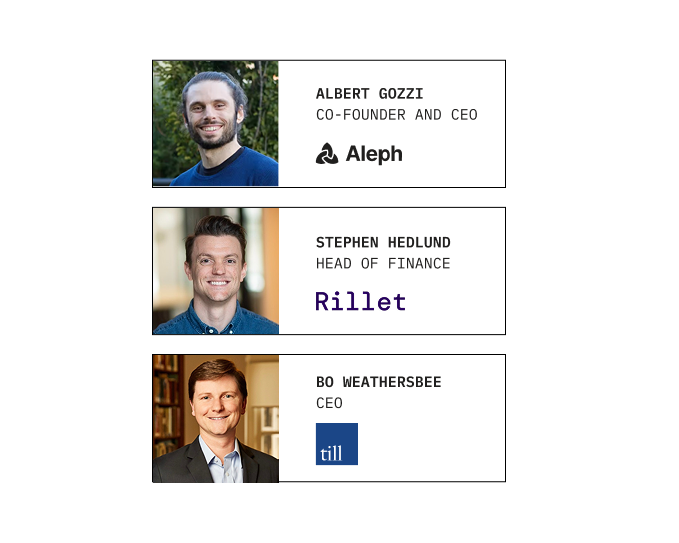
A live panel with Albert Gozzi (Aleph), Stephen Hedlund (Rillet), and Bo Weathersbee (Till CFO) on the newest role in finance.

Inside the session
The finance org is getting more technical. A new hire profile is showing up on modern teams: someone who owns automation, reporting infrastructure, and internal tooling instead of close cycles or board decks. The title varies, but the work is unmistakable.
Albert Gozzi, Co-Founder & CEO at Aleph, talks to dozens of finance teams a week about how the function is evolving. Stephen Hedlund, Head of Finance at Rillet, lives it day-to-day, running finance at an AI-native general ledger company. Bo Weathersbee, CEO & Co-Founder at Till CFO, sees the role take shape across the many finance orgs his team supports. Three vantage points, one conversation: what the role is, why it's emerging now, and how to set it up to win.
Built for CFOs, VPs of Finance, Heads of FP&A, controllers, and finance ops leaders at high-growth companies figuring out what to hire for next.
Join in on the discussion to learn:
- What a finance engineer is and where the role sits across finance, systems, and data
- Why the role is emerging now and what's driving demand for it
- How it differs from FP&A, RevOps, finance systems, and analytics hires
- What to look for in a first finance engineer hire (skills, background, instincts)
- How to set the role up for success: team structure, first problems, stakeholder alignment
- The early wins teams are seeing once the role is in place
- How AI is reshaping the work and why system builders matter even more
Plus, much more...
Watch the recording
Register to see how finance leaders are thinking about the next hire, with a live panel featuring Albert Gozzi (Aleph), Stephen Hedlund (Rillet), and Bo Weathersbee (Till CFO).
Chapters
- 00:00 · Welcome and speaker introductions
- 04:35 · Defining the finance engineer
- 07:30 · Finance people becoming engineers
- 11:25 · Why hire a finance engineer now
- 19:40 · What goes in the finance engineer job description
- 28:20 · How to become a finance engineer
- 37:32 · Claude Code, Cowork or chat, and deterministic data
- 46:40 · Q&A: finding and interviewing finance engineers
Read the transcript
00:02 All right, welcome everybody. Welcome to this new edition of the webinar. We're gonna wait for a minute or two until people start trickling in. In the meantime, if you can tell us where you're dialing in from in the chat, we'd love some audience interaction. So seeing a lot of New York, New Jersey, Austin, Stephen, you're in SF. Bo, where do we find you these days? I am up in the Adirondacks in New York right now. Sounds horrible. Horrible, Bo. I am in New York City. So today I am less jealous because at least it's not a hundred degrees as it has been, later early this week. Oh, we have Himanshu is dialing in from India. So I think probably the furthest away from us three speakers that we have so far. Anyone there? Okay, we have Joaquin from Chile. Anyone that wants to Oh, the Dominican Republic. Ali, I was just there in the Doctor in ***** Cana last week for a team off-site.
01:16 And we have Houston, Jersey. Yeah, next time I'm around for a team off-site, we'll meet up. All right, Rhode Island, quite a bit of different states. You know, a few people dialing in from SF. All right. Oh, got quite a crowd here this morning. Oh, wow. Martin is sending in from I'm gonna butcher the name of the city, Utrecht. Martin, correct me in the chat if I completely butchered. And that's in the Netherlands. All right. Utrecht. Oh, that's infinitely easier. Thank you, Martin. I don't know when I'm gonna use it next, but now I feel that I am much better equipped to represent your home city. So appreciate that. All right. I think we have a decent amount of folks there and I think we're ready to start.
02:27 So I'm gonna be kind of the moderator today and like trying to bring out the most out of our two esteemed guests that are the ones that have the insights. I'm Albert Gossi, co founder and CEO of Aleph. Aleph is AI native FP and A platform. And I'm joined today by Stephen and Bo. Stephen and we'd love for you to introduce yourselves. Maybe Stephen, you can go first and then we can pass it over to Bo. Cool, happy to. Thanks, Albert, and thanks everybody for joining in. We've been really, really looking forward to this. So my name is Stephen, head of finance here at Rillet. We're the AI native ERP. So you can you can think about us pretty similar to kind of what NetSuite built twenty five years ago is what we're building today. So kind of NetSuite built for the cloud era, bringing ERP online. We're making ERP intelligent. So backed by folks like Sequoia, a sixteen z, support some of the fastest growing AI companies of all time, like Merkur, Winsorf, Jukebox, Hebia, and then support lots of other public companies as well. And then very proud to support Bo and his team.
03:36 So I'm really excited to be to be here with you today. Good afternoon. My name is Bo Weathersby, founder and CEO of TILT, CFO. We are excited to jump on this with Rillet and Aleph, Albert and Stephen. You guys are amazing. It's been great to get to know you guys as we've partnered on the implementation side with both of you and we dogfooded Aleph and Rillet ourselves internally and our customers as well. Till CFO, we architect, build and manage finance infrastructure. We partner finance teams around the world to help them do that. So we have a team of finance engineers ourselves, Rillet and Aleph are key pieces to a lot of the architecture we build for our clients. Yeah. We had some of the best feedback among any customers from you both. So appreciate the partnership and I'm sure Stephen would say the same. I like to start always very basic. We have these fancy webinars. We have titles like meet the finance engineer.
04:45 I don't know how many people in the audience could accurately describe what they think the finance engineer is. So I wanna start from the basic and maybe get a bit of your take of, what do you think is a finance engineer? How would you define like the role of a finance engineer? Maybe Bo, I think you can start and then we'd love to hear your thoughts, Stephen, as well. Yeah, I think Palantir made this concept popular the last decade. It's the concept of a Ford deployed engineer. As we think about it and we hire for it has three kind of core components with an additional finance and accounting layer onto it. So technical engineering aspect, a platform engineering aspect, and then a solutions architect component to it. They can decomp complex situations and rebuild it using first principles. The fourth layer though, I think is the most important, which is kind of having the finance and accounting domain expertise to overlay onto that technical expertise.
05:55 That's truly what kind of brings it into being a finance engineer. So you mentioned both let me say it back to you, right? Like you said four skills, like one that is the finance domain expertise, which was the last one you were talking about. And then you have three that are on the spectrum of finance person to engineer, maybe a little bit closer to those engineering skill sets, which were, that's for engineering, solution architect, technical engineering. Is that the way they think about this? Like a mix of that finance expertise and some of that technical. That's right. Yeah. Yeah. And what's really exciting about this moment for a lot of finance and accounting professionals is the execution around the engineering is starting to become commoditized by the models. So Fable came out twenty four hours ago and now, I mean, it's crushing benchmarks on being a senior AI engineer and having that skill set. And so if you can harness the models, that technical engineering component that I just described is being commoditized, which means that the accounting and finance domain expertise is now the scarcest resource.
07:12 So, that's where this blend comes in and it actually becomes way more valuable to have the skillset, the experience set, the judgment around the domain expertise. Makes sense. And so I see it again, it's like this hybrid between a finance person as an engineer. Would love your taste, Stephen, of how much you define it similarly versus not. And maybe I would weave in also Fernando has a very good question that I was thinking about asking as well. Not to this credit you, Fernando. It's you know, you had a great idea. That is which side will you see more do you see more success in, Stephen? Is it finance people become engineers, or is it engineers becoming finance people? Yeah. Yeah. Yeah. It's funny because, in some ways, finance engineers still feels like a made up title. I mean, all titles and names are made up, but it still feels kinda made up. And I the good analogy of kind of seeing is so Clay invented this term go to market engineer a couple years back. And once again, at the time it was like, oh, cool. Fancy marketing title. Right? And now we have a go to market engineer on staff at Rillet. And there that that role's older, so a bit easier to kinda describe and flesh out.
08:24 But basically, his role is to automate as much of the go to market function as he can and accelerate the go to market function. So that includes everything from installing tools that help the team to automating some what AEs do, account research, things like that, automating BDR account research. Right? Like, his whole goal is just to help the go to market team move faster, stop wasting time on manual stuff. You apply that same mindset to the finance engineer, right, where they're coming at it with a finance mindset and saying, what are there tools that I need to install that could be a real NLF, or what processes do I need to put in place and build to automate these manual tasks our team is spending time on? And where I think the kind of difference in mindset shift is between kind of typical, I don't know, FP and A function of reporting versus finance engineer is it's less like, how do I get the work done? It's really like, how do I do the work better? And sometimes that can be done with someone already on the team, or sometimes you need separate function for it. So specific to, like, Fernando's question, frankly, I see a lot more success of going finance folks learning engineering than the other way around, at least at the companies at our stage.
09:38 Right? Once you get to, I don't know, maybe someone that's really a much larger organization, thousands of employees, something like that, then you might need someone with more engineering data background to step into finance. At the stage most of us are at, it's usually somewhat more of a finance background because it's still more finance heavy than it is true engineering. Right? It's still lots of vibe coding and systems thinking. Yeah. Boris, Cherny, the creator of Cloud Code, he was on a, he's at an event with Sequoia a couple weeks ago. He had this statement. He said that the best people positioned to write accounting software in the next few years will be accountants. So if you look at what he's saying, which he, they are six to nine months ahead of everybody else with what they know is possible with these models. He's saying that the accounting and finance domain expertise is actually the more valuable thing and the engineering is is getting commoditized away. Yeah. I think it's so I think it's really in the sense of, like because, yeah, there's a lot of domain expertise for accounting.
10:45 And how does that apply for else? But I think practically, so what does that mean? I think about a tool like Stripe, for example, one of the best billing tools ever created, period. But it is built for engineers by engineers. Right? So for all the accountants in the room to reconcile that with your GL as a Right? Like, you can just tell it's not built for it. Right? And it's just that mindset of it's not built by an accountant. Right? It's built by an engineer. So it works well for engineers but not accountants. And to your point that's the difference that accountants kind of building these systems and finance people building the systems. It really separates the kind of and usefulness of the tool at the end of the day. I'm trying to think, I'm a member in the audience. I attend this webinar and I will leave with a, I think you both are gonna be very in favor of you should have a finance engineer, right? Like just I'm hinting at that from Jim's answer so far. So I am a VP of finance, I'm a CFO. I go back to a CEO and I'm like, I need a finance engineer. Right? And they're like, It does sound made up.
11:51 Why are you coming with like a random title that like didn't exist? So maybe let's arm the finance people on the other side with like some arguments and express a little bit more of like, now? Why does it make sense to put a finance engineering in the hiring plan today and why not two, three years ago? What do you think, Stephen? Oh, man. I love this. I'll share a couple a couple examples. So I see Veronica Bruce in the chat actually, which is awesome. She's a she's a Rillet customer and has a wild vibe coding story. If I can share it here is, she had had seen all everything happening with vibe coding and pushed to kind of be able to do it internally and was initially told by, I think it was IT or something like, no. You know we don't have Claude. You can't access Claude, and she's like, I pay the bills. Like, I know we have we have Claude. Right? And finally they said, okay. Fine. You can use Claude for your team or for you personally. And then quickly within a couple weeks she proved the use case.
12:58 Right? Like, ships and cash reconciliation, kind of modules, features, was able to show hey. Look at the value I've created in such a short time. And then, leadership is like, okay, wow, amazing. Yes, it's like we're all on to everybody, right? And so, there, she wasn't kinda fighting for that finance engineer title specifically but was fighting for the automation and like led with proving it first. The other thing I've started to see, I've now seen this at three different companies, is when they hire for that accounting or finance role they're looking for already, instead of looking for a pure traditional background or traditional kind of JD, they write it with that AI enablement in mind. And so one CFO I knew he rather than hiring an FPA analyst, specifically went out and looked for a finance engineer. And the goal is one than to instead of hiring an FPA analyst, take the current folks doing FPA and help to accelerate them. Right? Automate what they're doing. So then the pitch for kind of leadership and headcount is not necessarily net new. It's more so like, can I replace someone else with this because they'll enable folks across the org instead? Yeah. I'll give, I'll give a live example that happened this week for us. So I think the reason why is because your system architecture is what makes it possible to fully harness the power of these models.
14:23 I mean, these models are now insane. Fable is an incredible, just I've been playing with it the last twenty four hours and it's incredible, but it has to be harnessed and the infrastructure and the context and the access to the context has to be built. It's probably a little bit like when businesses were going from being physical businesses to internet businesses, you had to redesign how all of your company's information flowed. You no longer needed inbox, physical filing cabinets. You now needed Amazon Web Service S3 storage buckets. And so I think going through that transition was probably really easy to know. I am an internet business or I'm not an internet business. This transition is just as big to rearchitect all your systems, but it's a lot more ambiguous of whether you're you know, AI native gets thrown around a lot. It's probably gonna become like saying you're an Internet business at some point. But right now, an AI native business has been redesigned from the ground up to enable these capabilities and the architecture is really important.
15:34 And the two examples I'll give is we dog food everything that we do for our clients. So I will use it for our own finance infrastructure. And so I wanted to put Fable to the test. There's this problem that we've had with we've been migrating over our billing from an old antiquated system to Rillet's native integration with Stripe. But we haven't had the time to do it and two or three months have transpired and it's just gotten to be a complex mess. So I wired in a couple of MCPs, so the Rillet MCP, the Aleph MCP, our billings MCP, then Slack to give it context. And I scoped the project, plan mode and clogged code and then told it to go. And it crushed it, like down to the penny. It was able to, using Aleph's data pipelines and data structures Excel, created fully auditable sheet for me to look at. Could really is awesome in this way. The MCP is awesome in this way where you can not only read, but you can write. And writing is dangerous, but it is the most powerful thing if you truly know what you're doing. And so it was able to read it. It presented it to me.
16:54 I could see the audit audible file that Aleph had created. And then I said, go. And it went and completely did. I just probably it told me it was about a hundred different right actions in the in the system, in Rillet system. So created customers that hadn't been created yet, created contracts that needed to be renewed and updated, backed all those invoices, spun all that up. All that being said, we have the architecture and the partners in the systems to be able to point Fable at. A friend of mine was telling me just yesterday, he'd been trying to break into Clog Code, and so he wanted to sit down and point at QuickBooks to pull a report. And so it's a family office. They have fifty plus QuickBooks books in their system. And he could not get past the authentication on the right books just from very get go, gave up completely and wasn't able to pull the exact report. This is the difference.
18:02 Having an infrastructure that is architected from the ground up with MCPs into all the systems and versus not having that, and it's a totally night and day difference now. So that's the As I think about the why now, like this finance engineer architects this and makes this possible and gives companies this new capability to harness these agents. I know I know Stephen is gonna ask you the name and the email of that, person with the fifty QuickBooks accounts. I saw I saw like, Stephen just like, thinking about that. No. And I think it makes a lot of sense and I like to go back to one of the things that you said Stephen and then tie it to what you were saying, Bob, of going back to a headcount plan. I know why this week I'm doing a webinar tour. I had a webinar yesterday as well. And we're talking about how in many cases people are spending a lot of money on AI, but they are not seeing a lot of ROI and a lot of usage, right? And all of the crazy stories of, people burning through the budget in two months, the budget for a year, etcetera.
19:15 So I do think that I really like what you said Stephen about in the end, if you have that finance engineer, you should see some of that in terms of, okay, we're planning of increasing our finance team, but now we can, keep finance team flat as we scale as a company. I think there needs to be some element there to justify. And I think it's fair to hold the finance engineer to that bar and being able to drive that level of automation and efficiency. Tayyip, back to what you were saying, Bo, I wanna go into kind of like what's in the JV. I keep going on the people should leave this webinar, being able to have everything they want to hire a finance engineer if they choose to do so. So what's in the JD? I think the things that I've heard, and I will let you go deeper or add new is a little bit of like systems, they should be, maybe they shouldn't be a decision maker, but they should be involved in, should I buy, legacy ERP or FP and A software, or should I buy Aleph or Relet? I think they should be involved in the decision and access to MCPs and other things are part of that.
20:26 There's a lot of actually automating workflows. I imagine a lot of let's rank workflows that define as an accounting teams are doing from most time intensive to least time intensive. And let's start at the top and go through that. What else do you think they should do? Are there things that they shouldn't do? Like, do you think that the best, for example, I have a, and I'm gonna stop the monologue, but one of the things is, is it good to put the finance engineer to, okay, now you should own payroll or you should own AP for a month. And that's, there's this thing engineering called pain driven development of, if you feel the pain of doing something, you're more likely to do something to change it. Yeah. How would you do it? Yeah. Yeah. I'll speak to the hard skills and then the soft skills. The softer ones are the harder ones to hire for, but the more important ones. The hard skills, I think they need some kind of accounting and finance experience. So they need to have been in a finance department. They need to have been a part of a finance team, accounting team. They need to have some sort of educational background around that, like a CPA, CFA. All of those are really important signals to show that they have the domain expertise and the judgment, which is, as we've discussed, becoming the most valuable skill set.
21:49 I think they need Not many of our finance engineers on our team have technical coding experience, but they do have this systems engineering mindset. And I think as I as we hire, we look at do they have that altitude control of being able to zoom way out and get at forty thousand feet to look at the problem holistically across you mentioned payroll, but that's a huge one that involves HR, it involves sales often, when commissions are involved, it involves obviously finance operations. So they need to be able to see the system as a whole integrated unit. But then they need to have the Altitude control to go all the way down into the details to understand when you process payroll and it does not have a native integration and all you get is an export of CSV, how do you work around that process and how do structure the data pipeline so that it ingests correctly? Being able to go back and forth high altitude to low altitude is another important skill set. Then the third thing I would say is just a sense of curiosity.
23:02 Some of our best engineers on our team are curious people. One was so curious, he moved to Russia to learn about Russia's economy during grad school. So that wide ranging curiosity about how the world works and how things operate is important. Albert, what do you I mean, you guys do this as well. How do you I mean, what you're thinking as you hire people that have to be able to put themselves in the seat of a finance professional that lives and breathes, excel all day long with the data engineering, that they have to have to succeed at building a less software. Yeah, do think to me, lot of it goes back to like you want to have a, and I think there was a comment from Hugo in the chat that I think was pretty good. And I would like to my answer of, Hugo was saying leadership can tell you everything should be AA native. Why do you have a finance engineer? Why not everyone should be a finance engineer? And I think the way that I think about this, there's different skill, there's people, there's from technical skills, there's analytical skills, there's domain expertise, there's even like people skills of like partnering with different departments.
24:32 If you can find someone that does all of that and like everyone in your team is amazing at everything, that's great. But like, that's not the most scalable way to build teams. You wanna build people with different spikes and you want your finance engineer to spike in system design, analytical thinking, and then you can pair them with someone that might be amazing at actually chatting with the different business functions and helping them think and they can be good at explaining and teaching others. I think it's hard to find, to have the bar for everyone needs to be excellent as everything. So I do think a lot about team composition in some way. Yeah. Yeah. I that's the part of why I like the finance engineer as a title, and then most titles are, like, BS. Right? Like, it's just a title. Like, who cares? Let's be honest. Right? Yeah. Our titles often rarely describe what we actually do day to day. But the reason I like it as a title it becomes very clear what the goal of the person is. Like, the goal is to automate mundane and manual tasks. It's similar to someone being in I started my career at Walmart, and we had an entire department, an SVP of finance transformation.
25:49 Like, that was their whole thing. And it was clear what they did with systems. Right? It was maintain SAP, maintain our ERP. Like, the whole goal was systems kind of architecture and setup. But the goal was more like systems. Right? The goal was not kind of efficiency and automation. And how do we how do I go go talk to this team and say, are the manual tasks consuming all your time today? How do I help you automate those? Either teach you how to do it yourself with AI and tools and process or actually go build something for you or go look for a new tool. Right? Like, the mandate was more just maintain SAP and make sure these things work. Right? And so that's why I like this title of finance engineer specifically. Like, the whole mandate is go automate. Right? Look for the most manual task. Look for the things consuming time, and then just go take care of them. Right? So we have one question in the chat about real workflows. We've got an AR agent now that will review, invoices that are overdue and then see when the last time the cuss like, we sent an email to them from our inbox, go draft an email, include a link to the invoice, and then we don't just let it send to the customer directly.
26:59 Like, we still review it and ship it. But we could set it so it could just go. Right? But so rather than us every Monday, whatever, pulling a report, seeing what's overdue, how much, going to get the invoice, getting the email from, who the customer is, drafting up the email, sending it to them to follow-up. Right? It just gets done, and it's still flagging things to us, and we can make it more aggressive. We sound like a pirate, whatever we want to. But it actually just handles that workflow end to end, and that's the finance engineer mindset. So that's what I would look for in the JD is folks that have kind of automation mindset. Yeah. And I think to me picking up again a bit of what you were saying, Stephen, is I think us as, people that are building software or like offerings in this space, we're doing all we can to make it easier, but there's a lot of value. It's, the real MLF MCP I think worked very well, but someone smart that is looking at that with like, and understand the problems is like so much better than just telling, Aleph at Relith solved my workflow, make no mistakes.
28:07 Like there's still a lot of customization that is needed. There's a lot of like business context. And I think unraveling that like, ball of wool that like business processes are, I think it's like one of the biggest skills. I switch gears a little bit based on some of the questions in the chat that I think we're good. We've been talking a lot around hiring for the finance engineer, but there's other persona here that is people that wanna become a finance engineer, right? I'm a finance person. I always tinkered, maybe I was writing some macros or Google Apps Script. So I lean a little bit technical and I like, I've been playing with Clock Code. How do I go from I'm tinkering with this to, okay, now I can change my LinkedIn title and call myself a finance engineer? Yeah, I would say the very first thing is you have to decide if you're okay banging your head against the wall. The fact that everyone's on this webinar means you're in the zero point zero one percent of AI right now.
29:20 And we're in such early innings and the tools are really powerful, but they're still really raw and rudimentary from probably what we'll see in two to three years. So you have to be a tinker. So you have to decide do I wanna just wait for everybody to figure this out and adopt it later and buy the software later? Or do I wanna be a part of building this now live for my company? And if you are in that camp, which is way more fun, I think, as a builder and entrepreneur, then I would say I would say dive into Cloud Code or Codex as a starting point. Go figure out how and we actually have we built this for our own team to get everybody off of Claude chat to Claude code, but we built a open and we open sourced it. Happy to share the link if you wanna reach out to me. But a Clogged Code course for finance professionals inside of Clogged Code that starts with what the heck is a terminal and how do I start Clogged Code inside the terminal. Because a lot of people get intimidated by that, and that's an important stepping stone. And then this is where that curiosity takes shape is you just start brainstorming and you can just say, help me brainstorm a couple of workflows or use cases.
30:44 Here's some of the fires that I have on my plate for this week. And you can pick one and start to just kind of go back and forth with it. And so that's the very first step I would take is dive into ClogCode or Codex and start there. Stephen, guys are prepping, right, to release the Finance Engineer Vibe Academy, which I'm super stoked about. But specifically for this because yeah. So we've been hosting these kind of vibe coding webinars every Friday for the last, I don't know, almost like two or three months now. I've been showing lots of what people are building, and, some folks have started building and built some amazing things, but a lot of folks are still wondering where do I get started? Right. Exactly to your question about what's the terminal and all these things? Or you kind of try it once and hit roadblocks as well. Like, we've got a Slack community for finance folks called the Clozebub, and there was a thread. This I think this was last week or week before. Someone tagged me in there, and I was in meetings, and I saw there were a hundred messages in there. And someone had gotten stuck with Cloud Code, and folks were trying to troubleshoot and suggesting this, suggesting that.
31:57 It still wasn't working and going back and forth. And it was it was awesome. But this is what we're dealing with, right, is we're trying to like, we all have jobs already. Right? We all have a million things we have to do, and then figuring out how to pause and take time to automate it is is very hard. So we've got like, we've done this now across all teams. The company is every, I think, every other Friday for most teams of an hour and a half blocked, and the whole point is to build something with that time. Yep. Right? And so intentionally blocked everyone's calendar from leadership, right, permission, right, to stop whatever you're doing and spend time building, automating. Right? Because otherwise, like, I'll do it tomorrow. Right? Like, I'll do it Monday. Right? Like, it's easy to push this stuff off. But, if you kind of have that mandate to get time dedicated to it, then it really becomes kind of worth it. We did this exact same thing. We called it a promote yourself day because, we're I love that. Moving from AI as a chatbot to a coworker. And so delegating the things that we don't wanna be doing anymore, promoting ourselves to being the manager of the AI. It's the concept.
33:06 But the reason we did it, we had everybody block off our schedules. It's a super expensive day in terms of our time, but we made the decision to do that because you do have to go deep. There's a focus aspect of this. You can't splinter your time is splintered like so many. I've been in the accounting and CFO seat and you get splintered into a million different Slack messages and responses and customer questions. And you have to push out all that noise and dive in. And so often what we find is it happens in the late nights or early mornings when it is a little quieter, unless you're super disciplined to block your time out. Or if you are the leader of a finance team, you could have a promote yourself day where you say, all right, guys, gonna get on a couple of Zoom calls throughout the day, but the focus is gonna be building with these tools and surging toward a workflow that you can build. Yeah. Well, one thing I would add is that, and I very much like those ideas. I think we've done versions of that and like AI hackathons internally ways of promoting. Maybe the one thing that Johann mentioned I would have is a lot of these things, the hardest part is getting started.
34:25 It's, imagine that you're not really an NF customer, you need to like, buy tools, set up, like there's a lot of activation energy of like getting started. Even when you start a workflow, there's a lot of like setup things that maybe, oh, you know what, like the agents don't know that I actually write my ears with four instead of like two ears and there's so many things. But like once you pass that, it needs to be like going downhill and like running downhill. I mean, that's become, I think everyone can get to a point where it is faster to do it the finance engineer way than it is to do it the normal way. And the only thing that is like separating you is that initial setup of getting things connected and getting things configured. Yeah. Here's another practical thing that we have our team do is we seed every once you do get set up in Cloud Code, we seed everybody with an intent framework document. And we have a prompt for this. I can share that too if you want to reach out to me. But The intent framework basically is an interviewing process.
35:40 So you run the prompt and it interviews you about what your job is, but it gets into the nuance of what your job really is. To Stephen's point, it's not VP of Finance, it's fixing all sorts of issues with all sorts of systems. And so through that conversational flow, it starts to learn about the guardrails, like you want the AI to make decisions on versus what you want it to give you approval on. And it works through your goals and priorities for shrinking value sets because so much of finance is it depends. The answer just depends. And so, there's judgment trade offs. And so, you can encode that judgment to some degree. Fortunately, there's still humans involved in all this stuff for all of us, but this type of a framework is a markdown file. Common language would be like a text file that the AI looks at every single time that you ask it a question. It has the appropriate guardrails, context, judgment that you've encoded and nuance so that as you work on your company's systems, every response is more tailored and shaped to exactly what you're doing.
36:56 And this is where it starts to become more like a co worker. If you're a manager and you have a direct report, that direct report's job is to do their job as if they were trying to be in your role. So I think that's an important piece too, setting your infrastructure up right. And there's lots of little practical ways to do that. Yeah. Awesome. There's a couple of questions in the chat that I wanna cover, kind of like maybe a little bit like rapid fire before we move on. CJ was asking why code over co work? Why would you, even within the Cloud ecosystem? I would start with Cowork just if you have a question around that. Designed to It's essentially under the hood, it's essentially the same thing. Cowork has a UI layer on it that's a little bit more knowledge worker friendly, nontechnical friendly. Once you get into Cloud Code, you can move faster and do a little bit more technical things, but CoWork's a great starting point. And CoWork is a you know, these labs, they leapfrog each other.
38:09 And right now, OpenAI with Codex has leapfrogged Anthropix version of Cowork. So Codex actually is probably a little bit more user friendly even than Cloud Code is. Stephen, anything you would add there? No. Nothing to add. I think I think we nailed it. The, and some is preference from what I've seen. So I initially started in a lot of, like, Cloud Code terminals specifically, and it makes me feel much cooler. I'll be honest. I still don't really understand everything going on there, but I feel like I feel like a MuralGrail engineer or something. Now I do a lot more just in, Cloud Code's desktop interface for it. Yeah. Because now you can do multiple instances at once, and it's actually pretty clean and looks good. And, that one has become easier to navigate. So so some of thing is just personal preference. Like, I generally just encourage trying it and see what you like. I will say we had this epiphany moment back in February where, we did these AI office hours, and one of our controllers brought this problem around RevRec to us.
39:15 And so we would do these AI office hours. He was using Claw dot ai, which is the web version, the most common, the chatbot that most people are used to, kind of the ChatGPT style version for Anthropic. And so we tried to solve the RevRec issue using We hadn't introduced Claude Co. To our team. I didn't want to intimidate. So we tried to use the Claude dot ai to do the work of RevRec. And so it was like just a massive failure. It just totally hallucinated, did not get anything right. He's saying that he checked it. It was wrong. I was like, why because I had done something similar, not the exact same thing, but I had done something similar the week before using ClockCode. And so after we got off the chat, or the Zoom call, I went and used the exact same prompt with the exact same data files on but used it in Cloud Code, and Cloud Code nailed it. I had a few tweaks. So I shouldn't say nailed it, but I had I had to do a few tweaks, but far, far significantly surpassed what we had done in Cloud dot ai.
40:27 And the only difference was Cloud dot ai, the web chat, is not designed under the hood in the same way that Cloud Code and Cloud Cowork are. So if you're hearing all this Vibe coding stuff and you're only in Cloud dot ai, the reason is because it's actually a completely different infrastructure under the hood that shapes and harnesses the model's capabilities. And so if you're on Cloud AI, I would say switch over to coworker Cloud Code as fast as possible. I will play David Sapoge here and do the opposite. I agree with a lot of what you both are saying and just for sake, I will play the other side of, every weekend I go on X and I see people talking about their AI setup and it's like, oh yeah, I have like a hundred different agents working in Bartle and like, what do you get done with all of that? Oh, I managed to have a setup where I have a hundred different agents. There's a little that where, with every new technology, there's a clarification on the setup. And I'm very much, let's talk about what you have to show for your setup and we'll judge based on that.
41:45 And I am a big fan of, start a simple, there's a lot of things where Cloud Chat, Cloud dot ai will work well. And, do agree that for a lot of use cases, coworker code might be infinitely better. But like, I wanna go back to the output is what matters and what you were able to get done over any setup. The despite cloud code making you feel cooler, Stephen, which is a very important, part you know, feeling cool is an important output as well. It is it is important. Albert, this goes to what we were saying earlier about the judgment. Your outcome does matter and your ability to judge and the definition of done and the accuracy of the output, whether it's Cloud dot ai or Cloud Code or Cloud Code Work, that's a really important piece. And we call it a ten eighty-ten sandwich at Till, but ten percent upfront specifying the intent, setting the direction, eighty percent of the work gets done by the model, and then ten percent at the end is is is human verification and validation.
42:54 That judgment is applied. And that twenty percent on both ends of the AI doing the work is still squarely human. And I think probably, I don't know, I shouldn't say always with all this stuff because who knows it does feel like there's always gonna be a human in the loop at some you know, to some degree with all this. For sure. And I was gonna add here is the I think there's some, like I don't know. Like, finance engineer or whatever sounds very intimidating in some ways, and I think they there. And, also, in some ways, I'm like, it's not that different from what we've been doing in many ways over the last five years, I think about. And when I started at Walmart, we had entire teams for data. Like, their whole role was just making the data clean and scrubbing it and building the SQL queries. And my role is mostly just take those queries and build the reports and do the analysis and things. And then I moved to a startup, and we obviously didn't have a data team. And, like, I learned to build the SQL queries myself and actually build the data structures and all of these things. And some of that is because it was smaller company and start up.
44:02 But some of that I've seen this across the board is finance folks becoming experts in data. And sometimes data even rolling up to the CFO within the finance org is, like and sometimes it's because we ask data team for things, and, like, I'm sure they want to, but don't have time to help the back office. Right? So we just figure it out ourselves anyway. So I see this as, the same thing. Is this is a new level in many ways. Obviously it's not just kinda data structuring and building, but it's still that same of we need these things for our future as finance folks, and we can ask for the resources and ask other teams to do them. And the reality is it's probably not gonna happen very often. Like someone said in the chat, why would you dedicate an engineer, to back office? And I'm like, fair enough. Probably the right move. You know? So we're gonna have to learn this stuff ourselves. But now with Cloud Code and these tools it becomes easier to do them. And, Tbow, to your point move from the mid office, from the back office to the mid office and front office. Yeah. It's really I'm glad you bring this point up that it's like bore like, just some of the old boring stuff. I think Rillet and Aleph have a really good taste and sense of this.
45:14 We talk about you want to keep the probabilistic layer as thin as possible and the deterministic layer as fat as possible with your workflows. And so what that means is AI is really good at generative computation where it probabilistically creates things. In finance, you do not want probabilistic thinking with your finance data. If a journal entry needs to match to the penny, you don't need it to sometimes match to a penny, sometimes match, give or take, dollars five hundred. You want it to be exactly right the exact same time. And so Aleph and Rillet are is an underlying deterministic data model and system to flow your accounting data and finance data through that. And that's largely just boring data engineering that has been around for decades. And that's a really important piece that I think a lot of people get dazzled by all the talk about what you can do with all these agents and having a hundred plus agents and all the LinkedIn bros saying they vibe coded away their job.
46:23 And the reality is that they vibe coded away maybe the thin layer of it, but that fat layer, the deterministic is really a lot, really, really important still. Yeah. I do think, probably Stephen would agree we wanna do the boring stuff so you all can do the sexy stuff on top. And that's kind of the mindset. As we have a little over ten minutes left, wanna switch fully towards Q and A. There are some questions that have been popping up in the chat, but if you have questions, please submit them and we'll start going through those. But the best question in the chat so far is from Catherine and it's Beau, are you wearing two watches? Tell us a that. I am a data nerd and I'm embarrassed that somebody figured that out. I do have, I have a WHOOP and an Apple Watch. And Alright. The WHOOP is, giving me a lot more physical biological physiological data than my Apple Watch does. I have not figured out how to get both of them together. Oh, boy. Look at this.
47:36 There you go. Alright. Good. I'm gonna do anything. I knew I liked you, Albert. How many do you have, Stephen? You have like zero things in your wrist? Wow. There's so much Yeah. So much real estate there, so much opportunity to put stuff. We welcome and encourage questions like that. If anyone has more questions like that, this definitely makes it fun. Like I think, we have here Fernando, some, this could be like a list from before, but I think it's still good. Like, are you seeing success developing this type of role? Oh, okay. We replied to this one already. So there's a lot of comments around your setup, Stephen, as well. Do they both feed into cloud and you pin them against each other? That's great. Maybe I can jump in here. Like, one question I've seen from folks about this is how do I find someone for this? Right? Like, if you're gonna go external for this how do you find somebody? One thing practical example I've seen, so I met, an accountant in Austin a few months back, and he was looking for a new role, had applied to two thousand jobs and not found any he was particularly excited about.
48:59 And he started posting about what he was building by coding on LinkedIn. And then a few weeks later, actually got outbounded by a CFO looking for someone who was very AI native and building here and could do these things. So he started doing the work, and then someone found him. And like, I like, I was like, dude that that didn't happen. Right? And it like, he, looked at his profile, saw the receipts. We're like, this is how it worked. Right? So, surprisingly, like, LinkedIn actually becomes an interesting way to find people doing those things. Right? The other way is to make vibe coding part of the interview process. This was really, enlightening for us with some of our marketing hires specifically and some of our data hires is give them a dataset and say you need to use vibe coding for this. And especially interesting because then as we drilled into the data, some folks could explain it really well, and some folks couldn't. And it was very clear which folks used AI and then also understood the data themselves versus the folks that used AI to just do the analysis and didn't understand the underlying data.
50:12 And it was it was very clear from the from the prompt and how they put it together. And so, I find helpful both yeah, on the on the top line, look for folks. Like, go on and look for folks who are building with AI, folks talking about on LinkedIn or folks even coming to sessions, webinars, etcetera like this, folks in the chat sharing what they built. If you're recruiting for the role, it might be helpful. Right? And if you're looking for roles like that, start posting about it. Right? Start talking about it. Put it out there. Let folks find you. And then, yeah, make it part of the interview process specifically. Like, what can you vibe code? What can you build? You have to use AI for this interview process. How are you gonna do it? I completely agree with that. We just hired a controller last week, and out of the hundred plus candidates that applied for the job, he had been posting about using Cloud Code, with his accounting workflows, and, that that was something that really got our attention. When we think about the injury process, which I very much agree, and I'm curious, both different, both of your takes of how you do it. Do you give people a dataset, let them by coded and then discuss the results? Are you, hey, let's open Cloth live and like, let's talk while Cloth works.
51:23 Which flavor have you been doing? That would be I haven't tried any live builds. That would be Live be fun and super intense for the in interviewee. We primarily give a use case and give them give them time to come back. And Alright. They have to they have to record a Loom doing it, though. So we'll have them record a Loom where they open up the use case from the very beginning and then so that we can see the screen as they build it. We haven't done it for these type of roles, right, like this finance engineer or this profile, but in other roles, like more on the engineering and the engineering side, one of the things we've done is we do the prework. They go, they by code something, they use AI, we go live and we ask like one or two follow ups live. So it's not like building the whole thing live because sometimes maybe the start takes five, seven minutes by these doing some of the, you need to bring your, cloud code chat open and we're gonna work through that. Brian is asking, has anyone started to ask candidates to see GitHub repos already? Which is again, common for those of you that might be less familiar, GitHub is platform to host code.
52:49 And when you're talking to engineers an engineering injury process, it's very common to ask for a repo and see what code they have written in the past. Have you done that now? We do for our engineer engineers, if that's a word now or a job now. But have not found any finance and accounting professionals that are non technical that have started to use GitHub. Our team uses GitHub now. So now our non technical users are submitting PRs and it's super cool to watch and see that process. But coming into our team, we have not had a candidate yet that is that advanced. So, Brad, if you are a candidate or if you have GitHub repos and you're accounting and finance professional, I'd love to love to chat. The on Michael's question realistic scenario without access to systems, I think in a couple ways, it's just datasets is you could either simulate, I don't know, your AP, your RampBreX data, your ERP data, your FP and A data, and have them do a reconciliation or mapping process or something.
54:01 So just providing the data because you like, we can do the same thing even with CloudNOW. Right? If you don't wanna connect it directly to these systems for security access reasons, whatever, is you can just upload the data in yourself. So depending on level of role, we just give it give them one to two datasets or give them different datasets and potentially have them disagree, find the nuances. I find it's helpful to have lots of different date columns in there that mean different things, because the AI especially has a hard time parsing those. But a human should be able to read through and say, okay. This is start date, create date. This date is when now the quarter that this opportunity originated. This is, the month that we booked the journal entry. Like, what whatever it is. This is the month that it was accrued, like, whatever it is. Right? But AI gets confused on dates, it's helpful to have nuances in there to make a human think through and sort through that the AI might not catch. Yep. Erin was asking, may maybe a quick one is, you all mentioned courses, skills. Maybe we can do with you know, if you can share that with we can do in the email that we send after the webinar with the recording.
55:08 We can make sure we include all of the links. So if you're looking for links, we'll make sure we get everything. We had another question, Stephen, I'm gonna direct to you as our LinkedIn group. I mean, Bo has become more active on LinkedIn recently, but like Stephen you're the OG LinkedIn poster here. So, is a question of like, is LinkedIn more useful than publishing code in GitHub? There was a question around, Mark was seeing a question that I didn't fully get, but maybe one of you all, if not Mark, you can come in the chat and clarify that I want to post, but not create a strong LinkedIn presence. Like talk to me a little bit Stephen about, LinkedIn and how you've been using it. I mean, sure. Like, I think LinkedIn is still extremely underrated within the professional community. It's weird to me that we all spend so much time on it now. Like, it has shifted to a social network, but it is the only social network that is not anonymous. It's the only one. And so it becomes very useful then for things like this where you can ask for questions, share all use cases. I think LinkedIn is a good medium for that. Other place I would share use cases, ask questions about these kind of things is any finance networks you're in.
56:28 So this is happening in our Slack community, Close Club. There's, another group I'm part of called Fifth, Females in Finance, where folks are sharing use cases there. Right? So all of these things, like, I know the few people in those channels that are the, like, VibeGo forward folks because they're talking about it. Right? So I can name in my head who these people are because they share. So now when I have folks who ask questions and wanna get connected to folks, I'm like, oh, go talk to Veronica. Right? Go talk to Beau. Go talk to Aleph. Right? Like, these are the people I know because they share these things, and they're not even posted on LinkedIn for some of them. It's just in these other forums and channels. And so, if you wanna start building yourself there, just start sharing what you've built or just ask questions. Right? Like, it's scary. Right? Like, it's intimidating to be ask things like, is the terminal? Right? So you can ask Claude those things or just ask them in these in these threads and in these groups. You know we're all learning together here. I have a final question to wrap it up as we're a couple of minutes. I saw a lot of comments when we joined around the NBA finals, both even Spurs or Knicks, and who's gonna win the soccer world cup as an Argentinian.
57:45 Know, I don't wanna bias, but I don't know. You just take it though and then I win, Steve. I would take the other side of that, USA, so we have to go on Spurs and France. Put in the chat your predictions as well. Bo, what do you what do you I'm with the Spurs all the way. Go go Spurs. They got a they got a lot of lot of ground to make up, though. And then on the World Cup, I will go with England. Oh, here we have Justin, agreeing with you. It's crazy how, I ask questions around the finance engineer, which was the topic, crickets, no one replies. I ask like Nick's or Spurs. Chad is Chad is bursting. And now every Yeah. We're smiling, Michael. Everyone is super engaged. So, that's probably Yeah, so we have, I mean, it's pretty split, a lot of mix coming there. Anyway, wanted to end with that light and fun note. We're gonna wrap because I'm sure a lot of people have a one pm Eastern, pm Pacific.
58:55 Thank you, Stephen. Thank you, Bo. This has been great. Thank you everyone in the audience for dialing in. You guys are great. Yeah. Keep building. Bye.