The rise of 10X finance and accounting leaders
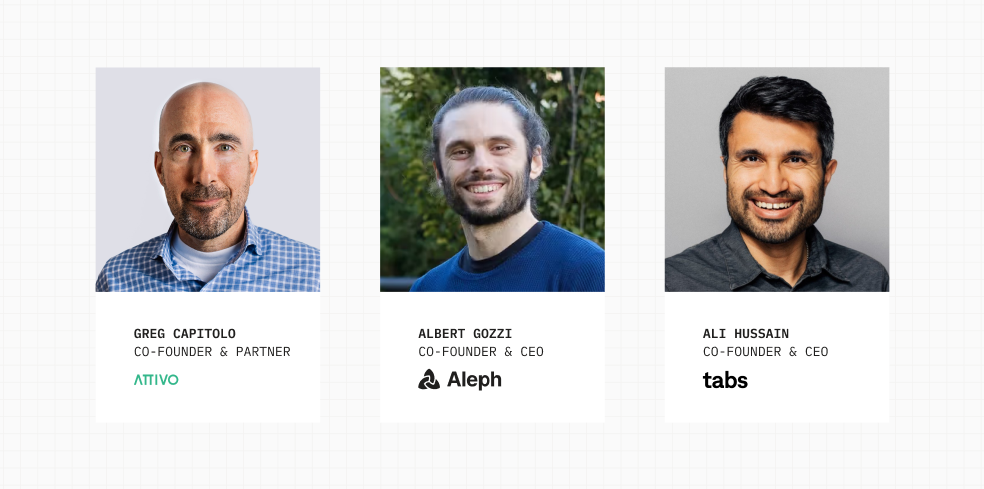
Join the co-founders of Attivo Partners, Aleph, and Tabs to discuss how advancements in finance software, services, and AI are building the first generation of 10X leaders.

How to go from incremental to exponential
Finance teams today are expected to do more with less—move faster, deliver sharper insights, and turn data into decisions.
The finance tech stack has been transformed to keep pace, and AI is bringing a whole new world of speed and capabilities. Finance leaders are finally unlocking the potential to scale themselves and their teams, without adding headcount.
In this webinar, Greg Capitolo (Attivo), Albert Gozzi (Aleph), and Ali Hussain (Tabs) discuss:
- The growing expectations of finance teams and leaders
- How SaaS and services have evolved to support modern CFOs
- How AI is creating a new generation of 10X finance leaders
- What challenges and opportunities will exist in the years to come
- and much more...
To learn more about the speaker's companies, check out attivopartners.com, tabs.inc, or browse around to discover Aleph.
Watch the webinar replay
Chapters
- 00:00 · Introductions: the view from the CFO's office
- 06:15 · Tabs intro: AI native revenue automation
- 09:58 · Aleph demo: AI variance analysis
- 15:35 · From back office to strategic finance
- 23:40 · Leaner teams and doing more with the same
- 31:45 · Balancing automation with human review
- 42:05 · Greenfield opportunities in finance tech
- 49:10 · Advice for getting started with AI
Read the transcript
00:00 Great to be here with Albert and Ali as well. So I'd like to start the conversation just saying a little bit about my perspective on the 10x finance professional and modern finance. You know, at Attivo, we serve we've served five hundred plus clients, and we I think we bring a unique perspective in what's happening in the office of the CFO. And so today, we see technology and AI changing the office of the CFO so rapidly that we have invested in our own tech and AI team to assess and help to develop AI that can sit across our tech platforms and connect the tech platforms that we use like Aleph and Tabs.
00:57 And that's become very important for us in terms of delivering quality data that helps drives appropriate decisions for our clients. A little bit about, Attivo. We were founded in 2017. We serve almost exclusively venture backed companies up into forty million in revenue. We support them with outsourced accounting and finance, and we have, developed an approach in which we really want to be part of the venture community. And so we have a number of events that we host for finance and accounting individuals in the venture community. We built our foundation on a culture of continuous learning and collaboration among our team members as well as with the extended VC community and the clients that we serve. You know, through the past seven and a half years, we've had the opportunity and pleasure to serve five hundred plus clients. And those clients through our through their processes as we've served them have raised over eleven billion in venture funding, and that's been a lot of fun to be a part of.
02:17 Adam, if you go to the next slide. With the you know, with our view from the office of the CFO, today, we're seeing changes driven by technology. And technology is really a core part of what the office of the CFO does in terms of setting up their platforms, implementing, processes that drive data that can help make decisions. And that's where we, as a Attivo, spend a lot of our time is building those tech platforms and accounting and finance processes for our clients. And tools, the tools are changing very quickly. In this particular slide, you see a number of names that that are really brand new within the last two to three years and that are really taking the office of the CFO by storm or coming up very quickly in visibility and the ability to support the decision making that we have to do with our clients or that the office of the CFO has to do with their management teams. Again, I'll say Aleph and Tabs are a significant part of what we're doing, and using them every day in the work that we do.
03:38 And if you go to the next slide, Adam. And then as we think about how that 10x finance leader is defined, it's really about being able to focus on what matters, and that's being able to focus on bringing information and data to our clients, to the management teams so that they can make better decisions. And we wanna do that in a manner that is efficient, is scalable, especially as our client those clients that scale quickly, that we want them to be able to continue to use that foundational platform as long as possible and then go through and make changes at as required as quickly as possible. We wanna then use that data to help them measure performance to and to help them predict the future. And that's what's really becoming exciting is being able to help our clients build financial models that become closer and closer to predicting what's going to happen in the future. And then the final slide, Adam. And then as we as we think about Attivo and how we've brought that all together, we use a framework around vision, strategy, and execution to help clients our clients define what their goals are, how to measure themselves against those goals, and then how to make changes in their business model and businesses and their operations so that they continue to can continue to scale and grow.
05:16 And with that, that's a little bit about Attivo. Our view from the office of the CFO in that technology is driving the 10x finance professional and has really got has to be, number one in how you're thinking about building your finance and accounting team. Yep. And thank you, Greg. Like, I think that this is a ton of fun. I also wanna preface and then say it's the beginning that, we do these things not as a sales pitch. I think that it's the unique and special perspective that Attivo has, and then we're gonna roll into some quick, kind of intros just to let everyone know that isn't familiar what it is Tabs in the left are up to. But this is these are not meant to be a complete sales pitch. After that, we're gonna, spend a few minutes on that, and then we'll dive into more of the topic at hand, which is how all these things are really kind of creating the rise of a whole new generation of 10x finance and accounting leaders. So, yeah, let's roll into quick self promotion, and a little intro about the company. So, Ali, I'll let you take it over. Yeah. Awesome. Thanks, Adam. And I think just to start, I mean, I'd love to make kind of our intro a little topical with how we build to the 10x finance professional.
06:33 And a couple principles, I think, are kinda key and top of mind for us here at Tabs. Like, we don't believe that is possible without a ton of automation software and AI in the coming years. And when we think about how all of you think about your systems, I think more and more we have built the conviction that the general ledger in the GL is shrinking in many ways. And without tools like Aleph and Tabs and many others that you've started to adopt going into the COVID era, whether it's something for APN spend or for payroll, more and more, many of you are moving things off of the GL. And the company Tabs was founded, by myself and a handful of cofounders, a couple years ago with the belief that one critical element of operational finance around the GL, which ties to all things revenue, had been broadly underserved over the last decade. So when you think about a lot of the advancements in operational software for finance, we saw a ton going into the COVID era, whether it was around APN spend with products like Ramp and Zip. Certainly payroll, there's been a lot of advancements in the last five to six years.
07:45 And I've had the great privilege to be working with folks on this call, folks like Greg and others to really think about why the flow of funds into finance have been broadly left behind. And, in early 2023, we were fortunate to get substantial backing to create the first AI native, solution in this space, which we think is not just AI noise. Like, fundamentally, most of you operate companies that have very different commercial models, b2b, PLG, flat SaaS, usage based, often negotiated at the contract level, which historically has made revenue automation incredibly difficult. A little bit about Tabs given we came out in the 2023 era, we were fortunate to benefit from a lot of advancements in LM technologies and other forms of AI. And so, really, our value prop is how do we understand your business model often at the contract level, which is, often very telling of how your business works and is often different customer by customer. And then from there, we're able to then operate all of the operational elements of revenue, whether that be billing, kind of some of you may call that order to cash, all the way from invoice creation, communication, escalation, and complete cash application.
09:08 But then what's different about us and what is AI is allowing us to do is go far more, horizontal in revenue workflows. So, many of you may have different requirements around revenue recognition to six zero six, non GAAP metrics like ARR, but also elements that tie specifically to revenue, like when you should collect from your customer and, the actual receipt, cash forecasting. So we are, we believe the most horizontal AI native solution, and a lot of what we'll talk about topical is what happens from an agent and AI standpoint that creates a lot more depth than AI application, which is certainly top of mind for us in the next twenty four months. So with that, Adam, thank you for hosting. Greg and Albert, I'm excited for this panel. And, Adam, Albert, I'll, popcorn over to you. Perfect. Thank you, Ali. And, yeah, I think, like, I echo everything that Ali and Greg were saying about, the role of AI in automating some of these workflows. So I wanted to do things a little bit differently, and rather than talk, I'm actually gonna show you some of the Aleph product. And so I'm gonna show you one slide and a very, very quick demo in max three, four minutes. So the way that Aleph, we're a next generation FP and A tool, and we like to say that we connect your data, your spreadsheets, and other layer in of AI and automation on top of that.
10:36 So the way that I left works is you can connect any, out of a hundred and fifty data sources like NetSuite or QuickBooks or even other providers such as TAFs. We centralized all of that in one place, and that's kind of the left source of truth, that middle ground where there's a lot of ways that you can track with data, using AI. But then the idea is that you can use that in either our web app based on the bottom right for things like dashboards or in spreadsheets. So before within what I'm gonna show you, the only thing that you need to do is connect something like NetSuite, which takes under five minutes. And all of your data starts to flow directly into Aleph. This is some of some of the interface looks like. You connect something like NetSuite, and you get a bunch of, different tables with income statement, balance sheet, cash flow. Once you have something like that, it's about starting to analyze it. I'm not gonna do dashboards, but I'm gonna show you some of the experience actually in spreadsheets where the idea is they can use Aleph, come look at your income statement that is coming from NetSuite, and come and say, I wanna come and by account and by month.
11:49 In this experience, that looks like a pivot table, bring your p and l for this year. Once you're doing that, what you would wanna do is try and, go from just bringing it to understanding variances. So a lot of what we see people using, and that's what, Greg's team at Attivo uses every day, is, we're spending more in software than we were two months ago. We wanna understand what's going on, and we wanna come and do a drill down and say, okay. Actually, what happens if we look at it by vendor? Is there something that explains that? And you can very quickly build that interactivity just within spreadsheets. We think this is pretty powerful. I'll probably show you here five percent of what the left is at the platform, but I think I want to show you show you this as a segue. Oh. Oh. I think I have some noise on your end. But I wanna show you this as a segue of, how we can use AI to make this process even more efficient. So here we have an example of a workflow that finance people do all the time that is just doing a variance analysis. So you have your p and l. You have one month.
13:00 You have the second one. You wanna explain what it is that draw the variance. You could do it one by one in the way that I showed you, just going to each and doing a drill down. That will take quite a bit of time. Or you can start using some of the advanced MLMs to do that in a more efficient way. So what you can do today with Aleph is come and say, I wanna pull and scan, explain variances that are higher than, in this case, wanna do ten percent and 5k. And then this is the LLMs doing the work for you. So instead of you going to all of these different accounts and doing this, drill down, AI will now take forty five seconds to a minute to generate the answer. And I think this is like I wanna show you this because this might take off a 10x finance professional. Part of it for me is actually making things 10x faster. And while the AI runs right? Like, I have a quick, math here of if you're doing twenty five accounts for variance, you're spending ten minutes each that, like, Greg was talking about, something like that, and you're doing this at a month over month, you're doing it by, budget versus actuals, you're doing it by department, you and your teams are probably spending couple days doing that.
14:15 With Aleph, that's already much better. But with Aleph and AI, you can start doing this in ten minutes for all accounts and get the result. So it's not only a 10x finance professional. I do think that there's potential here for the 25x finance professional, which we might be a new term that we're, coining. And then yeah. So we should trademark that one. But other than that, the idea is that, the AI actually goes and that's your commentary. And in the case of legal services, it tells you that there was one vendor that explained a lot of the variance. And something that we really is very important is having AI show its work and not act as a black box. So you can even come and say, what's going on here? The AI will tell you, I want you to drill them by vendor because that's what I used. And then you can indeed verify that it was one vendor that was driving, most of the variance. This won't work across all workflows. There's a lot of work. We've been working on this for, six, nine months, and this was years in the making with things like the NetSuite connection and so on.
15:24 But we do think that the AI is at a point where it can enable these, 10x finance professional for real. So I just wanted to show you, again, one small application, small yet powerful application. Awesome. Well, so much for not being self promoting, but it was, well worth the time there, Albert. So now let's dig into I mean, tools aside, I think this is all starting to bubble up. And I think, one thing I'd love to dig into is a high level thing getting into the content is the framing of talking through why did how did we get here? Like, a 10x professional why does why does someone need to 10x? And I think some of the underlying story is the role of finance has really changed a lot over the last few years and really tools and technology are starting to just really just trying to keep pace. But I'd love to hear the different perspectives of the team here about how kind of it shifted a lot from more of a back office to more of a strategic, function and driver of growth within companies. I think you need to tell us, Adam, who you want to take it away.
16:34 We're all we're all shy here. Since you spoke first, I'll let you go. Perfect. Yeah. So happy to write my perspective. And I think, very similar to Ali, I started Aleph five years ago. And along this last five years, I have probably, in the many, many hundreds, if not thousands, of finance calls. And I think many of you that, talked to me over the past years are here in the audience and know this. I think one thing one trend I've been seeing that has been quite a shift is from the why I always thought this, if you had a magic wand, what's one problem that we wanted to solve? And five years ago, a lot of the answer that I was getting was, I need to do reporting faster. And it was a very, scorecard type of finance workflow where I'm just keeping track of metrics and automating processes. Today, that's very different, and people tell me things like, our company is not growing fast enough. And I do think that that shows the shift of finance from, a scorekeeper and someone that is just counting the numbers and reporting to someone that is actually caring about the business and think about using that analytical toolkit and what they know about numbers and being able to go deep there to actually drive change and impact, in the organization as a whole.
17:57 So, yeah, that's for me the main shift I've been seeing, over the past few years. Happy Ali, sounds like you have thoughts. I can go next, Albert. I think there's a couple I'm excited to hear Greg's take on this because he sees this through so many companies. But what I'm saying at the customer level is two, I think, fundamental shifts. One, I think, started independent of AI, like, going into kind of the post COVID kind of market reset in 2022 where finance leadership and how boards and companies started to see it was just much more elevated both in terms of fiduciary responsibility, but also just strategic guidance on how to be the most strategic with cash and resourcing. And so I do think most organizations, even before the major AI era, twenty let's call it twenty three onwards, started to just, from a governance standpoint, elevate the role of the finance leader, whether it's the CFO, others to be kind of the counterbalance in some ways to a CEO or a founder or just really guiding the board on a different set of strategic topics. So I think that's one. Two is I do believe now with artificial intelligence and just the different types of scale and things companies are needing to reset on, Like, finances are just being asked to be both more wholesome in terms of how they think about the company's operations, but never at a time more, selfless, meaning needing to do a lot more with less.
19:32 And so those are the two, I think, paradigms we're seeing in the market now. And I'd say almost across all companies, that that is how it kinda works out. I have a, two thoughts on this. I'm gonna start with very tactical and then go to, maybe more strategic. And that, I actually had a conversation with a potential client this morning where we were talking about how we might structure a particular engagement. And he was saying that, as we're looking at this, maybe you can put some people on this that might be lower cost type employees, to process the transactions. And so that the cost of our engagement might be reduced. And I we responded to that to say with the specifically, we're we were talking about a Tabs implementation, Ali. And we said, in this particular case, that transaction processing is going to go away. And so what you really need is you need the people who are managing the system and the process that are not people who are processing transactions, but are really systems managers or data analysts, if you if you wanna call that.
20:54 And that, I think, is where as we see, from the office of the CFO, where resources are going to be invested. They're gonna be invested in systems and processes and teams that can manage those systems and processes. And then from a strategic standpoint, thinking you had talked, Ali, about Agentic AI, and that's what, we see Albert and the demonstration of some of the things that he's doing that we're going to have to incorporate that into our office as CFO, whether it's a Attivo or whether it's a Fortune one hundred company, we're going to be managed as I said earlier, we're going to be managing agents and developing agents to that are specific to our company and the work that we need to do. And we're going to be now we're gonna be developers, let's say, to some extent. And so that whole strategy about what we do to get the information to support the company is going to be entirely changed about how we go about making sure the data is good and then and then distributing and providing insights around that data. And it's a very exciting time, and it's happening very quickly. I wanted, Greg to piggyback off something you said on the tactical side. I think it's important. You know, you mentioned that, it's not the people.
22:15 It's about the systems and the, IT I don't remember the word I used, but you're simply like an IT manager that is managing the system. I would consider myself failure as a founder if we need that person if we need someone to fill that role in order to be effective. And I do think that the one of the powers that we have with AI is and, again, it's an ally on myself to have that bar in terms of user experience of bringing that to everyone and not feeling you know, everyone that is has the desire to learn about how these tools work should be able to do that. And I think democratizing access to software, I think is one of the promises that I think AI has that is very, very powerful. I'm not saying that you said it that way, Greg, but I'm using that as a yeah. I wanted to make that point because I think for me, again, it's important to what I care about personally as a founder. Yeah. And democratizing access to the two the tools and the ability to use those tools is absolutely a plus. I mean, that's, again, working with the Tabs and Aleph for us has been great, as we've been when we've we've been able to support you and provide insights, but also as we've seen the improvements in the in the platforms, and it's and I'll say it's not just the left and Tabs, but it's all the platforms that we that we're touching.
23:40 It's incredible the, how rapidly things are improving and make ultimately makes our job much easier. I'll be curious with this shift how do you how do you guys feel? And we can kinda pass the mic around. With this shift finance leaders and finance leaders isn't all encompassing. We're talking accounting leaders like, early careers. Like, this is just more of a movement and rise of the changing of the role and be taking more pre proactive stance. But, Ali, you mentioned doing more with, the same headcount or less headcount leaner teams. However, you're touching on not having admins and software engineers and data scientists. Like, part of this, how much of this is leaders also having more of a hands on role and also not only for them, but for the members of their team being more transitioning into the software being more tech savvy, but also working with tools that, remove that barrier. So, like, I think that that is an interesting shift that tech is doing, but it also comes with these efficiency gains of less, just monitoring the annual operating plan and more shaping it, forecasting it, tweaking it, having more frequent review cycles and feedback loops and using that free time that they're gaining in AI and automation to, take a more proactive role of impacting these things that historically just kind of more reactive.
25:13 Yeah. Adam, I think a few things on our end we're seeing from some of the best finance leaders. The first is the best ones right now in all of this noise are becoming kind of point of view oriented, meaning it's very easy to be reactive. But the best, I think, users of a lot of our products and other AI products are just coming in and saying, look. Like, I need to do more with less. These are the six activities that are the most painful for me. And instead of me just broadly being like, I want to use AI, I want to use AI for my reconciliations. I wanna use AI for my vendor management. I wanna use AI for my cash application. And I think they're starting with a top down view on where there can be efficiencies, and then they are looking to best of breed when vendors to do it. So that's number one is, like, I think you have to top down both you as the leader, but then to your org kinda start to evangelize that we can't stay status quo and spend thirty hours a week doing invoicing or whatever that may be. And then the second is I think there's something really interesting going on with AI, and there was actually a long debate the decade prior by AI.
26:29 It's like, what does product design and user experience look like in enterprise applications? And I think broadly speaking, that was actually the biggest risk factor is if you have to take on a ton of professional service, a ton of behavioral change management, and then inherit a SaaS product that was hard for most people in the org to use, you rightfully had the, hesitation to wanna move forward with technology. I think most of the products hopefully represented today, but in AI broadly, are completely changing the way user design and product experience works in which it's very intuitive. In many ways, you don't even engage. I mean, Albert showed you a demo. You're literally in Excel. Like, you're not trying to find a new interface on Tabs. More people in Greg's firm and others interact with Tabs via an agentic experience in Slack versus telling someone new to log in to a new portal and learn a new piece of software. And so I think if you have a POV and you trust where AI is also intersecting with a completely reimagined user experience, the level of change that forces top down is actually far more humanistic in how you work with a coworker than actually doing something that's going to completely reset a learning curve and change the way people need to learn how to work in their environment.
28:02 Greg, do you wanna go next, or do you want me to chime in? Go ahead, Albert. Yeah. Alright. So so I'm going back to your question about finance being more proactive in using AI. I do think that there's definitely the more with less, and I think that's very important. I always do like to have the lens also complementary to that. That is do much more with the same. And it's the idea of yes, AI could reduce to cutting costs and efficiency. But I think for me, the most powerful and the more I'm an optimist at heart and the more optimistic tale is the idea of, there's so many things that finance people want to do that they're not doing because they don't have enough time. And, like, AI is a path to unlocking some of that. So I see here, like, Brandon in the audience, which is one of our customers. We did a webinar for him with him couple weeks ago, and he was talking how he went from monthly closing and monthly analyzing variances versus plan to weekly analyzing variances versus plan and how that means that instead of having fifty two you know, instead of having twelve times that you can analyze and course correct, you can do that fifty two times a week. And I think for me, it's improvements like that that I think show the power of AI.
29:19 And I think there's the thing where without, automation and AI being a way to automate, finance teams don't have the time to do that. And I think that's for me the biggest unlock, in being more proactive. I think, Albert, that that that's a good point that you talk about doing more with the same. As we look at our teams serve serving our clients, they get very excited about not having to do certain things given AI is being implemented, given the new tools that are coming out. And they are saying, I get to support spend more time advising the client as opposed to getting the data together to advise the client. And it may for us, it may mean less time on each client, but the work and support and advisory role that they're receiving from Attivo is more and stronger as a result of the tools given that given some of the limited time that we have to spend with our clients. And that's the really fun thing about these tools is, go back to you using Aleph, this past month to do variance analysis.
30:36 It as you saw with what Albert, demonstrated earlier on, in a minute, you've got you've taken care of eighty percent of the work, and now you just get to do the analysis that's going to that allows you to interface allows us to interface with the client if you're if you're in a corporation or a company, allows you to interface with the management team. And that's where finance professionals want to get to is providing information, insights, data that drive decisions around the business. That's the exciting part of our job. And it you know, the transformation that we're seeing is fantastic in terms of how much time how little time we have to spend to get to that point. Yeah. Yeah. So I think for me, the summary there, Greg, is, I have enough time to make all of the impact that I want to have, said no finance person ever. Right? Like, it's not about a shortage of ideas and a shortage of analysis that you can do. It's always about the shortage of time. So I think that's pretty powerful. Yeah.
31:45 I think that that begs one that always comes up, and I'm sure would love to hear the perspectives, of everyone in this room. It's like there's always some sort of balance, especially in finance, which is, a more high value, high stakes thing in the sense that, a mistake can make you look awful on your board or cost your company millions. Like, there's in theory, like, AI is doing things in certain areas where it's like, yeah, there's hundred x productivity gains. But in finance, one, I think there's caution. There's a lot of curiosity but caution, but also how do you balance what you can automate versus what still needs human interaction review thinking, of that and how to find the balance of just not, like, AI has taken over the world because we live a thing where, one, trust, verify, and, everything has to be, ship shape. And then what you actually do with that, we're still way off from, like, AI truly understanding every nuance of your business, your industry the dynamics to make decisions from the data. So, where do you draw the line, or how do you guys think about that, specifically in the finance world where, it's a little bit more high stakes?
32:59 One mistake can be costly. Mhmm. Greg, do you wanna get us started? Start, Albert. I mean, I have a view right now that the tools today are providing efficiency and allowing for scale and helping us gather information and understand changes in information much more quickly than we have done in the past. In addition, they are automating processes where there is no longer, human inner I don't call it human action required. In today's with today's AI, at least what we've seen is that there is still human judgment, accounting and finance judgment required to make sure that transactions have been processed correctly, to make sure that, as we think about how we're building our business, that the that the, financial statements and the information reflect that. So so there's still some human interaction there. But that that's today. I do think in the long run that, the with the AI and as AI sees more and more decisions that are made in a you know, across companies that, to be honest, like, I get a little bit nervous about our profession because I think that the insights themselves many of the insights will come from the AI.
34:41 And you'll have financial planning tools that are connected to general ledgers that have produced financial statements that then are connected to broader ERP systems or operational factors that we'll be able to bring that altogether and provide pretty, eighty percent, eighty five percent of the way there in term in terms of insights. I don't know the time frame of that, but it's certainly in the next, five to ten years for sure, if not even more accelerated than that. And so it does I'm very interested to see that. I'll sit back and say that's why Attivo has invested, in identifying those tools so that we need so that we can see how our business model might change with the times, to see how we can better support our clients as they're saying we need a financial system, accounting system, and those processes to make decisions, how we can put that in place for those for those companies and not just be processing transactions, get you know, gathering data and printing Excel reports, we know that that's all gonna be done for us.
35:52 And so where you know, how do we make sure that that's right for that company in that unique situation is really going to be our role as more management consultants, let's say, around systems and process. That's the long run where I where I see us going with AI. Yeah. And, Greg, building to that, I think two themes we're seeing. One is and this is why I think the best of breed thing is really important because I think vendors are building expertise and domain expertise within different elements of finance and trying to say there's gonna be a for everything or one platform that does everything, I think, is going to water down the nuance and the science of finance. And I do think best of breed, whether it's around FP and A or spend management or whatever that may be, are gonna build really good domain expertise. But then at the point, Adam, you brought up of how do you choose and when, I think the framework for twenty five, at least from our standpoint, is we're moving from AI native to more agentic is really focus on the areas where you can be a little bit more comfortable on trust and is often tied with lower level either labor or more tactical resourcing because I think that's the area where doing more with less is the most impactful, and the trust is more imminent.
37:16 Frankly a lot of that resort resourcing and finance is not even available anymore. We talk a lot about the accounting shortages in the last five years, the change of cost structure. And if you're not using AI, you may be even be sending this work to offshore resources. And I think if you actually look at trust and auditability and quality, we're actually already there. And so I think we're seeing that in front of our eyes. So when you look at some of the most tactical things like doing billing your alternatives are actually in other formats of human capital that AI and software in many ways is if not only more accurate, more auditable, and more in your control than in a market where the average employee lifetime is less than six months, and then you have to reset again. I think where we go in the next kind of twelve to forty eight months is then higher trust level activities, but then much higher data and fidelity associated with that. And to Albert point earlier, that may not mean you replace the resource, but what that resource is able to do with this level of AI augmentation, both in terms of quality and insight and business impact. Besides the trust, it's just gonna be so much more impactful. And so that's the framework we're using in terms of how we roll out our products, how we guide customers to meet them where the puck is now and start to move the puck.
38:44 And it's and it's becoming more and more clear every day. Nice. And I agree with everything that both Greg and Ali say. And we have too many management consultants here, so I'm gonna add one more framework on top of Ali's framework. But I think it's the way that we think about AI and how I, work with our engineering team and productize features. I do think it's about thinking AI as, an a very junior analyst. And I think the best I think it ties to what Ali was just saying about things that are more transactional or more operational in nature. And it's about, AI is a junior analyst fresh out of college that, knows how to do math, but not great. But if you have a very defined process where you can have a lot of instructions, you will work, five hundred hours per week. And I think that's the power. And I think as the LLMs and the underlying models evolve and as some of the people building the space get smarter and how to interact with that, the level of intelligence of that, like, AI will go from, okay. Now it's an AI manager, not an AI analyst.
39:55 And I think we will get to in the next five, ten years, we'll have the AI CFO and, we'll need to find a better thing to do with our time. But I think in the meantime, I do think the idea of, AI is a very junior entry level analyst that works well with a lot of guidance. I think it's, helpful way to conceptualize it at least for us. Yeah. I think I just touching on some of the points you guys said, I think that one really important one, which is why it's such an exciting time, is that we're in this innovate or die and spawning not only the new generation of leaders and productivity, but part of that is through awareness of vendors. Like, it's a mindset of innovate or die or adapting the business model, adapting the products. And, Greg, I think you calling out that you guys are aware that this could either be viewed as it'll never take our job or maybe it's going to, change our job a lot and our role, but we're aware of that. So in ten years we adapt. And I think all of you so far have touched on this thing that's you either embrace it or you ultimately miss out on the opportunity, and everyone here is very self aware and open that this is still in the early innings.
41:16 It's changing. But it's like if you, refuse to type on a screen when the iPhone came out you would now be, completely, out of luck with, not even be able to find a phone with a keyboard. So, yeah, I think that's the most exciting thing about the time right now is how we're innovating so fast. And, there may be misses along the way, but I think that that part is, ultimately, as things train and learn against all of your data as you, build smarter ways to verify, and provide audit logs and checks and balances and everything else in these softwares when you're working with financial data that you can have you can open up a little bit more trust. But right now, it's probably a little bit of fact checking along the way, and spot checking. Which on that one, like, I'd just be curious. Like, what are what are sign of the greenfield opportunities? Like, what are what are you what hasn't been ironed out in the finance tech space that you're most excited about coming in the, next year or two the kind of dream scenario of some of the what ifs or, what's to come. Do you want us to keep away our product road map, Adam, or add Ali?
42:35 Let we can let we can, like, Greg start, and maybe Greg will be building one of the things that you in your wish list. Okay. That that sounds good. Like, a good way to start. So so I think, if what we would like to see and that we haven't and because of it, things have to be connected in when you think of best of breed, all you'd mentioned, best of best of breed, is how do we've spent a I'd say it this way. We've spent a lot of time looking at the accounting technologies. And when I think of accounting, I'll say that that's processing transactions, AP to vendors, payroll. We've done billing, collections, revenue recognition on that side, and issued financial statements. And we found best of breed through that, well synced. You know, I see, Albert's already started to put some AI on top of it. Ali, you have, in terms of connecting them, Ali, you have a AI specifically within your tool at this point, and we're putting some AI on top of all on top of all of that.
43:50 But we haven't yet, from my perspective, totally connected that for the earlier stage companies, go thirty million and less, to a to be predictive and say given our performance given the performance that we've seen in hundreds of other companies, Here's what we think is going to happen to your company. And if it's good, so so be it. That's great. If it's not so good, how do we correct that? And that's where so if I think about all that is can we make all that historical information and some attribute, some attribution to some of that historical information, how can we help that predict the future, make a financial model out of it, and easily play with that financial model and predict and create scenarios around what might happen.
44:45 And we haven't we there are tools out there that do financial planning and analysis, but it we haven't seen it yet totally connected. And that would that would really change us in terms of how we provide insights to our clients. They wouldn't be so so disconnected. It would be here it would just be the same almost the same tool where we're showing today. And based on today, here's we know that this is going to be a certain percentage accurate based on what's happened in the past. So I'll pause there. Yeah. I think for that, Greg, we need the AI senior analyst. You know? We don't need to go all the way to a CFO. So it's we're probably close. We're not you know, we're one promotion away from, being able to do that. That would be great. That would be great. So that that that for us is where we want where we wanna head. And I think, Albert, Ali, I think that'd be great. Like, I'd be curious why now we're starting to run short on time. So less sharing the product road map and more about finance tech in general. Yep.
45:54 Obviously, close to close to heart is gonna be some of the with the product. But what is that what's something that you're excited about, ultimately powering in the next few years? Now I'll go very fast to two things kind of, I think, are gonna be really exciting. One is just if we think even with and Aleph and Tabs and really forward looking firms like Greg's at Attivo, finance is just frankly still very behind in terms of tech. I'm in the Bay Area this week. We're fortunate to work with a lot of our customers are kind of leading edge AI companies in sales, engineering other domains and functions that have historically been a little bit ahead of finance, and you see the level of adoption and independent AI agentic thinking their tools are doing. And so just broadly speaking, I think what is about to come in the twelfth next twelve to eighteen months even for folks like Albert, Greg, and I who are thinking about this every day? Like, just the uncertainty of the opportunity is really exciting because I think it's gonna be all value creating. I think the thing I am most excited about is where we're gonna ultimately see some of these tools colliding and needing to work with each other. So as an example today, as we automate a ton of the invoicing, we tend to communicate out to a customer's customer.
47:18 More and more, we're starting to see our communication on behalf of the customer touching other vendors' communication, whether it's getting paid by Ramp or bill dot com. And today, often, a human has to come in the middle and mitigate the communication between ramp asking Tabs for a w9 and Tabs, giving a w9 back to, allow for a payment to be made. And I think those level of collisions that actually become collaborative, AI to AI, that make our lives so much easier in terms of perhaps tab sharing data with Aleph to make that all super helpful, etcetera, I think is gonna create a completely different paradigm in terms of efficiency and automation. I'm excited to see that in the, in the coming not even years. I think quarters we're quarters out from that level of, collaboration. Nice. I think I echo it that. I think one thing to add on my wish list, I think, is AI being better at math. And I think, like I don't know, Ali, in your end, but I think from us, developing the space, it's surprisingly how often the math gets, done wrong. And, again there's solutions around it, which is pairing LLMs with more traditional methods and double checking the math and things like that.
48:42 But I do think that that SLMs get better at math. A lot of use cases will start working much better, much faster. Alright. Well, if Sam Altman is on the call, hopefully, he takes that. We'll send him a text, and he will, for sure, listen. I think one other one, and then, hopefully, we'll have time for you know, field a few questions. I know we run a little short. I think a lot of people are in this space where it's excited about the future, nervous about how to implement it how much, they own. I'd love to go around the horn and, Greg, we could kind of, start with you. And how do you what's your advice? Like, finance leaders that are start like, how should they think about redesigning, implementing, outsourcing? Like, where do you even start if you're new and overwhelmed to this, that you know it's the future, but you are lost on how to get the ball rolling? It probably goes back to what we were saying about time earlier on because I think it does take some research to understand the tools that are out there.
49:57 There are a lot of tools out there. And we have as I as I said earlier, we have a number of people working spending at least fifty percent of their time focused on focused on understanding how these new tools work. But I think, regardless of time and you can outsource some of this as well, it's I think you have to build what you think something might look like twelve months, twenty four months in the future. And so kind of it again, I'm focused on earlier stage companies. So so when I say this is probably, let's say, fifty million or less in revenue, but it's where are you today, and what should things look like when you get to fifty to a hundred million in revenue? And research those tool tools out there that are moving in that direction and are and are being thought of as leaders in AI. And then as you're doing that and you put those systems in place, I agree with Ollie is that is that you can do best in breed, and you should do best in breed right now. Meet with those teams and understand and confirm that they are best in breed. So where does Tabs fit in? Where does the left fit in? Are you going you know, is it appropriate to use, a lot of our client clients use QuickBooks, but, are they seen as a leader in this space, and are they going to be moving as quickly as maybe a Campfire, ERP system or invest and market themselves, as changing and moving forward with underlying AI.
51:36 And then the same thing when you're doing looking at transaction. Who's going to be the leader and or, AP and payroll in the in those spaces? And design that system on a whiteboard, and then go do the research and understand what that product road map is, and where they're going. Could because I do think it's a best of breed at this point in time. There's not going to be one solution in the next three, four years. Yeah. I and I think on that this reminds me of a conversation where it's very similar answer and it's draw out kind of where you are, your current process, where you wanna be. Thought I'd wanna add was kind of mapping. I think this is top down versus and bottom up. It's like, as a leader, understanding where your bottlenecks are and, what could be automated. It's like tools don't dictate process dictates tool. I think that's changing a little bit. But then also on the bottom up, it's like, for your more, team members be open with them. Like, where do you think like, you tell me what are you frustrated with or, think could be automated or feels just busy work. And using that to identify the bottlenecks and where you can start chipping away at, best of breed tools, the existing tools you have.
52:50 So, Albert, you wanna Yeah. And on for me, just to add one thing, for me, it's understanding that sometimes the path is nonlinear, and sometimes in order to re leverage this, you almost need to erase the per the prior process and start from scratch with the way that it should be. And, like, I do think that sometimes we get caught up in we've been doing the same thing over and over for the last six months and then or years or five years. And I think taking away those, preconceptions of the way that you think it should work and starting from, like I think Ali was saying it before. What is it that you want to achieve, and is there a shortest path to the top that is not the one that I've been taking? I think it is it is, when you talk about being nonlinear, I do think with a lot of the new tools out there, it's almost like, a zero based budgeting. You have to start you know, that's good finance term, I guess. You have to start from the beginning Yeah. Almost and not initially build from what you what you have because the tools really are I don't wanna call it necessarily revolutionary, but they're getting close to that as some of these new tools are coming out.
54:03 Very different from what we've used in the past and how and how we use them. And the light at the end of the other, Greg, is once even if you sometimes have to take a step back, you will take five steps forward because the new tools are a lot more malleable and agile. And so what may feel like, oh, I wasted this by going with x vendor two years ago or x or services firm. Like, if you do make that reset, it's going to hopefully be a hard reset and then a big leap forward because you're gonna find the value day one, but what you may still see gaps on, the efficiency and velocity the AI native vendors are now moving with is just so much better, and they're all first party. They often implement the products fully first party. Their customer success support is not a Zendesk ticket offshore. Like, you are dealing with also an equally agile and first party support system, and I think it's a win for many finance leaders as a part of those investments. And, Ali, since you're on that role, I know we were a little short on questions, so we'll field some of them in follow-up. But to that, there was a question about how do you navigate this, implementing these AI native tools and infrastructure without having to rebuild systems every time your company grows and evolves.
55:29 Yep. And I think the thing we're seeing is the implementation times are going down drastically. But a lot of these companies and we saw Albert's slide earlier certainly drove Tabs. Like, they're building very open APIs to be able to deal with Omni GLs, Omni other systems. Like, they're adapting and putting endpoints because data is critical to hydrate AI native solutions. And so it's in the dual interest to be able to support you through that journey, whether it's Omni GL, payment processor, other vendor. And it is a small community that is heads down, and we're working together whether it's whether it's Tabs, me and Albert, obviously, certainly with Greg. And it's a small community building together, and I think these endpoints are coming together, very nicely. Yeah. I think for me, it's the it should be our problem, like me and Ali, not your problem. Right? Like, we'll and you should demand that from the software that you build, and I think it's, I think it's part of the value prop where it should be at least. It certainly I know it is for me and Al.
56:38 Mhmm. Yeah. I mean, this is the new kind of modern tools versus the rigid systems. Right? It's like the best of breed is part of the pitch. I know, Al, you mentioned it. It's certainly a point of Aleph is flexibility. And that means not only implementing fast and getting in for where you are now, but scaling with you or integrates with different tools. You know? You can completely change up your process in the tool, work it, and that kind of the next generation of tools is not a rigid ERP that you need to change your business model and you're going through a six month implementation. It's like, just do it, and, the tools will support are there to support you along the way. Alright. Well, we went a minute over. So I know people are probably gonna bounce to meetings and everything else, but we appreciate it. And, yeah. Greg, Ali, thank you so much. Of course, Albert, any closing thoughts? Thanks so much. Thank you all. Thanks, Adam, for hosting. We appreciate it. Alright. Cheers, everyone. Have a great day.