Scaling Finance: From first finance hire to $100M+ ARR
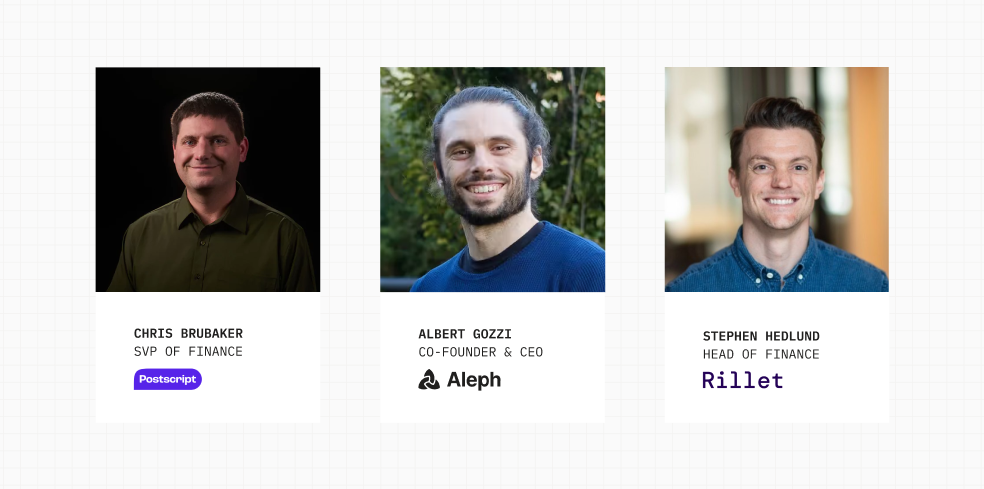
Join the Aleph and Rillet alongside Chris Brubaker, SVP of Finance at Postscript, who shares his journey going from the first finance hire to building an elite and nimble team.


Inside the journey
Unpack the evolution of the finance maturity curve through the lens of Chris Brubaker, who joined Postscript in 2021 as their first internal finance hire.
Hear the milestones and mistakes during Chris’s four-year journey—from inheriting a legacy finance tech stack and outsourced accounting to building and leading an internal, high-performing team across FP&A and accounting.
Hosted by Aleph and Rillet, this session will focus on finance team design, hiring decisions, systems evolution, and strategic shifts as businesses mature, and how finance at Postscript was able to adapt and evolve, supporting and scaling Postscript’s growth to $100M ARR and beyond.
Join in on the discuss to learn:
- When and where to build out your finance team
- Who your first hires should be and the playbook for sequencing them
- How the leadership changes as headcount grows, and the mind shift that comes with it
- How holding on to legacy tools for too long can hurt you
- Navigating investor and board relationships to build trust
- Looking back, what Chris would have done differently
- Advice for anyone looking for or stepping into a similair role
- Plus, much more...
Watch the webinar replay
Tune in to hear Chris's stories and reflections from the last 4 years of building an elite finance function that took Postscript to 100M+ ARR and beyond.
Chapters
- 00:00 · Introductions and joining as first finance hire
- 07:43 · Picking priorities and escaping firefighting
- 12:32 · Building the accounting and FP&A team
- 21:14 · Tech stack and leaving QuickBooks
- 23:55 · Finding community as a team of one
- 27:40 · Working with the board
- 32:05 · Advice for first finance hires and early mistakes
- 37:22 · Audience Q&A
Read the transcript
00:04 Yeah. First up, our host, and then we'll dig into the star of the show and get started. But, we got Albert Gozzi, CEO and founder of Aleph, and Stephen Hedlund, head of finance at Rillet. So, see change here from Nick who had to travel last minute, but, stoked to have Stephen here. He's gonna add a ton to the conversation. And, yeah, I'm gonna pass it on to you guys. We'll start with Albert. Just give us a big background quick background of yourself and the company, and then we can start digging in. Yeah. Thanks, Adam, for having me in your program. Albert here, cofounder, CEO of Aleph. I used to be a management consultant, worked with CFOs there, then I was CFO myself, and I had that early finance experience that Chris is having. I didn't scale that to a hundred million plus. So curious to learn from Chris here. And a little bit about Aleph, we're an AI native FPNA tool. We connect to a hundred and fifty plus data sources. We put on that all of that in one place. And then we let you work with that data, be it in the in spreadsheets, in the web app, and all with the magic of AI.
01:17 So excited to be here learning from Chris, and I will pass it over to Stephen. Hey, Hey, everyone. I'm Stephen, head of finance at Rillet. Spent my career in finance and accounting. So, started at Walmart on SAP, went to my first startup, did a QuickBooks and NetSuite, migration. Next startup, I was at Sage Intacct, and store story knew somebody was gonna fix it. All useful tools, but really dated. So I met our founder here about a year and a half ago and kinda said, where do I jump in? It's been a lot of fun. So so, really, it is the AI native ERP. You can think of it as if NetSuite were built today. So everything you love, multi entity and reporting and consolidation, with just faster implementations, native integration, so much faster to implement and cleaner data, and then AI native. So everything from natural language reporting to just really clean data that AI loves, frankly. So that's really excited to chat, more about it, but really excited to chat with Chris today. Chris is really one of the sharpest finance leaders I've met, but really humble, which is really rare in a finance leader, especially at a start up. So he's just really like a delight to chat with and learn from. Chris has really been at the finance game for quite a while.
02:26 Also, interestingly enough, has a JD in law as well. So maybe we'll get into that a bit. But in terms of background, he's been early finance and controller at various start ups, been an advisor to start ups, spent at Postscript almost five years now. In total, he's helped raise over two hundred million dollars in VC money. So really an incredible kind of background lot to learn from, and especially for Postscript has scaled it from basically zero as the first finance hire up to past a hundred million ARR. So kind of a dream that all of us in finance have to be able to do that for a for a company. So, Chris, really excited to learn from you today. So, yeah, Chris, maybe to start off everyone here, I think, knows Postscript and knows something with ecommerce. But what exactly does Postscript do? Like, set the stage for us a bit as we jump in. Yeah. So Postscript, we are, a usage based SaaS company where we provide marketing automation for online retailers, primarily in the Shopify ecosystem, and our main sort of vehicle for marketing is text messaging. With company was founded in late twenty eighteen, and we're backed by, Greylock and o one advisers. Cool. And then talk about so you came in as first finance hire.
03:37 Like, what did the finance function look like? Kinda where was the company at the time when you came in? Yeah. So when I joined, the company was, they had raised, their series b a six months prior to when I joined. And so they were at about a hundred and fifty employees, about fifteen million ARR, and we're scaling very quickly. And the finance team was nonexistent. There was, but they use an outsourced accounting firm, that we won't get into too much. Not a very strong accounting function. And, there was also, one of our cofounders was basically running the model. And, the model when I got there was revenue only, and it had a seasonally adjusted, at least, month over month growth rate that was just dragged out to the right for three or four years. Sounds like a good a good model. Never enough. You would be surprised how far those models get you. You know? I you know, part of the job for me is chatting with a lot of finance teams and a lot of people that jump into companies that have been maybe run-in a, in a very simple way.
04:45 And, yeah, I've seen those seasonal adjusting just trends, scale to many, many millions of dollars of revenue. Yeah. That's gotta put through series b. But, fortunately, I came in as they were starting to get ready for the series c, and that was about the time. The investors got a little bit more serious at that point. So Well, talk a bit about when you came in what was kinda first thing you did? Right? Like, even before hiring the team, how did you think about, okay, first finance person to see what do I do day one? Yeah. The day one was get to know the people. Right? You gotta understand who the team is that's there and what functions are they responsible for, how does, how does everybody work together. And then once you start getting a handle on who the people are, it's really figuring out how does the business work. Right? Understanding what drives revenue? How do we make money? What are the costs that it requires to make that money? So if getting a feel for the cog structure, we are a usage based company. And on text messaging, there's lots of variable costs. So really digging in and figuring out what drives that, how do we move the needle on that side.
05:56 And then also figuring out how does the sales motion work? You know? Especially in scaling SaaS startups, you have to really deeply understand the sales motion and able to both forecast accurately, understand what are best resources, and also how to support those teams. Yeah. Makes sense. Was it kind of you mentioned the model was, just kind of dragged forward. Was that kind of what you expected coming in? Was it better or worse? Did you know all this stuff coming in during the interview process? Yeah. I think one of the one of the biggest learnings that I had during this process was, to ask a lot more questions. You know, I asked a lot about revenue. I didn't ask a lot about anything else. So I knew how much funding they had, how much runway they had, what their what their revenue is looking like. You know, but I realized coming in quickly that COGS was actually gonna be a much bigger part of the job than it is at other software companies. And that's not something that's something I could have asked during the process and probably would have learned, but sort of just thought about it as standard SaaS. And so I thought it wasn't a wasn't a big question. And what were the main drivers of Cox, Chris, for the audience there? Yeah. So text messaging, with text messaging, you can't really directly integrate with any of the carriers to deliver the messages.
07:08 You have to go through what's called an aggregator. So like a Twilio, or an Infoket, those type of companies. And so just really understanding the nuance of how much it costs to send a text message, but not only that, the breakdown of the different costs by region, but there's different phone number types. And so there was just, there's this massive basically matrix of understanding. One message doesn't cost us the same amount no matter where it's sent. And so, getting a handle on that and being able to forecast it, a granular enough level that we could get accurate on our, COGS and margin forecast is really important. And one question there and one follow-up, Chris, is, again, you start, everything is a mess. Like, everything has opportunity to improve ten x. How I imagine that, the revenue forecasting, you talk about that. You know, now you're talking COGS. I'm sure that if you start to look at, even cash out, you're you know, why are we paying for all these invoices for things that we don't need? And, do we need more controls there as well? You know, how do you think about okay. You know, I need to start somewhere, and it sounds like COX was one of the things.
08:17 Was it like looking at the p and l and saying, hey. You know what? Like, if I move the needle here, it will make more of an impact that if I move the needle in you know, reducing our, SaaS cost on the engineering side. Was that kind of the way that you thought about it? Yeah. I think every business is different, but understanding where the biggest needle movers are and what is important in the market. Right? So we came in, and when I first started, it was twenty one, and growth was absolutely the most important thing. Right? And so yeah. Yeah. We can move some needle on cogs, but what really mattered was making sure we're making the right investments to drive pipeline, to drive closed ones, to drive increase in growth. Right? That changed very quickly in twenty two. It no longer became growth at all costs, and it became more like, how do you grow efficiently? And so that's when we started working on things like margin. We started working on, you know, sales efficiency methods. Right? How do we move the needle and make sure that we're not our paybacks aren't too long. Our cash conversion cycle is looking good. And so some of it is is the whims of the market, I guess. I don't wanna say whims because they don't they're not investors aren't changing their thought process on what a healthy business is every week.
09:31 But when there's major movements in the market, you have to think about what that impact is on your business and how that may impact your future fundraising, and exit opportunities and things as well. Yep. Yeah. Makes sense. I'm thinking about when you're kind of first finance hire, you said growth, all that matters kinda when you come in. We're at a similar stage now here at Realty. Like, we've got some traction, have a lot of customers. We've raised series a for Sequoia. Like, we exist in the market. And, also when I'm looking at my own work day to day, I feel like I'm just fighting fires all the time. Right? Like, how do I even think about like, I wanna get to some strategic point where I can start to think about my team, think about my tools, but when am I supposed to do that is is what it feels like with the calendar of the day. So how did you think about that early on even the simple stuff blocking time or finding time to start to think about thinking strategically? Yeah. And I don't know about you guys, but partners I like looking for scaling startups is the firefighting. There's gotta be some amount of that. Otherwise, things get a little bit repetitive in scale. But it's important to also know that if you're in constant firefighting mode, you can't ever get to a spot where things are getting better.
10:37 Right? You're just always figuring out what's next. And so it takes a really conscious effort to carve off some time to think about where can I start chipping away at the things that are gonna make the repeatable processes easier and also make some of the firefighting easier in the future? And so really dedicating that time to figure those things out. For example, when I give him a postscript, the first thing was we had to bring our accounting in house. Like, out external accounting just wasn't gonna work for us as we were continuing to scale. And so figuring out what that process looks like and what the tech stack needed to be, including things like, credit cards, banking platform, accounts payable, automation, even payroll. You know, we made a switch from Gusto to Rippling in my first nine months there, and that was an incredible change because Gusto was challenging at two hundred employees. But then on the FP and A side too, it's like figuring out making sure you have the right tooling so that you're not constantly going to pull new reporting. We actually fortunately met, a lot for really early on, and we were realizing that to do any sort of analysis, I was downloading reports from Snowflake, writing some SQL, figuring out, what was the what was actually the truth in Salesforce as we had a very, very small rev ops team back then.
11:57 And even pulling in stuff from, like, Gusto to get payroll stuff. And so matching all that together became very challenging. And so making sure you get the right tech stack in place so that you can spend less time wrangling data and more time automating your processes and also just doing the analysis can help you then carve off that that time to start building better processes for the future. Yep. Makes sense. We'll add that straight into our marketing collateral, Chris. We'll clip it, start paying you royalties, if it works out because I think you put it very nicely. Right back. And one of the things, that I think you touched on, right, was about, hiring and about bringing accounting in house. How do you think about, that transition from a team of one to a team of n, how to face the hires? Is there anything that knowing what you know now, you have done differently? I think I know a few interesting stories there, so we'd love for the audience to learn more about that. Yeah. So when we first started building the accounting team, I thought, we're a series c company at this point.
13:10 People don't want a controller. They think a controller is gonna be an important role, but I also need somebody who can operationally do the month end close process, things like that. So I hired a senior accountant and a controller basically simultaneously. In retrospect, I think that, a learning there is that it is really hard to hire both those roles at the same time. For me, I probably would have started with a senior accountant, get somebody in who can really do the day to day work of the accounting team. That would have allowed us to start offloading the outsourced accountant without also trying to establish a lot of forward looking processes at the same time. You know, I've I have the benefit where I've had some good accounting background. Not all, like, FP and A people are gonna have that same structure, and so you might need somebody more senior level on the accounting side. But if you have sort of the background or the time and, enthusiasm to learn how to run an accounting team, it's a great place to be able to actually bring in that first person who is gonna be doing the work. Yeah. When you kinda think about that first person, do you look for someone with prior startup background, prior big four? Like, what kind of profiles are you looking for?
14:22 What have you seen work well versus maybe now? Yeah. I've hired from both profiles. You know, for me, I think that the startup background can be extremely helpful. And so for that first accounting hire, I really do like hiring from a startup environment. My who's now my director of accounting, she came in as a staff a senior staff accountant, basically, but she had previous startup experience and just the culture of understanding what falls above the line and below the line for startup accounting, especially pre audit, is really important. But then, we eventually did hire somebody with a big four background as we were getting closer to our first audit to come in and really establish those processes, making sure that we had, all of our memos set up, our workbooks set up correctly. And it we move from how do we close the books in a way that we can run the business and pay our taxes and do the key things that accounting needs to do to how do we run an auditable business that's scaling and eventually ready for IPO. Yeah. Chris, we'll have to keep talking about the progression of after accounting, how do you do it and how would you do it.
15:34 Maybe quick side question, given you mentioned the audit. When did you start? You know, how was the decision of, saying, okay. Hey. We now we need to really step up our game. We should get started with audit. How big were you in terms of, revenue, company size, what prompted that decision? I think there's probably people in the audience that are starting to think about that. Yeah. Yeah. I'll say, we were in both a fortunate and unfortunate position where we negotiated well on when our first audit would need to be. And so our first audit was for fiscal year twenty four, when we had, nearly a hundred million dollars in revenue, which is kinda late for first audit. And so it had a bunch of its own challenges. That being said the timing is often external dependent. It depends on what your investors ask for, what your board ask for. And so understanding how do you build the accounting team for that timing is incredibly important. On the finance side of things, it's more like yeah. I would say for both finance and accounting, my go to mantra is don't hire until you absolutely must hire. And so just figuring out where are those bend and break points and how do you augment with software and processes along the way to be able to extend where those break points are.
16:55 And so I hired my first, analyst, in it's about eight or nine months after I started. And so that that was when I was really hitting the point where all of the work I was doing day to day became so that if I wanted to keep scaling up sort of the leadership side of my workload, I needed somebody to come in and do things like, BBAs and, run the OPEX model and things like that. And so that was my first hire there. I eventually brought in a second analyst more focused on go to market, which is a really great kinda short term hire. I realized that wasn't a long term need for that role. And then today, we've gotten to the point where I've hired a director under me to run FP and A, and he has two direct reports. And, Chris, maybe one thing that also different teams might slice the different problems in different ways. Maybe share a little bit about what's under your scope. I for example, you and I have talked a lot about, you owning the deal desk and that part rev ops. As you started evolving, those did those change hands, change owners?
18:10 And, if you were to do it again, would you own more at the start? Would you push out and hire leaders earlier? I think that's a lot of an interesting discussion. There's yeah. There's so many there's a lot of things that are clear cut finance, owned, but there's a lot that are in a gray area. Yeah. Analytics and rev ops are two very interesting departments. You know, we when I took over, analytics, it was like it sort of started out under engineering, but there was never really anybody under there. Then it was under rev ops for a little bit, and then so we ended up splitting it out and hiring a director. I think that was an extremely good decision. It could, in another world, have reported to our COO and then a completely fine opportunity as well. But finance is one of the biggest consumers of the outputs from analytics, in my opinion. And so having that close one to one relationship there has really helped make sure that we have rock solid financial information and can build the right path. It also being a shared service allows us to not over index BI to any one department. Right? If BI lives under engineering, it becomes a more heavy data engineering platform and is focused a lot on engineering needs.
19:24 If it's under ops, then it can often become an operational resource. And if it's under sales or marketing, then, of course, it's always focused on go to market, and you don't get any of the other stuff that you need. Yeah. And so finance becomes like a nice, a nice place for it to live, because I can kind of align the workloads and the roadmaps for BI with where we're making our investment strategies on the short and long range plan. RevOps, on the other hand, I think there's kind of two schools of thought there. It should report to the CRO or your head of sales or whatever that may look like at your company, which I think in a lot of ways makes sense. Right? They are often the ones that are directing the RevOps workflows and what that looks like. There's a full of thoughts within our finance. Right? Rev ops has a lot of forecasting. I'm partial to that. I like it under finance. Maybe selfish and biased, but I like it. Yeah. They do a lot of forecasting. And a lot of what they do directly leads into how we think about investing in the business and how we run the business. And so I think the key with having RevOps under finance is that your head of finance or CFO must have a very good relationship with the go to market teams. Because, otherwise, you end up in this spot where if they don't trust RevOps, then they're running their own forecasts and their own goal setting and comp planings a mess.
20:41 And so it needs to have a really strong relationship for that to work well. Yep. Yeah. The risk you run with it in finance is it can be very data driven and actually not be that helpful on the sales side and not be as helpful in driving the business forward, getting deals done, or you as CFO gets sucked into closing deals. And that's you usually skill set or best for the business anyway. Yeah. I was I was way too into deal desk until, I had my director about p and a year ago. Yeah. Makes sense. The just talking on tech stack for a minute. You said earlier, we were prepping for this. You moved off of QuickBooks probably too late, in the accounting stack. Kind of how did you think about tech stack, and what's your tech stack today? Yeah. I, so we originally were on QuickBooks, but we inherited that from our outsource accounting firm. The yeah. Also, then our tech stack today is we're on Rillet for our ERP. We use Aleph for our, like, FP and A tool, and then we have rippling for payroll, and we use, like, Brex for virtual cards.
21:55 We also do use Rippling for some of our a AP stuff. But we've simplified a lot of the tech stack, and then our CRM Salesforce, we use Snowflake, for, some of our internal data stuff. But those are kinda like the core data systems. We started evaluating leaving QuickBooks middle like, early to middle of last year. Basically, it got to the point where month end close was a nightmare with four entities in across three countries. And so we had four QuickBooks instances. It was it was causing pain with us trying to close the books in even six days, which was too slow for me. We wanna be able to run the business faster than that. And there was also all sorts of, like we have over twenty five thousand customers. They all get invoiced monthly, which is it's just it's way too many invoices to process in QuickBooks, and so reconciliations became extremely challenging, also. So we you know, I would say it was too late in that sense, but we also got the implementation done before we started our even closing balance prework for the audit. And so we did it, I guess, right in time. But I would have doing it again, I would definitely do it a little bit earlier.
23:08 Would you recommend it more like twenty five, fifty million? Like, when would be your recommended time? Yeah. I think it that used to be a much harder question. I think that the sort of scale up startup ERP space didn't exist very well four or five years ago. Right? Like, you're gonna go from QuickBooks to, like, Intact or Sage, Xero maybe. And those things made sense, but it was mostly, you were pushing off how long until you moved to NetSuite or GasID or something like that. I think now that there's an actual environment of true scaling ERPs that go from startup really core mid market all the way up to true enterprise and later, I think it makes a lot more sense to start looking earlier. Yeah. Yeah. I'm a little biased, obviously, but I think that too. Nice. Makes sense. And maybe taking one step back to the early days, Chris, something I think is very interesting. I was seeing the results to some of the surveys that the team was sending, and most people here are either teams of one or two or at most three people, in the audience.
24:21 It gets very lonely. And I think that you know, I have a lot of direct reports of mine that are teams of one today, and I am their peer, but, like, I'm not fully their peer. What do you use in order to stay connected, stay connected to other finance people, communities that you had, success being a participant in. Yeah. I know that's something that you're very active on, so we'd love to, hear more about that. Yeah. No. It gets it's definitely it's definitely lonely, especially before you start scaling up the team. This is my second first finance hire in a row, and so I spent, probably a cumulative nearly a year and a half as the only person in finance and accounting, across these two roles. And some companies do even longer than that, which is, impressive. I would say that the key one is making relationships across the company first. Right? If you really get to know the other leaders and everybody else in the company, it'll make you a better finance leader. It'll also make things a lot easier when you have to make hard decisions, just building those relationships super early. But at the end of the day, you can't really lean on the other leaders in the company if you have questions about accounting policy or about FP and A best practice. And so going out and finding some of those communities, there's tons on LinkedIn.
25:39 There's Slack groups, that I'm in I'm in a couple of those largely vendor driven, that I think Airbase has one. She Wiz has one. And so just participating in those communities is is really fun because you get to have resources you can bounce ideas off of. You get to see what other questions people are asking, which can be maybe not perfect for your stage. It might be something to think about ahead of time that you didn't think of before. And so, yeah, there's with Internet, and I think especially after, like, COVID, a lot of communities moved online, because there was less of that in office interaction. Yep. Yeah. Brian just dropped in the chat the f suite as well is really awesome. Oh, yeah. Ben Murray's, has a SaaS CFO, so that community that's really active. And then, a lot of times our investors have networks that somehow they don't tell us about and we have to ask about. So good to ask your investors if they have some kind of CFO network. Sometimes it's Slack community. Sometimes it's just email thread. But I found that to be very useful in terms of evaluating tools and even hires and just bouncing ideas off of. It is very lonely, this early stage.
26:51 I've been surprised what even this week, I had a few calls with some other early, startup folks. I expect it to kinda be a waste of time. Like, they're not clear partners for us or something, but it's so refreshing to just be like, oh, you're really stressed too. Yeah. I'm really stressed too. Like, just to be able to share the load a bit actually helped me work better the rest of the day and the week. Like, it was thirty minutes well spent, even though there wasn't anything productive that happened in that time. Like, I think taking time to share some of those struggles with folks really makes a difference and kind of does absolute grind of the start up culture. Yeah. Absolutely. One of our investors did a matching program, that they basically like, once a month would match you with somebody either same level, different function, same level, same function, or different level, same function, across the portfolio companies. And I met just a ton of really great people that way, learned a lot of new things, and stay in contact with several of them to this day. That's awesome. Kind of speaking on relation on investors, Chris, how has your relationship with the board changed over time? Kind of thinking both first coming in, were you reporting to the board directly in board meetings from day one?
27:59 How did that change? What is it like today? Yeah. So I didn't initially report to the board. I started, attending to and presenting to board meetings a year or two years ago. And it's been a kind of a learning process. You know, I think as the company continues to grow, they wanted to hear more directly from finance specifically. And so really learning about and as we brought in new investors too understanding how does the board dynamic change, what sort of things are you looking for, and really learning how to both tell the story of the company performance as well as what's going on in our long range planning based on the industry and macro trends that we're seeing. Yeah. It also changes based on the specification of your board too. Right? I did board presentations the whole time when I was at a, was at a company from pre c through series b. And, just seeing what those early board meetings were like compared to what they were like much later when there were more sophisticated investors and more, more established board members was it's just you just have to kinda fill it out and keep those relationships going. What are some of the key things you do now in prep for board meetings that feel like massive unlocks for you? Yeah.
29:15 We've gotten it's become much less of a scramble, as we've gotten our timing down. We used to do a board meeting somewhere between twelve and fifteen business days after the end of the quarter. And so it used to be just an extreme scramble to get closed, get the data, get the deck put together. We managed to collapse our close down to about three days, and then FP and A close takes about another one business day. And so we actually have a real time to do more narrative building. And the other big benefit there is that, we use the pre meeting sometimes. Right? Sometimes it's really good to preview what's gonna happen in the board meeting individually with board members, and having the time to be able to do that and get feedback ahead of time so we can really center the board meeting and make sure it's a really productive discussion that helps add value and drive the score. I think, Chris, maybe one of the biggest flex about your tech stack and the setup that you build is that we're on business day number eight after closing the quarter, which means that probably you have BOD meeting around the corner, and you're here spending time with us instead of scrambling. So I think that that's the biggest flex is that, you don't need to be, putting long hours because you've set up the right processes there.
30:27 Yeah. Even with the fourth of July holiday weekend, we are we're closed. We have our I've we've already presented, financial results to the our team, and we're in board prep already. Yeah. So so if anyone here on the chat is struggling with board meeting prep for q two, you can come over to the right side and do what Chris does. I think that's great. And maybe that's a also a good plug. Chris is a second time, I left webinar, panelist. The prior webinar that we did was actually about board meeting prep, and it was like a forty five minute long discussion, with Andy, with Even App. So maybe, someone, Adam or Lucas, maybe you can put the link in the chat for people to check that out, just so I don't ask all the same questions to you, Chris, again. So I think, some of those will be covered there. The Oh, good question from Brian in the chat there. Do you do board notes, board decks? Like, what's the actual format you use for the board? So we use both. So we have a sort of a consolidated board deck that we use to run the meeting. And that's what we'll send it out forty eight hours ahead of time so they can look through the slides, and then that'll be what sort of grounds the agenda for the actual meeting.
31:48 But we do board notes as the actual prep for the meeting. And so we try and send those out about a week ahead of time so they can actually read through it. And we do those on a sort of a vertical structure. So there's three board pre reads, one for g and a, one for s and m, one for PDE. Yeah. Nice. Like that. The maybe thinking more kind of we'll go to audience questions soon, kinda open it up. But I'm thinking maybe two pieces of advice here, two questions. One what advice were you would you have for someone taking on their first head of finance role at a start up? And second what advice do you have for someone who wants to be the first finance hire at a start up? Like, what do you have to do to be in a place to do that? Maybe we can break those up, but that's what I'm thinking. Yeah. Let's start with if you want to be. I think that if you want to get to that first finance hire type of role, it's trying to learn just as much as possible from the leaders you work for today, is incredibly important. Right?
32:52 Make sure you get those opportunities to do some of the early stage things. But, eventually, if you want to be a first finance hire, you need to get early stage experience. And so, it's much harder to jump from a Fortune five hundred company finance senior analyst role or the manager role to a first finance hire because the environment and the pace are so different that you're just not gonna find a lot of people who want that. And so, taking the plunge and jumping to an early stage start up, even if it's not the first finance hire, can be a really enlightening experience. And then it gives you sort of the grounding to be able to do it as the first finance hire. You know, advice for when you are the first finance hire, I think the two big things are you have to be humble and you have to listen. Right? You know, coming into a business, there's a bunch of stuff established. And so in order to be somebody effective in the finance role, you have to deeply understand the nuances of the business. I think that's true across all companies. And the best way to do that is really just strap in and talk to everybody as much as you can and get a feel for it.
34:00 Spend a ton of time with the founders and understand what their vision is for the company, why they built things the way they did, and what they've seen as both positives and the challenges so far. And then the other thing is be willing to spend your time learning. You're not gonna know everything as a first finance hire. It's just not possible, and things are gonna come up. And so using those communities, using your resources to learn and ask questions and not hesitating to ask for help when you need it. Because it's incredibly important also that we're gonna make mistakes, but not making big mistakes and knowing how to immediately and quickly correct for any mistakes is essential at this stage. Yeah. Any early mistakes you can share? Let's see. Not implementing real fast enough. That's one that we already talked about. So There were we ran into some issues with commissions once. We did not have a good process in place for calculating commissions. And so we had, we had a fundamental flaw where something broke in our data pipeline and we didn't notice it, and we didn't have the right checks in place.
35:21 And so we actually ended up mispaying an entire commission payroll run-in both directions. Like, some people got underpaid, some people got overpaid. And unwinding that mess was just a disaster. Right? We are able to quickly remedy it and make sure people's paychecks were fixed. But you don't ever wanna be you don't ever wanna have to send a type of payroll around five days as extra payroll in five days late. You definitely never want to have to pull money back from employees if you can avoid it. And so, that was one that I learned that we you really need a good process to check things and make sure that there's a strong vetting even if even if you need to find somebody in a different department to help with that. Right? If you're the only finance person and you have to run all this, say hey. Maybe your partner in HR. You're like, I'd really love to have just a second set of eyes on this. You also see the payroll run every time. Like, take a look at this, see if you notice anything, but also just building in the general checks and everything that you should be doing. Yep. Yeah. Makes sense. I wish I could say I've always paid commissions out correctly, but that would be a lie. So I empathize. True. Comp plans is also clutch for that.
36:36 Like, making sure that you can have it documented and can point to exactly what it's structured as. Yeah. And consistent across folks is good too. I find that often is an unlock for almost everything across the business. And sometimes it's very hard because often finance is not the driver of business process, and for better or worse. Right? Like, sales has to close a deal, close the like, whatever. So they wanna structure this deal a certain way and fine. Maybe that's the right thing for the business, but often this has very negative impacts downstream for finance. But kind of building the process when we have a mandate, especially on commissions or something, can make mistakes like that a lot more rare when things are simple and clean. Or maybe we can jump to audience questions quickly. I know we're coming up on time here, and there's quite a few good ones in here. I wanna start with one from the top. Maybe, Chris, start with you. But as you scale teams, how did you balance growth and automation of workflows across all the aspects versus growth and headcount? I think it's especially interesting now with AI and automation and new tools. But how did you think about that both maybe early on and now? Yeah. I think I maybe it's overly rudimentary, but if it's cheaper to use a tool, then hire person. I will always try that first, with the caveat that there are some things that you can't take the time to figure out how to fully automate.
38:02 Right? Billing ops was a big one for us. Like, we were having a you know, we were collecting only ninety two percent of our invoicing. And once that became a clear issue, it was like, okay. So we can invest a bunch of time and resources into building out this automated process. That's the right decision long term. But how much how many months are we gonna waste in that time? Right? And so I went ahead and said, okay. Let's pull the trigger on it. We're gonna hire a human being to run, basically AR, making sure they're contacting customers who are paid, getting accounts cleaned up if they're not being invoiced correctly and stuff like that. And we've worked over the last year and a half to rebuild that, kind of the automation and the workflow now. We still have plenty of work to do for the human being we hired for that, as we scale, which is it ended up being a nice, benefit that we had that role. But, I think trying to hide to automate first is the general default, but sometimes it's gonna be a lot quicker and a lot more impactful to hire somebody and then figure out the automation later. And maybe, Chris, there's one related question that maybe we can do next, here from Matt.
39:21 Are there industry benchmarks or standards that would support a case for expanding our finance team as our company grows, and any data demonstrates finance staffing levels relative to company size or growth rate. So maybe I talk about how much do you think about that and external benchmarks versus, just, we need we need to solve billing ops, and we're just gonna make the case individually. Yeah. Maybe talk a bit about that. Yeah. I mean, industry benchmarks are lagging. Right? Like, they don't predict the future. They just tell you what's happened so far. And especially right now, there's a major paradigm shift. And so, we look at the benchmarks. We don't ever wanna be above the benchmark. But I don't think a benchmark is permission to go spend money. I think it's I think you really need to look internally about what your business case is, what support you need, and use benchmarks as a ceiling, not a guide to how much you should spend. Yeah. Makes sense. Good question here from Christian and don't need to speak to a little left, but thinking more like tech stack in general how do you evaluate vendors and decide which one is the right one for you?
40:32 Especially, it feels like in a lot of buying processes, it's hard to differentiate until you really get your hands on the tool. How did you think about that? Maybe we're a little less of helpful, but just in general, what's your framework? Yeah. I think there's sort of a couple ways to approach buying tools. One is figuring out what tools you think can augment your process and your stack and doing POCs to try them out. Right? That's how we've come across several of our tools. We've been early into companies that are trying to launch something. And, being a part of that early process helps you see what their road map's looking like and how you can shape that. Like, Rattle, for example, is one of our favorite tools. And we were super early on with Rattle, and we've ended up being able to scale that pretty infinitely. When it comes to more established processes that you like, rip and replace is a very different evaluation than adding a new software. Standing up a net new process look like, because then the investment decision is different too. One, you already have budget, and you may be willing to pay a little bit more for better future sets. One, you have to justify the investment altogether.
41:45 Is spending this money going to make going to save us money? Is it gonna give us capacity to drive the company to more revenue? Whatever it may be. But it's also okay to try things out and then not work. That's okay. You know, we've tried several softwares that we thought would make a big impact or we thought could, drive an ROI on them, and they haven't. And so just make sure you structure your contract in a way that you can get out of this. And I like oh, so I like that framework. I'm just like, everything is fixable. Yeah. It's I guess Jeff Bezos has a framework of is this door decision we can walk, back down, which is helpful. But it's good to remember, especially in startups where every decision feels hyper sensitive and important, like you're gonna break the company. And sometimes that's the case, but, normally, everything's fixable. Yeah. We use that framework all the time. Like, one way doors take a lot more scrutiny than two way doors. And so we try to avoid walking through one way doors unless it's for sure conviction. But even moving from QuickBooks to Rillet, if it didn't work for whatever reason, I wouldn't call that a one way door.
42:53 It would have been a massive pain to migrate in ERP a second time within a year. But, I software decisions can always be fixed or undone. Yeah. Yeah. Thankfully, it was one way to win that case. Now it's fine. Yep. Okay. Very good now. Chris, wanted to do a quick follow-up into something that I think where I think you're, maybe on one extreme of the market that is how willing you are to work with very, very small teams. And I'm talking, teams of five people just hacking away on an idea. Again, I think it's very different to evaluate those than it is to evaluate now, or, that are much further ahead as a company. How do you know, when it's five dudes in a garage how do you go about evaluating? Is this something good to, connect my financial data? That's a lot of security implications, spend time and energy with them when the odds the market odds say that they will likely not work out. And, again, you were able to pick Aleph and we're still around.
44:02 Right? Like, how you think about that? And it's almost thinking more as an investor than a than a finance leader in some way. Yeah. I think it really depends a lot on the how critical something is. Right? I'm much less likely to pick a very early stage start up or something that's customer facing, that's present in our product, or drives a critical process that could cause us to not be able to generate revenue, not be able to service our customers. Right? And so from that aspect there's lots of things on especially from the business process and internal operation side of things that we're very comfortable going super early stage with because it's trying to solve a problem that we haven't found another solution for. And in that sense, it's more experimentation at that stage. Obviously, you still wanna bet the companies and make sure that they seem to have good stability because the only thing worse than solving a problem is solving a problem and then having that solution shut down. But I think it might take it makes a ton of sense to take bets on some early pros early companies. You can also usually get them for relatively cheap in order to, like because they're early stage, they want the user base and they want the thought partnership. And so you're not risking a ton of money generally to get in early.
45:19 Chris reminds us that every renewal that he was one of our first fifteen customers, and we still happily give you give Chris the discounted price even at the scale. So, that's always it's a long term, long term moat in some way. Mhmm. That that's very good ROI at that point. Yeah. For sure. May maybe one that is interesting, going back to some of the board dynamics here from Leonard, how involved have you been with fund like, the funding of the company and raising money, and how has that changed over time? You know, you talked that you were before series c, when you first, joined. How involved were you in that process, and do you end up getting more involved as time progressed? Yeah. I think that one's super dependent on, your founders, basically. If your founders are highly experienced fundraisers, then you may end up being somebody who is not involved until they start digging into the real financials. If a founders is is, more green, hasn't done a ton of fundraising experience than you have, then you may be in those rooms from the first conversation.
46:33 And so, my very first fundraise was at a startup over ten years ago now, that our CEO didn't want anything to do fundraising. And so I was the a senior analyst. It was just me and the director of FP and A pitching to VC firms, which was a very weird dynamic. I wouldn't recommend that. But I think in a lot of ways like, finance can drive a certain extent of fundraising, especially earlier stage. But investors aren't investing in your growth rate or your path to profitability at series a, series b. They're investing in the founders, and they're investing in the vision. And so, finance is gonna take a back seat. As you definitely get into that series c plus stage, the financial become important. Right? Because now they're not trying to get three to five x return on a couple hundred million dollar invest or valuation. They're trying to get a two to three x return on a multiple hundred million billion plus valuation, and that becomes much harder to do if you don't have a clear financial picture. Yeah. It would seem also a massive red flag to me as an investor to not have the founder or CEO in those discussions.
47:45 Like, whoever's gonna be leading this business is not the one I'm talking to. Do these finance folks have any authority to do anything? Here. Math. The founder needs to kind of drive that vision all the way through. Yeah. My company didn't make it very long. Yeah. You know, people shouldn't go to your LinkedIn, Chris, to check the company. So we'll keep it, private. It's fine. It's been it's been closed for eight years. Makes sense. Let's maybe see I know, Stephen, if there's any that you wanna, do you have your very self serving there's one very self serving question about what about really convinced you that it was the best option? That's good. And maybe the right way to frame this is the default for literally the last decade has been NetSuite. Right? Like, whether we like it or not, I'll get inspired for buying NetSuite. Like, it's no surprise there. If I was going back into traditional finance role, like, I would look at NetSuite. Right? You know? Or Sage. Yeah. But what convinced you? Without pitching us too much, I don't care. Right? But what convinced you that Rillet was the right fit for you guys at your stage? Yeah. For us, we had some grace because we have some timing. Right? Like, we're currently we're not gonna go public in the next twelve to twenty four months.
49:01 Right? Especially with the backlog of large successful public companies or private companies that still need to go public probably before we get there. And so we had a little bit of time, and we know that we didn't need to make the perfect decision right now. Like, we had room to take a shot on something that we thought had a ton of promise, and we thought it would be much better for our business, which was a very fortunate position to be in. The other thing was just thinking about, my previous experience with NetSuite. You know, I've run NetSuite migrations before. It sucked. It takes way longer than you expect. It costs way more money than you expect, and we were on a timeline. We wanted to get done before we did our audit, and we knew that there was no way we are gonna hit it on that suite. It doesn't matter that we they told us they could do it in four months. They wouldn't. It just it just doesn't it doesn't happen like that. And so I think those are two the two biggest things that gave me the comfort to go outside of the easy decision, the don't get fired decision. And then we did evaluate a lot of different platforms. For us, we felt really good about Relay because of the vision that y'all have and the accounting expertise you have on staff, which I think is a part of what differentiates from some of the other players in this space.
50:16 Yeah. We get a lot of good marketing juice out of that built by accountants for accountants, but, thankfully, it happens to be true. Yes. And I think it actually makes a big difference. Like, when the people who know the pain points build the tools, it's a big deal. Nice. Cool. There's been awesome. Chris thank you very much. Albert, any anything else you wanna add or maybe, Chris? Like, any parting thoughts? Like, maybe in with what's the best piece of advice you've gotten from a mentor either, like, CFO on finance or maybe just on startup kind of scaling in general that you either come back too often or sits in the back of your head all the time? I mean, it's it is extremely basic, but basically, I learned from one of my earliest FP and A mentors to always be learning, and that FP and A impacts the entire business. So that means not learning just about FP and A or just about accounting. It means learning about everything that goes into driving and, running business. Right? And that mentor went on to found a YC company or a company that got into YC. I was an adviser for them for a while, and so we maintain a good relationship. But it also meant that, like, I can use him, and I can use other people I've met and continue to build my network and learn from everybody that I can talk to.
51:33 You know, it's I love coming on these things, but I also love attending these types of webinars too because you get to learn a ton of, just turn the information. You can see new perspectives. And I think that's gonna become even more important over this next couple years. Right? Like, I'm not one of the, like, AI doomsdays. It's gonna replace all accountants in the next twenty four months, but, I think it is gonna make a major impact on you know, if in AI is not gonna replace accountants, but accountants who know how to use AI are gonna replace accountants who don't. Right? And I think being able to make sure that that that applies to everything. That applies to all new tooling. It applies to all new processes. It applies to new tax codes and stuff like that too. Just always be looking to better yourself and continue being at the top of your game. Yeah. Makes sense. In our interview process now, we ask, how are you using AI today? And if you're not using it, that's at least a yellow one. Yeah. Yeah. Agreed. Chris, this has been awesome. Thank you very much for sharing thoughts and insights and journey and even being vulnerable on mistakes and sharing those.
52:37 We especially on LinkedIn, we share a lot of the highs and make sense. Fair enough. But it's nice to dig into some of the troughs as well. So thank you very much for coming on. Yeah. Thanks for having me. It was really fun. Yep. Thanks so much, Chris. And just a reminder for everyone, we will send out the recording. There's a feedback survey anonymous when we when you exit out. We'd really love your feedback, to help us improve these and bring more topics and speakers to light. And yeah, thank you, thank you everyone for attending. Thank you, everybody. Happy Thursday. Thank you. Let's see.