Scaling your specialty finance function in the age of AI
Aleph, Scalepoint, and ZRG break down the stage-by-stage org design playbook for founders building lending and financing businesses.

Inside the session
The rules for building a finance team were written before AI. They haven't been rewritten yet.
If you're running a lending business, a leasing or asset-based lending company, or you're embedding a financing product into your core offering, your finance function is more complex than your SaaS peers and your org design decisions matter more. When do you bring in a fractional CFO? When does a fractional stop being enough? And how does any of that change when modern tooling means one person can do the work that used to take three?
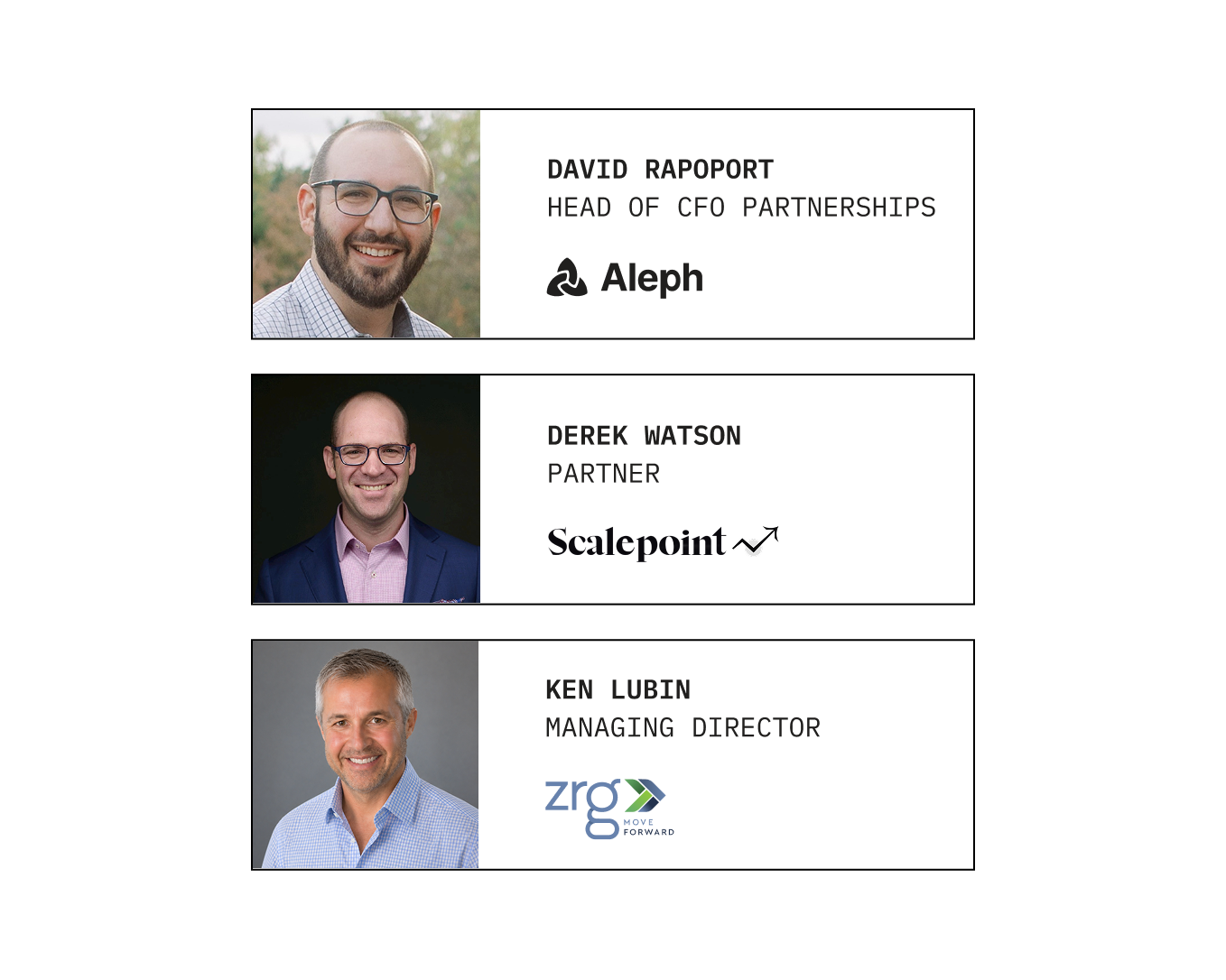
David Rapoport (Aleph), Derek Watson (Scalepoint), and Ken Lubin (ZRG) compare notes across hundreds of fractional CFO engagements, executive searches, and FP&A deployments inside specialty lending and finance businesses. They'll map the org from pre-seed to Series B and call out what AI actually changes, and what's just hype.
Designed for founders, CEOs, and operators building lending or financing businesses, Seed through Series B.
Join in on the discussion to learn:
- A stage-by-stage org design map for finance, from pre-seed through Series B and beyond
- How to know when a fractional CFO is no longer enough
- What changes at Series A and why FP&A becomes the inflection point
- How modern tooling is shifting where and when finance hires create the most value
- What to look for when making the in-house CFO or VP Finance hire
- The honest truth on AI in finance: what's hype, what's working, what founders should ignore
- How a fractional CFO with the right tools can take on six or seven clients instead of three
Plus, much more...
Join the webinar
Register to see how operators are rebuilding the finance org for lending and financing businesses, with live insights from David Rapoport (Aleph), Derek Watson (Scalepoint), and Ken Lubin (ZRG).
Chapters
- 00:00 · Welcome and panel introductions
- 03:20 · Biggest mistakes in building a finance function
- 09:58 · Fractional CFOs at pre-seed and seed
- 14:41 · FP&A at Series A: who to hire first
- 17:50 · Hiring a full-time finance leader
- 30:46 · Fractional CFO fees and CFO compensation
- 36:43 · AI in finance: what's real and what's hype
- 42:59 · Closing thoughts from the panel
Read the transcript
00:02 Good afternoon, everybody, or good morning or good evening, depending on where you're joining from. We will get started in about a minute or so just letting people join. Hope everyone in this week is off to a good start. Good. So why don't we, get started? Good afternoon, everybody. My name is Rahul Kapoor. I lead the fintech practice at CRG Partners. Really excited to host this webinar today. And to moderate this, we have three great experts to talk about the evolution of the finance function within specialty finance and specialty lending. It's a topic that we're all having a lot of conversations with our clients about, particularly given the rise of AI, given the fluctuating capital markets and operating capital availability.
01:18 So we're really excited to have this discussion today. I'll let the experts here introduce themselves, but we have David Rapoport, who's the head of fractional CFO and advisory at Aleph. Derek Watson, who's a partner at ScalePoint, and my colleague, Ken Lubin, who's the managing director and leads a lot of ZRG's work in the specialty finance space, from ZRG. David, I'll turn it to you first to do a quick introduction of yourself. Awesome. Thanks, Rahul. Thanks, everyone, for joining. I'm David. I lead this fractional CFO practice here at Aleph. We're an AI powered FP and A tool, and dedicated to helping teams, finance teams scale and grow effectively by helping them streamline their internal operations. Real excited to be here today, and I'm based in Austin, Texas. Derek, I'll kick it over to you. Thanks, David. Yeah. Derek Watson. I run the fractional CFO practice at ScalePoint Advisors. We provide fractional CFO and capital markets advisory services to early stage lending businesses, think series c, b, that, don't need a full time CFO on the team, but need that expertise because of the business model complexity and also the debt complexity that comes with, lending based businesses.
02:37 Yeah. So pass it over to Ken. So Ken Lubin here. I've been with ZRG Partners the last twenty five years, focused placing senior level executives in the specialty lending, marketplace from equipment finance through fintech, through crypto based crypto based money. So anything sort of specialty money is is the market that we play in, but now we're seeing the rise of AI and the importance of the CFO using AI and the FP and A function with AI. So really looking forward to chat with everyone a bit about this and what we're seeing in the market and what you're seeing in the market. Great. Thanks, guys. Great to have all of you. Why don't we start with the big picture? And every founder in the audience right now is making finance organization decisions based on playbooks that were quite honestly written before the last two years in particular with the proliferation of AI and just, how much foothold that's taken to replace some of the things that we traditionally did by hand or by human interaction.
03:45 Before tools like Aleph existed, before fractional CFOs were a default option. So let me put the question to all three of you. If you were advising a founder today in twenty six on June sixteenth, what's the single biggest thing that they're getting wrong about how to build their finance function? Derek, I'll turn to you to start. Okay. Well, I think it honestly depends on what stage the business is is at. Right? So earlier, I think, index with probably, I would say this, wouldn't I? But, fractional CFO help to get your model up and running, do your fundraising, to get your first credit facility up and running. And then as the business progresses through the stages, product is launched, it's scaling, that's where things like AI tools and David space come into a bit more. But at seed, maybe even A, I think common mistakes, probably twofold. One is maybe leaving it a bit late to bring in expertise and kinda taking it as far as maybe the a CEO type figure can take it.
04:56 But then that often misses critical nuances that build up problems for later, especially when it comes to operationalizing a credit facility, managing the covenants, managing your cash flow. So that's one side, leaving it a bit late. But then the other side is taking it the other way and probably going a bit too hiring too senior too early. And then you have an expensive resource that's maybe not fully utilized, that potentially also creates a bit of a top heavy org chart a bit too early in the life of the business. And you can have, too many cooks spoiling the soup as it were. So yeah, when I think about what we see often at the earlier stage, it's either leaving it too late or going or taking on the, know, too large and expensive for resource too early. And, Ken, what that's it's a really great point about too large too early. Ken, from your perspective, from an executive search perspective, what do you see is kind of what the mistakes are that people are making today or what people have made, in the light of AI and other factors?
06:08 Well, I think too. Right? I think the importance of and like Derek was talking about is getting too hop too top heavy too fast. We've built businesses from the ground floor and even before AI, really, finding someone who's a functional VP of finance. Right? Find someone who understands the FP and A function. Someone early on who's much more hands on. And I think really going from the fractional piece to the permanent piece, that could be a unique play because if you have a fractional CFO who's a bit more senior, they could hand off the tools that they've known to someone who's a bit more junior who could then ramp up. So really, I think a lot of people have been seeing the big the big dollar swallow is not really where it needs to be early stage. I think that's later stage type stuff. And with the with AI becoming more and more incorporated, I think the second tier, the VP of finance, the directors of finance, those are actually the ones using AI much more than, say, a typical CFO is using it because they're much more in the weeds in the day to day operation. Right? So you've gotta sort of find the perfect you gotta find the perfect, combination of what works and what doesn't work based on timing is typically what we're seeing right now.
07:27 And, David, that's interesting from your perspective. I'm sure you're seeing in different way given the angle you come at from the technology and the AI side. Curious as to what you're seeing as what's working and what mistakes people are making right now in terms of building their finance organizations. I think first, like one of the biggest things that we see a lot is that the playbook that maybe founders and VC and funds were using three years ago, two years ago, in terms of like, when we reach X milestone, we're gonna bring these people on. Like that playbook has completely changed. And in a really wild way where, know, a lot of firms would like raise their series A and then it's time to hire a VP of finance. We're seeing a lot of firms move, a lot of companies move a lot later in the journey because of all the tools and the automations that the internal companies can do themselves. So I'd say like the playbook has changed a lot. And then maybe Ken, to the point that you were saying is like, what we're seeing is that the expectation is that everyone is not just a leader and a strategy person, but everyone ranging from the CFO down to the lowest level analysts are the ones that are actually getting their hands dirty because that's the expectation of not just do you know our business inside and out, but how are you testing a new workflow?
08:48 How are you helping automate something? How are you helping us improve our operations? And that really starts it all the way from the top down as well as bottoms up. And so I challenge that a little bit in terms of like, I think the most impactful CFOs that we're seeing today are actually the ones that are driving the organizational change forward and pushing the AI adoption, really saying, how do I not go hire that next person because I've just done this entire workflow end to end with the help of AI in a way where I used to have to go spend and then hire that next analyst. So I'd say the world is changing and it feels like if we did this webinar three months ago, we probably would have had very different answers. And that's like the fast pace of change that we're seeing. And the best organizations are the ones that are really like on the cutting edge of how do we continue to improve operations day in and day out. Great. Thank you. Before we move on, just a reminder to the audience, there is a q and a button. If you would like to submit any questions that our panel can speak to later, please put them in and we'll work them into the discussion.
09:58 I wanted to turn back to the pre seed and seed in the fractional CFO era. And Derek, you've run ScalePoint's fractional CFO practice, worked across dozens of specialty finance companies, and a plug to your book, which I'll let you plug. The data in your book is pretty clear. Pre seed and seed, there's almost always a fractional CFO, but not a full time hire. But there's a wide range of what fractional really is. Some people think of interim. Some people think of truly twenty, thirty percent. Some people think of their fractional and end up being full time anyway. Walk us through what a great pre seed and seed engagement actually looks like, what the founders should be getting for their money, and what the early warning signs are that their fractional CFO is the wrong fit because often that does happen. Okay. Yeah. I think, rather than anchoring it in things like, a set number of hours or, is it interim or part time or whatever, it's more important to focus on the actual deliverables that the client needs at that time, right?
11:05 And the deliverables, change over the course of the as things progress through the stages, right? I think it precede really the role of a fractional CFO or a finance advisor is kind of anchored on the financial model, right? The financial model that's needed for the fundraise. Oftentimes, we see founders that are coming into this lending space that are not coming from a financial services background, right? So their financial modeling, it might just be a little bit too one dimensional for the type of product and business that they want to launch. And I specifically focus on really the debt and the cash flow aspect of it. Everyone can build a P and L, right? You don't have to be a CFO caliber person to build a P and L forecast. But where it gets tricky for lending businesses is the balance sheet element, right? Like you're gonna have a credit facility, there's gonna be haircut capital. And really dialing in your fundraising journey in terms of, how much debt are you gonna need and how much equity are you gonna need and when to support that volume that forecasting. And that requires just a little bit of understanding of the additional nuances.
12:18 Thanks for the book plug, we've released a book called Technology Enabled Lending that kind of covers those additional things, right? So everyone or many people, good generalist founders, good entrepreneurs, but there's a few additional nuances for lending businesses that people should know, right? There's the capital markets. There's the more complexity in the finance function. There's credit risk. There's compliance, BDM partnerships. So we do cover that. And back to the question, early is sort of the model. Then once some fundraising gets done, things are starting to take shape, it migrates a little bit into making sure the finance infrastructure, the foundational level is solid, right? So, some good accountants that know that type of business model, a really good structure of, chart of accounts in the P and L and balance sheet, kind of laying the groundwork so that, problems don't build up in the future, right? It's like looking ahead. And a lot of it is just kind of rinse and repeat, these, once you've done this a few times, you kind of know where the challenges are and it's our job as advisors to help clients get ahead of them.
13:31 With regards to how things evolve and back to the AI discussion, I think obviously at the seed and pre seed stage, AI doesn't really come into it. You might use the general tools for your research. But I think once the finance function starts to evolve where there's more work to do, there's more analytical work to do, more FP and A type work to do, that's where the equation really changes because in the past, you might, okay, think that's when we need to hire a VP of finance and kind of sunset this fractional CFO. But I think now you could probably hire like, an FP and A specialist who's armed with tools like Aleph, and they can do they can be so much more effective. So in that early stage, the kinda step change for building out the leadership org is more of a is more of a smoother ramp, I think, with the tools available. K. And then that brings them to series a, which, David, I'll turn to you.
14:41 The FP and A inflection point is certainly something you've seen on both sides of this is you ran FP and A with Graphite a Graphite with seventy clients since fifteen staff under you. And now you're inside Aleph watching how finance teams can deploy modern tooling and AI at this stage. And there's an old playbook that says series a is where you make your first FP and A hire. Wondering if that's changing because I'm hearing from a lot of founders that that math has changed. What's actually shifting at series a right now, and how should a founder think about the FP and A function and hire when a fractional CFO with the right tools can do a lot of what used to take a full time analyst? Yeah. Think where I'd like to start is that for a lot of companies, series A was really where you were proving that you have a product, you can start to develop a go to market motion. Maybe you're starting to get kind of like some momentum as you get into your series B fundraise. And that was really kind of the deciding factor of I need somebody that's gonna help me be more hands on, be more in the business day to day than a fractional CFO may have been. What we've seen is that a lot of companies are a lot earlier on in their journey finding product market fit, getting customers.
16:00 And so we see this kind of like divergence in company stages where like the old series A is actually probably a lot more of like seed stage of it's easy to get my product to market, maybe a little less so in like the capital markets lending side of things. But then what we're seeing on the other side of that is like a really heavy reliance on what Derek was mentioning of like that functional experience where that first VP of finance that you might have hired before was kind of a generalist. They were gonna do your financial model. They were gonna oversee the accountants. They were maybe gonna help them to fundraise, but maybe they don't have that really deep capital market experience. And so we agree with Derek where maybe that barrier to entry is not like a VP of finance first. It's an FP and A manager. It's a really good and young kind of senior analyst that has done it a little bit in their career, but with the right guidance and support from a fractional CFO can actually grow into that VP of finance or director of finance over time with the guidance and support of knowing how to negotiate debt covenants and how to negotiate lender agreements that you only kinda get when you have seen it and done it multiple times in your career. And a lot of times that are an early stage company, you can't afford that.
17:13 So we see this really interesting split of like companies are getting traction a lot earlier on, which is forcing kind of this do I do about my staffing to make sure that as a founder you're getting the support you need? But then also how do I have enough hands on ground and that somebody is deeply entrenched in my business to know how they can be helpful and strategic as we roll out a new product and we want the right metrics and they wanna work with the marketing team. And so we're seeing this really interesting split in the market where, that the VP of finance in an early stage company is moving a lot later in the journey. That's interesting. And that probably gets us to where they really move as it's in series b. And I'll turn to Ken. Ken, you and I have shared lots of war stories about Okay. You know, the good or the bad and the ugly. But you've placed, as you mentioned, twenty five years placing finance leaders at growth stage, specialty finance businesses. You've seen what happens when founders nail the in house CFO hire, but you've also seen the other side where it hasn't worked.
18:22 And so two it brings up two questions. One, what's the trigger that the founder is motivated by that sees that it's time to sunset fractional or even interim and bring in a full time CFO or VP of finance, to David's point around it's coming later in the cycle. But what is that trigger? And then secondly, what's the most common hiring mistake you see founders make at this stage and the one that's burned the companies that you've worked for from a senior finance, whether it's a VP of finance, head of FP and A, or a CFO hire? I'll start with the second question first. Right? Because that's, talking about war stories. And as we all know, there's plenty of war stories in this business. And I think probably one of the biggest mistakes that you see founders make, a lot of times is letting the investors influence who they need to hire too much. Right? It's the investors, PE firms, the VC firms think that you need one person where the current founder knows that they need a different person. Right?
19:33 So there's a lot of there can become a lot of headbutting at that point. A lot of founders typically will then go first with the recommendation of their investors. And then, secondly, in ninety days or six months out who are, so called perm hires, they have to hire someone who's to their style. And I think that's really where a lot of organizations struggle because, founders think that their investors know more about the actual role versus what they actually do. Because founders have, their knowledge they need to augment their knowledge. Right? They don't need someone to come in and tell them what to do. They need someone to come in and partner with them. They sort of need the Wozniak, the jobs. Right? You know, they need someone who can be their right hand person. So I think that's one of the big one of the biggest mistakes that we see, number one. Number two, a lot of times, this is where the fractional piece can come in, is thinking that you need one person versus understanding what you don't need. Right? I think that's the second hardest part of, hey. I fell in love with this person.
20:46 They said all the right things during the interview. They said, oh, this is what I've done, everything else. It's really weaning that out and get a good understanding. And then lastly is personality fit. Right? If your personality doesn't match with your CFO, it's very difficult because the CFO now is no longer just an accountant. They're no longer just a numbers person. Right? They're actually partner in your business. And that's really where we can go into the next piece about talk about sunsetting that person, sunsetting the fractional out into a permanent role. Because, as complexity increases, you need someone who's you know, really understands your business internally. Right? You know, understands capital markets, warehousing lines, reporting, portfolio management. And that's really where a full time finance leader becomes a central CFO, VP of finance. Number two is you don't really you know, in a startup world, early season, early growth mode organizations, you don't wanna hire someone who's coming from a Fortune five hundred. Right? It's a totally different ballgame. It's I always like to say every organization you know, people have expertise as a person who's great from taking a company from a million to five million, and then five million to fifty million.
22:02 Right? And then fifty million to five hundred million, then five hundred million to five billion. It's really under no understanding the expertise of who you need in based on, sort of the phase of your organization. Because you're not gonna go from, twenty million to two hundred million overnight. Right? Obviously, it's gonna take a while, and you need somebody who understands that piece. Because a lot of times, a fractional CFO is much more of a, big company person versus getting in the weeds person. So you gotta really understand that. And that sort of segues into my next thought talking about, the player coach. Right? Understanding, someone who can coach the team, who can coach the CEO, someone who can actually coach the investors is becoming more and more important and understanding the AI automation behind it. Right? You know, AI right now, it still just really helps with streamlining the process that can help with forecasting, that can help with reporting, and, covenant compliance and decision making. And the finance role is no longer just about the spreadsheets, but the same sentence you need to someone who can still understand the spreadsheets.
23:09 Right? AI is not a hundred percent yet. So, you need someone who can dig deep, who can question what actually AI is saying, And that comes with knowledge. Right? That comes with market knowledge. And I think that's where, junior person versus two senior person, right, sort of the Goldilocks. You're looking for somebody who's right in the middle. That really gets that understanding. And another piece too is, you don't want somebody who's gonna, come in and overbuild the organization too quickly or come in too early. That's another issue. Right? You know, you come in, someone's like, I've done this blah blah blah blah blah, And it's putting, it's putting a, I'm aging myself here, but putting a bus engine into, a GTI, right, or a small little car, you don't need that giant engine yet, and that comes with the growth of the organization. And then, lastly is really, like I said earlier, hire for judgment, hire for communication, hire for leadership. These are all the important piece and then tying AI into that, really taking that piece into it. And then lastly, AI is much more of a it's still a tool. Right?
24:20 It's not a decision making tool yet. And I think it's really important to understand that. And somebody who understands the full nuances and the full leverage of AI tools of what works and what doesn't work is probably you know, it's just important as everything else. So those are, I think, some of the issues, that we see when people are making the transition to sunset a CFO, as well as someone who understands the AI component. And I think, Ken, just maybe real quick there, Rahul, like the way that I describe it with companies we work with is like an early stage finance hire just has to have grit. And you have to be able to just roll up your sleeves and just do whatever it takes to get the job done. Not only because you're oftentimes like a team of one, but there isn't anyone else that knows the business better than you do that's more directly interfacing with your investors and the CEO. And it's not to say that the first finance hire has to be best friends with the CEO, but I do think that interpersonal relationship of what is constructive, what is, what is supportive, how am I augmenting maybe where a CEO doesn't have the strongest skill set?
25:28 And how am I complimentary to building out the organization is a really important part to figure out early on. Is this person gonna be a right fit in the organization as we grow and scale? Or is this a temporary solution until we get to x and then we need to rethink what the world looks like as we reach that next milestone? And we all know, right? CFOs are very process oriented, right? And, David, to your point, I always like to say, you need someone at this level who can take the trash out on the way to the boardroom. Right? And I think that's probably more important than don't let ego become an issue because, ego can become an issue very quickly. And you need someone who's got their ego in check. I see, a question from RJ or someone I know. It's you know, you have to think like an operator. Right? You gotta think about a business operator rather than just knowing the numbers. And early on, the numbers are easy. Right? It's when they become more complex down the road. So Oh, and you guys also hit on something when you talk about the right person and RJ's question about thinking like an operator.
26:40 And we got another question that was present actually before this. But, David, on the FP and A hire, you hit on this a little bit and can hit a little bit hit on this a little bit with tools, etcetera. But what's the profile that actually works today? Because the job has changed. Person needs to be much more technical. They need to be comfortable with tools and things like Claude and Aleph and, comfortable working alongside a fractional CFO. What should the founder be screening for, and where do most founders go wrong on this hire? Oh, did we did we lose David? Oops. Looks like this dropped off. Yes. We can move on to the next question. We'll go back to David for that. Let's talk about the AI cross cutting and zoom out a little bit. Sorry about that. David, I don't know if you caught that question. Yeah. I caught it. You know, I think the CEOs that are screening for that first finance hire, I mentioned a little bit of like grit willing to like roll up your sleeves, but I think it's also genuinely curious.
27:49 One that's willing to test like the playbook from before of, I know what I wanna achieve now. Is there a better and a smarter way to ultimately do that now with the age of AI? And so somebody that's willing to push boundaries, but also keep the understanding that everything has to be a hundred percent correct. And that's where AI can have some limitations. And so you have to be able to know those numbers inside and out, maybe to a little bit of like RJ's question is, but you also have to be able to just get stuff done. There's gonna be a lot of things that just the CEO asked for, the board asked for, the next investor in the next round asked for. And how are you stack ranking and prioritizing and just saying, this is now like what we need to prioritize to help keep the business running. And then here are the kind of the ideas that we're gonna push to maybe the next week or the next quarter, because they aren't gonna help us close that next round or the debt facility or whatever it is. So I think it's like a really nice blend of somebody that's curious, working hard, has like experience at smaller companies to Ken's point, like a fortune five hundred person probably doesn't deploy well into a ten million dollars series a type of company, and it's not enough on those backgrounds.
29:02 I think it's just companies of that size operate very differently, and you have to be able to wear multiple hats where one day you may be reviewing red lines on an agreement with your general counsel or your outside counsel. The next day you're at the board meeting. The next day you're doing leading a strategic planning session for the company. You know, that's, I think, the fun of working at really kind of earlier stage companies. But yeah. Derek, go ahead. Yeah. I think it's worth noting, yes, the CFO, whether full time or fractional or VP finance, yes, they have to wear multiple hats. But I think what the business needs from its finance leader changes over time as well. And that kind of changes the persona that you need in the role, right? Like where we typically focus seed A, B, the business is highly speculative at that point, right? Like we don't really know. It's an idea. You know, we spend a lot of time in fundraising. The business model might change, several times, a lot of AB testing, and your finance leader needs to be totally comfortable in that operating environment of we don't really know yet what the business formula is that's gonna be successful.
30:12 So there's an element of agility that comes with that. And then the other piece is a lot of it is just putting in foundational blocks on which a future finance leader can then take those and make them better. But then once you get to the B and what we're talking about now, yes, you still have to wear multiple hats, but the focus becomes more optimization process, analysis, dialing, really starting to dial things in on maybe unit economics, pricing or whatever it is. So I think the it's just a general point that what you need from your finance leader is not the same as you go through the stages. Great. Thank you both for that. And we actually got another question, and it's kind of gets more to brass tacks around costs. So the audience is interesting. Derek it's really the Derek and Ken. Ballpark, what is a great fractional CFO engagement cost at seed in series a?
31:18 And then, can when a founder is ready to make that full time hire at series b, what's the comp range they should be budgeting for base plus equity, and how does that differ between a CFO or a VP of finance? Derek, I'll start with you. We'll go in life cycle of it. Oh, okay. So the most simple unit at Preseed would just be like a standalone, financial model, and there's just not you know, it's not an ongoing thing. So we typically price that at fifteen thousand for the model. If it's model plus setup, I think at seed, you're looking at kind of all in five to ten a month. And then at a, I think you're looking at sort of five to fifteen a month. That's what we typically see. Great. And then, Ken, as you migrate into a full time hire? Right. This is the question of the century. Right? Everyone's always like, what does this mean? Is it equity? Is it base? Is it bonus? Right? It depends on what the investors wanna give up. Or if, the owner owns forty nine percent of the company, does he really wanna give up equity?
32:31 Right? So there's a bit of a gray area with this, and, Rahul, we've dealt with this a lot recently where founders, they become a little bit territorial. They don't wanna give equity up right away, so cash is king. Right? So it's it varies across the board. But if, typically, if you're looking at, series b, you're looking at the base salary by two fifty to three fifty, probably you know, average number is probably closer to two seventy five to three and a quarter. That's really what we're seeing. You know, with bonuses that are, twenty five to forty percent, bonuses may be higher if there's no equity involved. Right? So they'll go to fifty or sixty percent, or they'll do a bonus plus, percentage of, net profit of the business. And that can some people want the equity. Some people want the cash. Right? So and a lot of times too, a lot of CFOs are pretty smart about the equity because they know that a lot of the times that's just really a lottery ticket, but it can be a meaningful lottery ticket based on their knowledge of the market and what's going on. You know, growth series b, thirty to seventy five million dollar businesses probably ratchet that up about ten, twenty percent.
33:43 And then, later on, you're pushing it up another ten, twenty percent from there. Ken, how do you think about advising CEOs that come to you about aligning incentives between what the CEO may wanna drive in the business and what they're bringing the CFO in to do to make sure that everyone's kind of aligned of how they move forward. A lot of them are really, sitting down with the CFO. Right? Let's create KPIs. The is sort of the best way to do it, right, versus totally being random. Be like, hey. You know, you help us raise x. You help us with the securitization. You help us with, building, an equity plan, right, internally, that type of stuff. So there's a lot of unique KPIs that you can use along the way, and I think that's really the only ways to measure people internally at the beginning versus, hey. You're just a good person, and we're gonna give you a bonus, and we have no idea really where we started and where we're going to. I think that's probably one of the hardest things, I think, that's out there. And to be honest with you, a lot of CEOs are using tools like an AI tool, right, to say, hey. Help me with this.
34:49 Help me create these KPIs because it's a fairly unique model of compensation. Right? And, what's the base? And is the bonus a real bonus? Right? Or is it a performance based bonus? A lot of CFOs that come from big organizations think their bonus is a guaranteed bonus. Right? A lot of CFOs that are coming from smaller organizations understand that's, a performance model. Right? So you gotta really understand that piece as well to what's the performance? What performance is necessary to get your bonus. And it's, and it's, nine times out of ten, it's company based, but there's a percentage of, you as the leader of what your bonus or, what your performance states into the into, your bonus payout. Yeah. And at the risk of a moderator answering his own question, I would say just can just to add to what you said, we find that c CFOs are very much driven first. Right? Just the nature of them. So to Ken's point, they see there's an equity play, but particularly with longer old cycles by PE firms or, at series b, etcetera.
36:04 Sometimes that, to Ken's point, is a lottery ticket that they never come to fruition. But one time, we do see some CFOs. If they built something, they've exited, and they wanna do it again. That's where you might get somebody that's more equity driven. So there are a lot of variations to that, but I think, Ken, you hit on the on the right kinda target cash comp for a series b type CFO. We've got about seven, eight minutes left. Wanted to close out with a very broad topic that I think all of you will have some great insights on. AI is the variable that's rewriting every part of this conversation. Right? And that's gonna be underpinning of this whole webinar and this whole discussion. Derek, you're seeing how change how fractional CFOs work. David, you're building inside one of the tools that's driving a big change in the industry. And, Ken, you're hearing it from CFO candidates about what they expect their stack to look like and how it's changing, what their world's going to be, what their organization looks like. Sometimes their employees may not be employees. They may be AI agents. Right? But let me ask each of you in the same the same question.
37:20 In the next twelve to eighteen months, what does the founder really need to understand about AI in finance? And what do they need to understand about it in order to make good decisions about their finance organization? And just as important, what's the hype they should ignore? What do you think that's overhyped right now that's not going to go away in terms of what a specialty finance company needs with their CFO suite and their CFO in their finance organization. Ken, I'll start with you on that one. So it's pretty funny. I was actually having a conversation with a consultant yesterday. He's actually a friend of mine talking about, the use of AI, right, at the senior level and c level, c level c level executive. And it was really talking about right now, it still is a tool to augment, right, versus actually rely on a hundred percent. And he works for one of the big consulting firms, and, his coworkers are telling him, you can't tell the c f the CEOs that because in their head, they think it's, one way or the other.
38:26 It's either all in or you're not all in. And I think that's the biggest thing right now is that still it's a tool. Right? It's not something that you can rely on a hundred percent of the time, but it's a tool that can turn, the work of five people into ten people fairly quickly. So how do you use that? And I think that's really one of the biggest things that we're seeing out there is, the reliability on it is, I think there's much more hype around it that it's gonna be stealing everyone's jobs and everything else. It's not even close to that. Right? It's one of those things that is gonna augment, the function, the CFO function. It's you know, we're starting to see it in sales, how it's augmenting sales. We're starting to see it in, research and all that type of stuff. So, in eighteen months, will it be completely different? Who knows? Right? You know, the government shut down Claude's latest version a couple days ago. And, that you know, where is this gonna go? What's the actual tools? Right? What regulations are gonna be in play? Where is this gonna go, thinking forward down the road?
39:31 I think it's gonna be the bigger issue. But right now, CFOs, finance roles, ops people are really using as a tool to augment their current staff that they have. I'm gonna push back on that a little bit, Ken, and say that's actually not what we're seeing. We're seeing a lot when you talk about the work of five, we're think we're seeing that be turned into the work of one with AI agents doing the work. That's what I'm saying. The work of five to ten is what I said. The work of five is a team of ten people. So yeah. So we're seeing that, which is the agents and depending on your setup and where your data flows and all that is contingent items, actually is streamlining a lot of operations for companies of all size ranging from small kind of like, ten, fifteen person companies up through hundreds of employees. And I think the companies that are truly like leading the charge are continuing to push on that every single day to say, how am I automating this workflow? How does this work that maybe was done offshore before can be done by an agent? And how do I trust and verify that workflow? And so I think Rahul to your question of like, what happens in the next twelve to eighteen months is I think the workflows of agents take over a lot more of the workflows that humans are doing today from end to end, where maybe companies or people don't have the belief that they can do it all today, but I think we're going to get there.
40:58 I mean, we've seen it change so much in the last quarter alone. And so I think that's like where I feel strongly and we feel strongly is that agents are the workflow that most companies are gonna get really good at and helping them streamline the operations of it all. Derek, I'll give you the last word on this. Yeah. I think from my perspective, if you think about where ScalePoint works mainly at the seed a b stage, I would think the importance is making sure your data systems and your data infrastructure are properly set up to be able to take advantage of the tools in the future. You have this golden window of opportunity while you're building it for the first time to think ahead and be like, okay. What are the future use cases that I'm gonna deploy here with my AI tools? And we talk a bit about this in the book as well, technology enabled lending, where there's often a problem with the data infrastructure that then struggles to do a lot of the financial reporting for the for the ABL facility. It's a version of that, but thinking about how you can maximize your potential to take advantage of operational efficiencies from AI by making sure your data I would spend more time and more thought on your data infrastructure as a as like your pregame for when you're ready to deploy AI tools.
42:26 You know, we typically you know, you might see that often it's kind of not quite rushed, but a lot of the data infrastructure covers the priority is more like the product experience and not really thinking about finance needs, which are gonna be a fast follow once you operationalize things. But then now you should additionally think not only product and finance needs, but future operations needs that are gonna you know, to be able to work effectively, they need really good data. So that's my two cents there. Great. I'll turn it actually to one last thing for each of you. Any closing thoughts you'd like to leave everybody with? Yeah. I think it's I think it's exciting times. I think there's it's easy to get caught up in the hype and lose sight of things, but I think if you take a step back and really think back to sort of first principles on your business and your business model, and especially at the early stage where you really have the opportunity to put in, well, you don't have any tech debt or systems debt, you have the opportunity to be really thoughtful about how are we gonna build this sort of AI first and think about the upcoming years while not losing sight of the fact that it's not a silver bullet that's gonna solve all your problems.
44:00 You still have to be a effective business manager and operator and entrepreneur. I think we're, I agree with you, Derek, like building from kind of the ground floor building for scale and structure is interesting, but I know we talked a lot about kind of AI and some like pretty advanced like ideas and workflows. The thing that I would like take a major step back and say, if you aren't trying it, today, don't be scared. Don't feel like you're behind. Like, just start and experiment. And obviously don't use real to produce your board slides until you're a hundred percent confident. But take that first step, like try and build one workflow, try and connect to one data source and say, wow, now that this is done, what can I do at my job? What can I do for my team? And just be willing and able to try things and acknowledge when, okay, this was great, this wasn't great, how do we continue to tweak through and ask for help? There's probably a lot of people within respective organizations that, especially on the engineering and the product side that are living and breathing this every single day. And I love to find organizations that are partnering across the entire company to help advance the business world.
45:12 Great. And Kevin, anyone else? You know, lastly, know who you're hiring. Right? It's I think we're in a phase right now where it's sorta like social media was ten years ago when everyone was a everyone was an influencer or, excuse me, social media expert, and that they posted on Facebook twice and, they put something on LinkedIn. So now they're social media experts. Be careful when people say they're AI experts. Right? I think that's the other piece is is really understanding their knowledge of that. If you're looking for someone to use it as a tool, really understand how they're using it as a tool versus, say, oh, I built a spreadsheet for my personal finances, and now I'm an AI expert. Right? It's really understanding that piece of it the best you can because I don't think really any of us really fully understand the capabilities of that. And it's under you know, it's really talking to the person, getting a good understanding of what they're doing. And like you were saying, David, don't be afraid to try as well either.
46:18 Right? Because I think, we're still in its infancy of all this. And like I said earlier, what's it gonna be into twelve months? What's gonna be into eighteen months? Because eighteen months ago, CHETGBT only went to two thousand twenty one. Right? So or two years ago. So, how quick it's actually happening and changing and with agents and with all of that is really gonna be the game changer moving forward. So really just get a good under if you're the leader, get a good understanding of what you're looking for, get a good understanding of their, more importantly, their business sense. And then, lastly, it's sort of, what's your connection? How do you connect with the person? I think those are probably the three biggest pieces. Great. Well, I'd like to thank all three of you for your great insights today. I'd like to thank our audience for joining and participating. Some great questions. We look forward to doing more of these, but really appreciate everybody's time. You can find all these folks on LinkedIn and through their company pages and as well as myself, and we look forward to seeing you again soon.
47:24 Thanks all. You.