The Finance Org Chart Playbook: When to hire vs automate as you scale
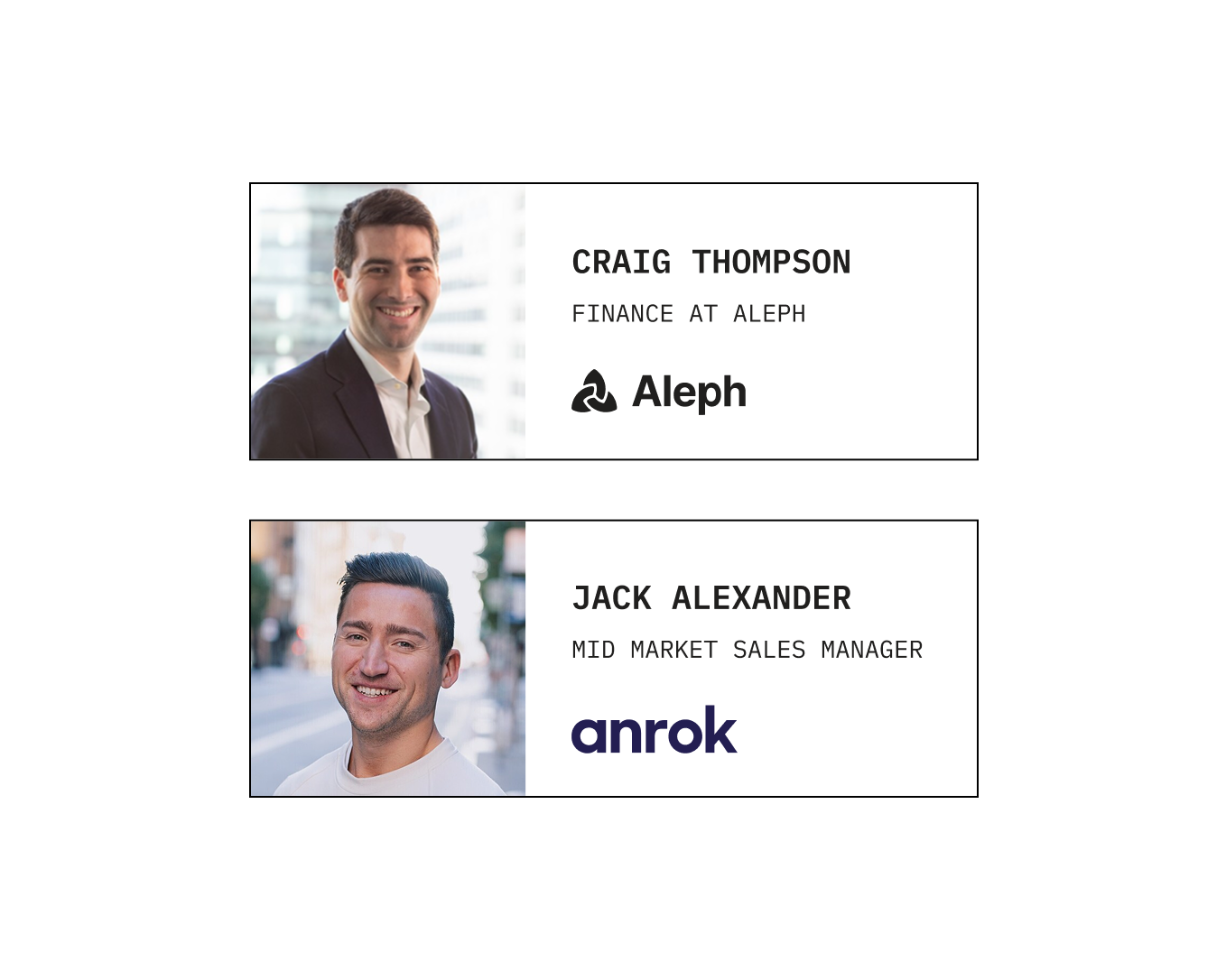
Join Craig Thompson (Aleph) and Jack Alexander (Anrok) as they break down the predictable stages of finance team evolution, what to hire vs. automate at each stage, and why sales tax and VAT become unavoidable as companies expand.

Inside the journey
Finance complexity doesn’t grow linearly. It compounds.
As companies scale, finance teams hit predictable inflection points: new roles get added, systems begin to strain, compliance risk increases, and decisions that worked at one stage quietly break at the next.
In this webinar, Aleph’s Craig Thompson and Anrok’s Jack Alexander walk through the predictable stages of finance team evolution and what leaders should hire, automate, or prepare for at each phase.
Built on Aleph’s Shapes & Sizes research, this session will help you sanity-check your current org chart, understand which decisions matter now versus later, and avoid carrying stage-one workflows into stage-three complexity.
You’ll leave with a practical, stage-aware framework you can apply immediately.
Join the session to learn:
- How finance teams typically evolve across headcount and ARR ranges
- Which roles to hire at each stage and which workflows to automate instead
- The signals that it’s time to move from scrappy to structured finance
- Where teams over-hire, under-automate, or automate too late
- Why finance complexity accelerates faster than expected
- When sales tax and VAT shift from accounting task to operational risk
- How early compliance planning prevents painful retroactive fixes
Plus, practical examples and live discussion.
Watch the webinar!
Register to learn how finance leaders build stage-appropriate org charts, avoid over-hiring, automate intelligently, and stay ahead of compliance before it becomes a bottleneck.
Chapters
- 00:00 · Introductions and agenda
- 04:30 · Survey setup and teams of 5 to 50
- 08:05 · Finance teams at 51 to 250 employees
- 15:20 · Multilayered teams at 251 to 500
- 17:30 · What AI is good at in finance
- 27:15 · Finance orgs at 500 plus employees
- 29:07 · People, processes and systems
- 31:28 · Live example: when to automate sales tax
Read the transcript
00:00 I it's funny. I think Jack, where remind me where you're from. But I grew up in Minnesota, so no stranger to the snow. No. It's so it's funny. I feel like all the East Coast folks, myself included, are flipping out about it, but then I see six feet in Tahoe, and it's like, oh, man. You know? Like, we have no idea. Yeah. That's a that's a different level for sure. Yeah. Yeah. So the Californians who might be joining possibly have a of the most snowball. Amazing. So I think, in a in a second, we'll have a couple of slides to walk through. And as we go through these, if we wanna throw on those slides, I think the main kind of ask and ground rules for everyone joining is, we're gonna be sharing elements of kind of like a survey that we've run, personal anecdotes and experience. We'll intro ourselves in a second, but everyone here is unique experience working at orgs of different sizes. And part of making this like a really helpful and collaborative experience for everyone is going to include hearing from you as well.
01:15 So we're going be pretty reliant on the chat as well. We want to hear from you about what you've seen work well. And if everyone's participating and everyone's volunteering their opinions, I think it'll be an even more informative and helpful experience for everyone. So so I think, next slide with that, I wanna go over a kind of a couple of organizing agenda of what we're trying to do today. So Jack and I will introduce ourselves in a second, but I think the primary goal of this is sharing some insights on finance team composition from a survey that that we ran recently. And along the way, as I mentioned, we're gonna layer in personal anecdotes and frameworks from different sizes and stages of finance orgs that, that we've worked in. And lastly and most importantly, we wanna hear from y'all as well. So with that, I'll spend a little bit of time talking a little bit about us. So my name is Craig Thompson. I run our finance function here at Aleph. I've worked at Aleph, which is about a seventy employee org today. So right on the, cusp and having just passed the cusp and at least one of our benchmarks, that will that will run through.
02:28 Prior to this, I've worked with very big multibillion dollar companies, started my career as an investment banker at Goldman Sachs. Was a private equity investor at KKR. And so from the operator hat, I've seen a lot of the zero to one hundred. Then I you know, a lot of this is more anecdotal on the one hundred to five hundred plus. So that's where we're hoping to lean on y'all. And, Jack, I'll let you introduce yourself. Oh, you're on mute. Yep. There we go. Thanks, Greg. And great to meet everybody here and really appreciate you all joining. Yeah. I'm Jack. I'm market sales team here at Anrock. We're about a hundred and thirty person org series c. Yeah. I've I got my start in management consulting, moved quickly into revenue operations, and then couldn't resist jumping into the sales org. So I've been doing that ever since and love it. So I'm excited to get started and talk a little bit more about sales tax as it pertains to company stages and growth. So we'll hit on that closer to the end. Perfect.
03:32 And one fun thing that you'll see that we're gonna do at the end is I think, we're gonna start in kind of the theoretical of benchmarking again we wanna hear from everyone else here, kind of what your experience has been. But then as it comes to things you're starting to think about as you scale perhaps for some of the more earlier stage startup folks, a preview of problems you might face that you're going to scale, Jack and I are actually gonna run through kind of like a live example that we thought would be fun of how to think about sales tax software where, Jack obviously coming with his Anrock hat on and me, being a decision maker at an org that currently does our sales tax ourselves and we don't pay for software. So we figured it'd be fun to kind of run through that thought experiment of just like one example of something of like what you might be thinking about, and Jack and I haven't prescripted that part. So it's gonna be it's gonna be really good improv and you never know what's gonna happen. Maybe I'll walk out of here with some new software. So with that, I'm excited to dive in here. So the foundation of what we did was really looking at b to b companies that went through Y Combinator at some point.
04:50 We looked at basically a little over two hundred of these orgs and tried to get an even distribution of about kinda fifty in each of these buckets of kinda the five to fifty employee range, fifty one to two fifty, two fifty one to five hundred, and five hundred plus. Ultimately, as we all know, headcount is a kind of an odd proxy for a lot of these things. Like, you might wanna triangulate between, revenue, growth, headcount. There's all these other metrics that that you might care about. But I think in terms of what was, readily publicly available and reliable, I think this is like a great benchmark. And the first thing that I think stood out to me is of all of these companies, seventy five percent had at least one full time finance team member, which is actually kinda low if you if you, are thinking about it or, I guess potentially high, if you think about it from the AI context. But a lot of these orgs, went through YC between twenty fifteen and twenty five. So I did I did find that to be kind of an interesting statistic. So first, I'd love to hear in the chat from folks how many of you are in an org that is this size today?
06:06 This, five to fifty range. And, if I hear crickets, then maybe I'll assume that no one here, is is a finance, team member at a company this size, which I think is in some ways borne out by the data. So in this case, if you're, companies this size, it's really rare to have a full time, finance team member. That was certainly the case for us where the idea is, we work with or we you know, when we were at this stage, and it's still true today, working with kind of like a fractional accounting resource. A lot of orgs have kind of like founder led finance. And then if there is a full time finance team member, it's someone who wears multiple hats. I think for companies at this stage, when you're trying to, allocate resources efficiently, it's really hard to justify expensive headcount for a nonrevenue or product generating role. I think, there's this great trope of in startups of, there are people who sell, there are people who build, and then there's other. And I do think that we're sort of at this early stage. There is a lot of impetus to try to minimize and reduce the dollar cost going into the other bucket, and try to keep headcount lean so you're investing for growth.
07:24 As I try to think about kind of like nudges of where our finance muscle, was really focused at this point in time, when I when I joined Aleph, there were only fourteen people at the at the company. And so having seen, a lot of how we've scaled through this time, I think, really, a lot of the focus was on, thinking about efficiency metrics, thinking about CAC payback, thinking about, burn multiple, and then also thinking about like, revenue efficiency and hyper detailed on everything for how kind of the top line is growing. Again, I'd love to hear from any folks in this range, but sounds like, peep people aren't there, which I think is coincides with what we were seeing in the data. So with that, we'll go we'll go to the next bucket. I'm sort of guessing that these next two will be probably the most common and most popular among attendees. Would love to hear from folks. You know, if you are working at a company that is this company range, would love to hear how many finance full time finance team members y'all have.
08:34 And the second question I'm interested to hear is who is that team member? You know, is it basically after the first hire, is that first hire someone who's scaled through startups? Is it someone that comes from more of an accounting or an investment banking background? And then the related question is in those first hires, how much do you think about it being, more on the accounting side, more on the FP and A side? And while we do that, just running through a little bit of what the data says here. So I think this starts to be kind of the point where companies hit scale. I think this is where Jack and I will dig into a couple of examples of where you're starting to think about, what types of software tools you need. At what point, do you want some things to continue to live in maybe a g sheet or excel world? And at what point do you want it to be more scaled? And what's the right balance there? So, yeah, so seeing Chris, you're squarely in this bucket. And, yeah, it's a it's a I guess, really a five person team, is smack in the middle of what the data says is typical where four to six is kind of the typical led by a CFO or VP.
09:51 So in this case, CFO, controller, an FP and A manager, an accounting manager, and an operational, and I guess, accounting team, maybe that's is that full time or one person, but, yeah, not four or five person range. Then, perfect. Full time and offshore is nice. And then, Justin, yeah, twenty five. There is a finance lead and a contractor for APAR. I guess, Justin, the other thing and may maybe you are the finance lead. What I'd be curious to hear what percentage of your time is on finance topics and what percentage time is on other and maybe also what your desired balance would be like. I know there's the you're probably getting pulled in a lot of directions and both what you feel like you could be doing or should be doing and what you're actually doing. I think I'll also be curious to hear. As so as we think about kind of like this, size range and by the way, Aleph, we're in this range. So we have basically, our finance team is me, and it's probably seventy percent of me still. It's still not even quite a hundred percent. So I think we're still really focused on trying to leverage tools and automation in a lot of cases where we can.
11:12 But I'll talk in a second about kind of the areas of pull where I feel like we're kind of dragging and even how we're thinking about this hiring decision. Yeah. So, yeah, Justin. Fifty percent finance treasury and accounting, twenty five percent HR, twenty five percent hodgepodge. That that sounds like, well, welcome to the world of, yeah, twenty five person companies, and it sounds like, perfect description of in a lot of ways, kind of what I was doing too. So I think we're all in good company here. As we at Aleph think about this size range, I think this starts to be where a lot of the really interesting decisions come because I think, Chris having had an example of probably double our overall headcount and kind of this median kind of finance team size. I will say a lot of how we're thinking about things internally is really a bias towards automating whatever we can, leveraging tooling whatever we can, and really trying to minimize what sort of long term enduring commitment we have to full time headcount. With that, I do think areas where we're starting to see some pull that are starting to get a little bit messy, I think, definitely on the accounting side, I think revenue recognition, in, a structured way is something that we're, improving on.
12:38 Really accurate accruals, I think, is another thing that's starting to become a little bit more of a pain point for us because we care so much about CAC payback. It's really important that we have the accruals right when we look historically at where we're allocating costs. So these are, I think some things where we're starting to feel a little bit pulled. And then the other thing, I think, is really around kind of billing and tracking is kind of like a, b to b SaaS, company. I think the billing kind of life cycle of quote to cash, I think, is definitely an area that we focus on. On the FP and A side, I think we're doing a ton like, a ton a ton of work there. We're obviously leveraging Aleph internally ourselves for that. And all throughout all of these, I do think, the company is changing a lot. We're growing a lot, and spreadsheets just continue to be a really big part of the process. So I think that's one other thing I'd love to hear from folks is how much of you like, maybe you could give employee range of FTEs, and then how much of your finance org is reliant on spreadsheets? I think it's another interesting question I'd be I'd be keen to hear.
13:52 As we're going through this, by the way, I hope that you'll be able to submit q and a and questions along the way. So I think it's like the chat is a great place to ask questions. There's also a little place for q and a on the on the right. And, again, I wanna make this collaborative. I wanna make this interactive and hear a little bit about you all are kind of going through all of this too. Yeah. So, Alonzo, this is now kind of like a great, sort of like right at that in between point at the high end of this range, low end of the next range where it's about fifty between Excel and between systems. And I really think that that mix feels you know? Yeah. And so we'll call, like, Excel and g sheets. I think that mix, I think, really feels you know, once you start getting to a hundred FTEs, maybe under a hundred, I think it's like a lot of spreadsheets, potentially an FP and a tool might even be an FP and a tool that's leveraging spreadsheets. Once you start getting over a hundred employees, I think that's where that starts to be a mix, and they start making decisions and start making trade offs.
15:05 I think one of one of the fascinating things with systems for companies of this size, especially for orgs like many of ours that are growing pretty significantly or the business model is changing is how you think about trade offs of structure and flexibility and those sorts of tools. But that is a is a great segue, to starting to talk a little bit larger, a little bit scaled. And by the way now that we're starting to get into this two fifty plus org, I would say that two fifty one to five hundred is the really the bucket where I talk with a lot of our clients during this space. I think this is very much a sweet spot for where Aleph starts to get used as a as a product, but it is an area where I personally, as a finance leader, don't have direct expertise. So really excited to hear from folks in the chat how y'all are thinking about that that sort of work as well. On the team side, I think this is where we start to see, maybe these two, four person teams starting to get a lot bigger. And this is the first time that we start having a multilayered finance org. I think, under two fifty, it's a lot of kind of like ICs potentially with a CFO or a VP of finance that's orchestrating things.
16:29 I think now we're starting it again in the range where there might be different layers of different types of things where people are focused. And this is also, I think one of the areas where we have started seeing AI creep more and more into handling not really a hundred percent of somebody's job, but it's starting to be, larger and larger percentages. So that for some of these orgs that might have, three FP and A analysts, on a go forward basis, rightsizing that head count might go from three down to one or two. I think any place in this stack where it's kind of like one person, I think AI can add a lot of leverage. I think it can really help. But I don't think we've yet seen any specific cases of going from one to zero. But now I do think we're starting to get into cases where we've seen five to three to two, and that sort of leverage, which I think is like a great segue to how do you think about what are the things that that AI is good at. I think this is one of one of those topics that I think is, very buzzy and very interesting.
17:44 I'll give you I'll give my personal perspective. But while I do, I really wanna hear from you all as well as how you're seeing AI adopted in the org and not just where are the pilots, but where you're seeing impacts and where you're seeing leverage. I think this is also one of those topics where as I think about kind of the various, like, Slack communities for finance folks that I'm in, I think this is kind of a an area where everyone's sort of looking around and trying to wonder what are you doing? What are you doing? Like, I haven't seen, my team go from ten to one, like and based on my LinkedIn feed, I feel like I should. So what's going on there? But I think, with that, a couple of frameworks that I personally, use, have seen other people, talk about and really like is, what are things that LLMs are good at? I think one thing that LLMs are not good at is being a system of record. I think at the end of the day, as you start to think about your ERP, as you start to think about a CRM, as you start to think about an HR, like, information system, as you start to think about a data warehouse, these, at the end of the day, I think, basically, with a hundred percent, share are still a deterministic tool.
19:08 I think I saw this terrible, post on Reddit that just gave me so much anxiety about someone, posting how they learned that the AI they've been using had been making up analytics data. And it just like, I can't imagine being in that in that case where you're realizing that after months of having leveraged it. And, yeah, it's just like, I think everyone on this call is like, just imagining that happening really doesn't feel good. So I think at the end of the day, the system of record still has to be software. And I think a lot of that software can leverage LLMs and AI for components of how it gets updated. But my personal philosophy is that every action that happens in any system of record needs a human owner. So you basically need someone full time in accounting who's kind of closing the books, might be leveraging AI to help with that. And I think there's a ton of ways where that can happen, but there always has to be a human in the loop reviewing and approving and owning everything that goes in that system. You need kind of like that system to be that single source of truth, and it kind of has to be there.
20:25 So that's where I think, like, LLMs in, the, system of record context, I would think of as really an intern. It's someone who you can't rely on for actual work, but might be able to help you along the way. You review it, but you review it with this kind of lens of skepticism. I think the second thing that that I think is really interesting is querying source data. Now that you have this system of record, what are you doing on top of that? You're trying to pull a report, build an analysis, kind of show something. And I think that the LLMs are really good at describing variance. But when you're actually running and pulling the data, this was that kind of, like, Reddit thing of it was making up information, and there was no audit trail. I maybe this is even still a little bit of a hot take in this era. I think anytime you're querying data or running an analysis, I think that analysis has to be deterministic. I think it has to be deterministic because you have to be able to go down to the source data and validate is this right. There has to be a real chain of command there of here is my operating margin.
21:39 And if I wanted to double check that this is the operating margin, I need to see every number and every subcomponent that goes into that, and I need those numbers to come directly from a system of record where a human owner kind of validated that. So, yeah, again, like, I'd love to hear kind of if anyone agrees or disagrees with that take, but that is sort of the framework for me of basically thinking as we're kind of building our finance team and we're thinking about where people belong, I think more and more as you have a workflow that is taking more than one person's time, I still think we're in this world where and these fifty to two hundred fifty person orgs, I don't think we're gonna see so much material change in who we hire. The only caveat that I can imagine is more athletes potentially. Like, I think if you can have someone who has sort of controller level, experience and expertise that can also manage, agent interns that are working on billing. Like, that would be an example where I could see potentially taking that, full time ARAP resource, making it fractional or taking a fractional ARAP resource and maybe trying to avoid that and just scale the bandwidth of one person.
23:03 But at this two hundred fifty, to five hundred person orgs, you're starting to see bigger teams and you're now maybe saying that yes, this one human owner of the workflow can actually own more things. They have more bandwidth. And so there's scale and efficiency there, which by the way, I think might mean smaller teams, but I think it means so much more leverage and value for the top quartile performers who people trust to own multiple processes. So I'm actually really excited about the opportunity that this presents, for folks that are willing to roll up their sleeves and own more things, and I think there's a lot of opportunity there. So now we're kind of in this deterministic pouring of data, but, man, LLMs are great at analysis. I think everyone who isn't using, in particular, Claude for Excel, who isn't using kind of an FP and a tool that runs a lot of, like, AI variance analysis for you, everyone that isn't using, even, like, ChatGPT or Claude to ask questions about their data. I think it's just really good at analysis when you know the numbers are what they are and you wanna interpret and analyze it.
24:16 I think they're really good at this. And this is where I would even say that LLMs can do not just analyst level work, but they can do associate level work. And what I mean by that is, there's still sort of this, like, VP framework who's reviewing all the analysis, reviewing all the commentary, making sure it's suitable and appropriate for the audience to whom you're presenting. But in terms of building and writing a lot of that commentary, I do I do think it's pretty good. The last thing I wanted to talk about in this framework, which is really thinking about actually building a model itself as you're thinking not just about analyzing historical data, but budgeting and forecasting going forward. I use Claude for Excel all the time. I cannot believe how good it is at banking associate level work. When you bring in Claude and ask it to analyze a ten tab pretty complicated Excel model, I'm blown away at how good it is at analyzing it. It's great at catching errors. It's great at formatting. It's great at spotting edge cases. I don't really trust it to build the model. So for any folks here who come from investment banking backgrounds, I think one of the funny things about especially bulge bracket investment banking is there's this weird dynamic where the associates are kind of like the indirect, dotted line bosses to the analysts, but the analysts tend to be the only ones who know how to model.
25:50 Like, I feel like a lot of associates are MBAs who are kind of learning kind of as they go. They don't quite have the expertise that the analysts have, but their job is basically to audit and review these models. And I think actually that, like, Claude for Excel is much better at model auditing and review work than a person, just like the process of opening up an Excel model that you didn't build and figure out what's going on is not fun, and LM's really good at that. But I don't really trust them to build the model again because I sort of view your budget forecast as its own kind of source of truth system of record in the same way that a CRM might be. And so, ultimately, I feel like that needs a human owner, a human builder. And I think that because the LM is better reviewing than it is a building, I think there really still needs to be a person there. So I'm very bullish on the future of people in FP and A. It's kind of my closing comment here. Looking at the chat, I see, yeah a lot of kind of agreements on, system of record and audit trails, checking the AI's work. If you notice other workflows where you feel like you've leveraged AI in a particular framework of, like, AI is a great intern, but bad analyst.
27:12 It's a good associate, but bad VP. I'd love to hear more and more about those use cases. I just love learning about those more myself. Pivoting now to kinda like the five hundred plus employee organization, I think this starts to be where things start getting much more layered, much more enterprise grade, and I think there is a ton of room for automation and improvement and modern tooling here. I think this starts to be like, if we if we survey the data some of these orgs have forty to a hundred plus FP and A folks. These are deep hierarchies with many levels. And I think this you know, at these orgs, I do expect that AI is gonna lead to a lot more kind of like consolidation and asking more from fewer folks. And I think that can mean one thing for people who are kind of doing the same workflows, but for folks like you all who are interested and curious and engaged in kind of how leading companies think about team building, how they think about workflows, I do think there is also tremendous opportunity there as well.
28:28 I think this is also we also team specialization the treasury function starts to be a real, function. There's more systems, engineering work that's going into finance as well. Obviously, the f p and a and accounting teams are starting to get bigger and bigger and bigger. You might be more multi entity, multi continent. You might have multiple ERPs in different places, lots of subsidiaries, and all of those things lead to additional complexity that I do think, still continue to need more people because as I mentioned, you still need that kind of human owner for each one of these systems. So with that, I kinda wanna wrap a little bit on this section. Jack, I'm excited to invite you back to the stage. And so kinda like as we start thinking about building people, processes, and systems, now we're starting to move from, not just like who are the people doing the function, but now how do you know when you're in it? Like, let's say you are a org that has hit a new kind of like size or scale threshold where you think we need more resources.
29:39 The current kind of like capabilities of the current team working how they work today isn't covering enough of this use case we're getting stretched. How can we improve? I think this is probably people, processes, and systems. I feel like CFOs everywhere kinda use that framework all the time. I think it's pretty well recognized at this point, and the idea is basically you need to make that change. How like, what is the thing that you should change? Is it change the process and improve how you as a team come together to fix that problem? Is it systems? Should you be bringing on a new tool or switching tools or a different tool that'll better help you accomplish that task? Or is it a people thing and the answer is just hire more headcount? So I think this starts to be kind of like a fun thing where, Jack, what we'll do is sort of like a couple of live examples of how to think about these things. And along the way, I do wanna touch a little bit on my personal opinions of the role of the spreadsheet in a scaled org. What are the places where the spreadsheet is still critical?
30:48 It's how we think, it's how we work. And deciding to abandon the spreadsheet because you think you need scaled systems often ends up just leading to more fragmentation where there is the scaled system, but there is this trickle of knowledge and ad hoc modeling and scenarios that live in a spreadsheet that now don't talk to anything else. So with that, I guess we can remove the slides and Jack, let's talk about sales tax. And maybe do you want to start just by motivating a little bit like how you kind of like came to this problem space, things that companies think about and then, yeah, we can go through a live example. Yeah. Absolutely. Thanks, Craig. Excited to riff on this live with you a little bit. So, yeah, we'll be jumping into what is I know everybody's favorite subject, sales tax. It tends to get put on the back burner, especially in these early stage companies. But, Craig, what you said about having a system of record for something as important as sales tax where jurisdictions can audit you and they can they can, demand money. Alright. Chuck, I think you may have, frozen there for a sec.
32:07 I think you're back. Am I am I back, testing? You're back. Alright. I'm back. Sorry. The office is having spotty Wi Fi today, so I will be talking to my IT guy after this. But tell me if I go out again. Yeah. So we'll be using Craig at Aleph, a real live example. So we'll walk through just a quick discovery of like, what are you doing? How are you thinking about sales tax and start to peel back the onion a little bit on some of this automation. So to jump right in, Craig, know you're at Aleph, you're about seventy employees, series B, right? So how many states do you think you have economic nexus in? So meaning you've crossed the one hundred k threshold. Yeah, it'll be directionally. So we have economic nexus in a bunch. We also are fully remote fully remote as an org. So also have nexus by I don't know what you call by headcount or by a physical presence in a few more. Let's yeah. Yeah. So let's call it twenty states. And you can also Jack, you can define nexus for folks too who might be newer to that topic.
33:27 Hit a certain threshold in a jurisdiction, so either a state or a city. There's actually thirteen thousand jurisdictions just in the US alone, all with their different tax rules and rates and how they tax different products. SaaS tends to be more complex than most. I think it's taxable in roughly twenty four states right now. So there's economic nexus, meaning you've sold a certain dollar amount into that state. Most states, it's a hundred k. A couple like California, it's five hundred k. And then the other way you can achieve nexus is, by physical presence. So that's what Craig mentioned. They're a fully remote org. Meaning, every time they hire somebody in a new state, they actually trigger nexus, and they are liable to file and pay taxes in that state even if they're below the economic threshold. So that's a bit on nexus. Okay. So, Greg say you say achieve yeah. You say achieve Nexus like it's a good thing. I don't for me, it's not a good thing. Not a good thing at all. I know. It's definitely something that you're not super excited about, so maybe I'll rephrase it.
34:33 You hit Nexus. You begrudgingly crossed that threshold. Yeah. There you go. There you go. We've triggered next. I like this. Triggered. Yeah. Triggered. That's the perfect Well, okay. You said about twenty states with economic and physical combined. So what do you sell exactly? Is it pure SaaS? Do you have any, professional services, implementation fees, any hardware components? Pure SaaS, baby. I guess we do we do charge implementation in a few K premium support, like consulting option, but the vast majority of it is just pure SaaS. Got it. Okay. So that makes the product taxability piece fairly simple. I'm sorry if I'm cutting out again. Tell me if you can you are having trouble hearing me. Okay. Cool. So let's transition into more of the manual burden to hit on some themes Craig mentioned earlier about automation and knowing when to scale. Craig, can you walk me through what filing looks like today for you? So you said you don't have a system. You do this manually. Like, how long does it take you, and how often do you do it? Yeah.
35:48 So I think for where we are, I think first, the Nexus by presence for us is pretty easy. So we use, like, Rippling as our HRAS, and we use, like, Aleph as our FP and A tool. So we have a Rippling integration that lets me basically spit out all of the states where we have for folks based in the US, like, all of the states where we have physical presence. I think that part is pretty straightforward. On the revenue side, basically, what we do today is we do all of our invoicing through Stripe, and Stripe has states billing states for everyone. So we also use Aleph to pull in how much we build in each of those states. So that's so I would say at the state level, that's kind of how we do things. At the city level, local level, I think we're it's like a little bit of manual work. It's a little bit of figuring it out. And the honest answer is that I personally like, it's like one click for me to refresh the state and employee level stuff, but we do have a still a fractional finance resource that does a lot of the filing.
37:06 You know, we basically offload it to them, and they definitely bill us for it, but they lump it in with everything else. And at the end of the day, I probably don't know the exact dollar amount that we spend on getting that done. Yeah. And that that's, I would say, pretty typical for an org your size. The rippling integration is nice. You can you can roughly see physical nexus. Still a little bit of manual work, but, yeah, Stripe makes it fairly easy to pull at the state level. I think where things break down is, as you mentioned, at the city level. So what this means is Chicago, for example, taxes software. The state of Illinois does not. That's called a home rule jurisdiction, meaning the city has different rules than the governing state. Colorado has about sixty of these home rules. There's home rules all over. So that's where we typically see the manual approach breakdown, if you will, open up companies to some pretty significant exposure. And you're doing a mix of manual data pulling and sounds like some semiautomation combined with offloading to a an hour of a billable resource.
38:15 That's right. Well, Craig, you're obviously a smart guy. Like, you clearly know sales tax is a thing. You're doing your best to tackle it manually. Why haven't you bought a tool yet? What's the real reason? I think it's really if you look at the places where we have economic nexus, it's been few enough that if it's whatever thirty local municipalities or jurisdictions or whatever it you know, it's, a lot that are in San Francisco. It's a lot that are in New York that kind of stuff. We've been comfortable so far just manually running on a monthly basis, and that's been okay. And then as we sort of think about prioritization of how big of a problem this is, it definitely is a problem. It growing this year in particular as more and more of a problem, but it's more one of those everybody does everything and how do we prioritize all these things? Isn't that the story?
39:25 Well, Craig, I won't grill you anymore here. I appreciate you being guinea I wanna talk to the folks watching. So I bet a good chunk of you are in Craig's situation, meaning, you're between fifty three hundred. We saw that in the chat. Finance team of, two, three, maybe five p side responsibility. But I wanna share a little bit more about what we see in the data. So as companies scale from startup to enterprise, again, aligning with the chunks that Greg shared earlier, we see roughly a fifty x filing increase as those companies scale. So that's roughly two filings per year all the way up to ninety four plus. Roughly forty is the breaking point. Again, that's where we see that two to four hours per filing done. That's eighty to a hundred and sixty hours per year of manual filing work that you were paying hourly for that you're offloading. And again, roughly five to ten million in ARR company stage, the average company would have about four hundred k in potential back tax liability if not compliant. So, again, I think that what I wanna emphasize is the pattern we see over and over that companies that come on to Anrock that start to automate this is they manage it manually until they can't.
40:44 And that can't usually shows up as a nasty surprise, meaning an audit letter, a due diligence finding before a fundraise, or maybe a customer asking for a tax exempt transaction, and nobody knows how to handle it. The companies that that plan ahead and get automated in this, I'd say, all important system of record, It's all about avoiding that painful expense and cleanups down the road. So, Craig, I'm gonna follow-up with you after the show about this. I love it. I love it. Amazing. So I think, with that, I think we've covered a lot of ground today in terms of, team building and sizes, shapes and sizes of different orgs. I hope this is really helpful from a benchmarking perspective in terms of where kind of a lot of your peer set is, how they're thinking about things. We chatted a little bit about examples of where, software automation and even approaches to AI can help kind of improve and build efficiency. And we even give kind of like a live example of what are some of the triggers of where you might start to feel pain points?
41:54 What are some of the places of when are you ready to prioritize having something? And I really do think, to Jack's point, a lot of those frameworks are really around how much time are you spending on a problem today and at what point is it worth investing some amount of cost to investigate what tooling or systems are out there to improve that problem to save you on x amount on a go forward basis. So I think yeah, Ezekiel great comment there, implemented like a SaaS solution to calc and file sales taxes. It's a game changer. I think at the at the end of the day, if you're trying to stay lean as a finance org, you need to find ways to lean on automation. You need to find tools that have good fit for the process and isolate what are things that a person needs to work on, what are things that tooling can help with. And I hope these are really great frameworks. Think with that, I think we because we've covered so much ground, I feel like we can probably wrap a little bit early today. We'll let everyone get back to their morning if you're on the West Coast, their lunch if you're on the East Coast.
43:06 And we'll see kind of like a couple links to share a little bit more if you wanna learn more about Anrock as a potential sales tax tool, if you wanna learn more about Aleph as a potential FP and A software, get to see a lot of AI enablement there, please feel free to reach out. The last thing I'll offer is feel free to connect with Jack or myself on LinkedIn. I'll put mine in the chat. And thank you so much for tuning in. With that, we can wrap and leave it there. Thanks so much all. Thanks everyone. Appreciate your time.