The New Finance Team: Part Human, Part AI, Fully Global
Aleph and MAVI on how CFOs are rebuilding finance teams with global talent and AI-native tooling.

Inside the journey
The old finance hiring playbook is breaking. Hire a US Senior Analyst for $100K, hire another, repeat. That math worked when finance teams were small and the tooling was thin. It doesn't work anymore.
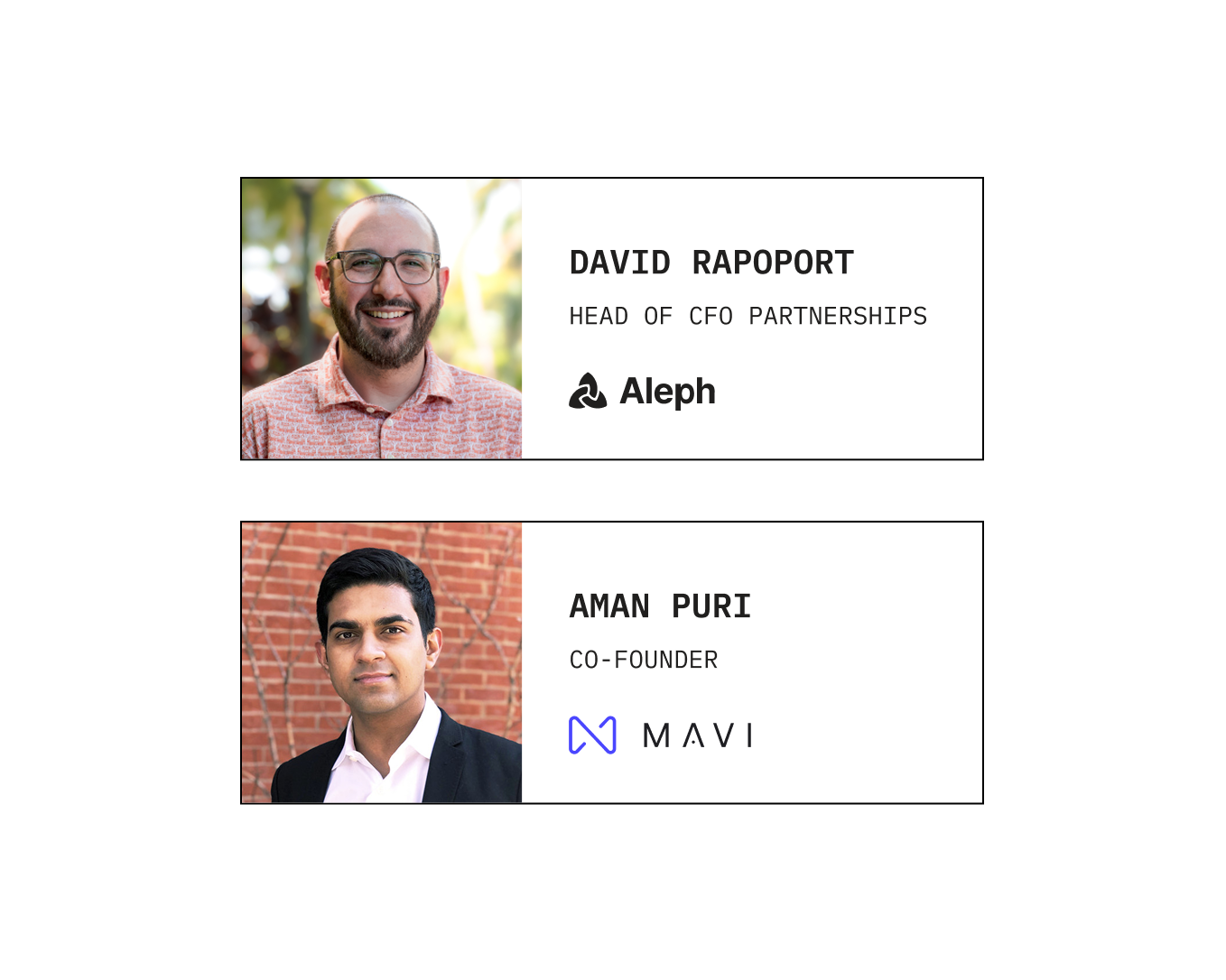
CFOs who pair global talent with AI-native tooling are getting 3x the firepower for the same budget (or less). In this session, David Rapoport (Head of CFO Partnerships at Aleph) and Aman Puri (Co-Founder at MAVI) walk through what's actually happening in the market: real case studies, a decision framework, and a practical blueprint for building a global, AI-augmented finance team.
Built for CFOs, VPs of Finance, and Heads of FP&A at VC/PE-backed startups (Series A through D) who are scaling their finance org and rethinking what a modern team looks like.
Join in on the discussion to learn:
- The new finance team shape: who to hire in the US versus globally, and why the split matters
- Where the market actually is right now, and how the old hiring playbook is breaking
- Real case studies of teams pairing global talent with AI-native tooling
- Which finance workflows transfer cleanly to a global team and which don't
- The key tradeoffs: global versus domestic, human versus AI
- Common myths about global talent (quality, AI proficiency, manageability) and what's actually true
- How to structure and manage a high-performing global finance team
Plus, much more...
MAVI is the world’s first AI-driven talent marketplace built specifically for finance and accounting, filling core, in-house finance and accounting roles with deeply-vetted global professionals in as fast as 5 days at 50% less cost than US salaries. Book a call to know more!
Watch the webinar
Register to see how CFOs are rebuilding their finance teams, with live insights from Aleph and MAVI.
Chapters
- 00:00 · Welcome and introductions
- 06:35 · Why the old hiring playbook is breaking
- 12:45 · What the next finance hire looks like
- 17:15 · What is driving the change
- 23:30 · Hiring global finance talent
- 34:10 · Training people and choosing AI tools
- 40:35 · Hire or buy tools first
- 45:00 · Case studies and closing thoughts
Read the transcript
00:02 Hi everyone. Welcome to the webinar. I'm David. I'll be one of your panelists as well as our moderator today. We're gonna give everyone a chance to kind of get together and join. So we'll start in a minute or two. But while you're joining, if you wanna go ahead and drop in the chat where you're calling in from, we're always curious where folks are around the US around the world, but feel free to get settled, give us a minute or two to get everyone in here and then we will get started with the content. Hey, everyone. If you're just joining, go ahead and welcome. Thanks for joining us. Go ahead and drop in the chat where you're calling in from. We'll give us just a minute or so while we get everyone to join, and we'll be right with you. Got a lot of Canada coming in. First two out of three from Calgary and Vancouver. Welcome guys. Thanks for joining. I see some more New York City folks. I think there's a lot of those joining us. I'm David. I'm based in Austin, Texas. Well, you'll hear a lot more from me but feel free. Keep joining, post in the chat where you're calling in from.
01:28 We'll give everyone just another minute or so, and then we'll get started with the content. Okay. We're gonna get started in about fifteen to twenty more seconds. Thanks everyone for joining. We've got a good group joining us from all over. If you haven't already, drop in the chat where you're calling in from. Feel free. We're gonna use the chat and the q and a function throughout this webinar. We've got folks from both the Aleph and the Mavi team manning the chat. And so we'll make sure that we're gonna answer some questions along the way, but feel free to drop them in there and we'll weave your questions in. And we've also got some dedicated time at the end of our session to go through some live q and a as well from the questions. We got another Canada one. Wow. I'm we might have more, people in Canada than I expected normally.
02:33 Yeah. Wow. International audience. Oh, we've got some India. Awesome. Okay. Let's go ahead and get started. We're a couple minutes past the hour. So thanks again, everyone, for joining. My name is David. I'm the head of CFO partnerships here at Aleph. Joining me is Aman Puri, who's the co founder of Mavi. We're really excited to have you all here today to talk about the new finance key. Many of you saw the webinar description, but I'll just give a quick intro of what we're gonna cover today. You know, the old finance playbook was, we think that that model is breaking. It used to be you're a new head of finance. Your first role is normally hiring a US based senior analyst that costs somewhere in the range of, eighty to one hundred thousand dollars And you just repeat that process. And that works when the tooling was really thin and when there wasn't great access to global talent or it wasn't available at all sorts of the business sizes. And so what we're gonna do today, Aman and I will introduce ourselves. We'll talk a lot about what we're both seeing in the market, both from a recruiting perspective, from a company perspective, and a tooling, and try and bring all of the things that we all are hearing in some of our conversations into tangible action items that you all can leave here with to really kind of rethink this process of as you all are building and scaling your finance teams, what that next role or next hire could look like and how it may have changed from what you did six months ago, twelve months ago, or even a couple of years ago.
04:03 It feels like things are changing so fast. So let's go ahead and we can pull the slides down, but, where I'd like to start is just doing some quick intros. Aman, I'll turn it over to you if you wanna give a the audience a quick intro yourself and kinda who you're what you're here for. I'll do the same, and then we'll dive right into the content. Perfect. Thanks so much, David. Thanks for having me, and thanks everyone for joining. I'm Aman. I'm the founder and CEO of Mavi. We're the world's first AI driven talent marketplace connecting the top two percent of global talent with US companies for in house roles. Just some background on myself. My career has been in finance. So I did m and a in capital markets in New York and Morgan Stanley for a number of years before moving to the Bay Area, joining the SoftBank Vision Fund as one of the first fintech investors on that team, invested over a billion dollars of capital and worked with some of the most disruptive founders, and ultimately was very close to the problems finance leaders were facing by being in the fintech space. And that's where we came across the sort of massive accounting shortage. And that combined with what we're seeing right now with AI is is is what's kind of sparking this conversation of what does a future team look like.
05:11 So excited to get into it. Awesome. Thanks, Aman, for joining us, and thanks for bringing all the insight to the market. Just a quick intro of myself. My name's David. I run the fractional CFO channel here at Aleph. I've spent my whole career on the other side of finance from Amman. I've been in house at early stage startups, being head of finance multiple times my career and facing a lot of these decisions that many of us here on the call today are faced. I've hired analysts. I've not had tooling. This was all in a free AI world. And I joined the Aleph team to help work with fractional CFO firms to help them figure out how to implement tooling and scale their business. I'm based here in Austin, Texas, and I'll play moderator and also con content creator for today. Just we're gonna launch our first poll just as Aman and I start talking just to give us an idea of kind of who's in the audience and what your team looks like today. We're gonna launch just a quick poll of like help us understand what does your finance team look like today? We know that we've got folks ranging from it's just you and you're trying to figure it out to I've got a team of more than ten. Help us kind of understand where you're at in the spectrum and we'll come back to these results in a little bit.
06:25 But feel free to keep responding to the poll. If you missed out also feel free to drop in the chat where you're dialing in from as well. So with that, while the polls kind of running in the background, I guess I'm on you know, where I wanna start is just, some of the challenges that we're facing today and how the model has really changed from what you and I talked about early on is before it was, a new head of finances joining and they're being asked to do more than probably what they got signed up to do. And there's more work to be done than hours in the day. Talk to us a little bit about kind of like what you're seeing, in the market and the conversations that you're having with companies and firms? And kinda give us a lay of the land of what you're seeing in the market today. Yeah. No. Absolutely. It's a it's a great question. I think, that is a big challenge that everyone is facing, in terms of how should they structure their finance teams today in the context of, a couple of the big challenges that I mentioned earlier. One is, a massive shortage of talent that we're seeing in the finance and accounting realm in North America. There's a huge accounting shortage. Seventy five percent of CPAs are graduating. Even on the FP and A side, it's become incredibly difficult to find really high quality talent at speed.
07:36 And then you put that on top of the context of today where, obviously, AI is is is blowing up. Everyone is using Claude, and every single board is pushing their leadership team to do do more with less. And CFOs are being told you need to run a one person finance team. And so it is becoming challenging for them to think about, how can they actually achieve the objectives of the finance function and keep the, keep the business running and the engine running, while being sort of cost effective and cost efficient. So that that's definitely a huge challenge that we're seeing. David, I'm curious if you're sort of hearing and seeing similar things. Seeing the same things and, a lot of the what I hear in talking to companies and firms is that, well, I'm gonna prioritize AI spend instead of maybe deploying my next finance hire. And what I what we found in, and I think Graham has some great research on this as well, that companies that are actually spending more on AI are actually hiring at a faster pace than those that aren't. And so what we're seeing, especially in the use of our own tool, is that companies that are able to find scale and efficiency, they're actually able to tackle more projects and more meaningful work within the individual company to help the business grow faster and stronger because you're able to really deputize some of those more like analyst level work items to agents and AI.
08:57 And then ultimately, be able to use that to provide better insights. I think we've got a quick slide that we're gonna pull up, which is some of this research here is that on average, what I'm hitting on is the very bottom, which is those heavy adopters are actually growing at ten point two percent for firms that are adopting AI over two years faster than other companies that are not adopting AI. So it's a little bit of a misconception in the market of like, it's either or I'm hiring for AI, I'm using AI or I'm hiring it. We're actually seeing that it's a lot of both. And then it's also being more strategic about where am I going to deploy that hiring and how am I going to have that person contribute the highest value instead of having to always bring maybe a more junior level analyst to the table to do more of what I'll call the grunt work. We're seeing a lot more of that being up leveled and upskilled because the data is just in a better spot. Yeah. I completely agree with that. I think maybe just build building on that into the other two data points that we're seeing here. As you mentioned, David, the real demand is for that sort of mid level and mid layer of talent, especially as companies are trying to adopt more AI tools.
10:10 They're realizing you obviously still need, someone who is skilled in accounting or FP and A who can ultimately manage, run, and oversee and check, whatever AI agents or agentic tools that that that they're using in the business. And that's why so just looking at some of this data on the top, a lot of survey results have shown that, thirty two percent of finance leaders recognize FP and A as a big skills shortage, and they're seeing in their teams. I've even seen similar data on the accounting side where the senior accountant, which is, the more mid level, there's a huge shortage there. And so it seems like there is a real skills gap. And I think to your point, David, around, the entry level, you don't need a junior analyst anymore. Right? AI can sort of do that work. But I think what's really interesting and what is starting to play out is that as that junior analyst gets completely removed, there's just less people that are gonna be moving into the mid level, while at a time when that mid level is actually becoming increasingly valuable and important because you need that mid level to ultimately manage and orchestrate those AI tools. So I think that is, the challenge of finding the right people for that mid layer and mid level is is a big challenge that we're seeing and facing in the market.
11:20 Yeah. Thanks for sharing that. And I think this is a good time to go back to that first poll that we launched, which was like, what is the average size of a finance team of folks that are here today? And what the survey that they're gonna put on the screen, awesome, is a little bit over half of the folks on this audience are a team of two to four people, which is normal size for what we see in the FQ and A space. But a quarter of you here today are solo. And I understand that I've been that solo person and it always feels like there's just not enough hours in the day to be able to go around and we're skewing here. But we're actually able to like, how do you prioritize what's going on and what the most meaningful work is, especially if you're at a venture capital backed company or a private equity backed company. You know, you've got a weird mix of investor reporting requirements. You've always got the next board meeting. You've got forecast cycles you're trying to run, but then you also wanna be strategic in the business and not just doing the reporting and analyzing the past, but ultimately, how do you provide value and how do you find that scale and leverage to bring your experience to the table in a way that only you can. So that's where we wanted to kind of start the conversation. I think this group definitely understands a little bit of like what a lean finance team looks like. No one here has more than ten people on a team, which I've never worked on a finance team that big.
12:40 I don't know what we would all do, but I think this group definitely understands a lot about being a very lean structure. And so where I wanna go there is kind of thinking about what next is. Aman, you kind of hit on this, which is, the old playbook was your head of finance. You're gonna hire your first analyst. It's gonna be a US based senior finance analyst. That's what you've got in the budget. They're going to probably handle a lot of the reporting and the board reports and all these things. Tell us a little bit more about what you're seeing in the market of how firms and companies are thinking about their next hire. And then we've also we want to hear from the audience as well. We've got a little bit of a poll as you think about what that next hire is. We want to know what you all are thinking about for how you're going to hire your next person. And so we'll launch the poll live. But, Aman, tell us a little bit about what you're hearing from companies that you talk to today. Yeah. No. It's a it's definitely a very relevant conversation, again, in the context of yeah. I think the biggest thing, and it comes in different flavors, but all finance leaders are being pushed to think about how can I increase the ROI of the finance function? Right?
13:49 The do more with less is the biggest thing that, is top of mind for a lot of finance folks. And, so they're obviously, going towards AI, but AI is not solving, all of their needs. And so they are we are seeing more and more finance leaders, especially ones that are more sort of forward thinking and tech savvy, starting to think about alternative structures. Like, with several of our customers, we're seeing now hybrids of sort of, fractional, some part time talent in addition to full time FTEs. And the big change that we are seeing and that we obviously at Mobby are helping facilitate is building an actual global team. Like, having a mix of sort of US hires and global hires, which ultimately helps play into and accelerate the ROI and solve a lot of the talent gaps. And so I think the future and modern finance team structure, and I think we probably have a slide that we could share on this, is going to look we think it's gonna look very different. Right? The finance modern finance team in five years is going to have a different structure and is going to be focused on sort of really maximizing three to five x ing the ROI of what you're spending on the finance function. As we can kinda see here, like the legacy team, like you said, David, a lot of people, older structure.
15:04 With the new team that that that we see in the future, you have sort of US based leaders, that are sort of overseeing a mid layer of really high skilled global talent, which we have found and exist in a place with many sort of, mid market US businesses. And they are overseeing and orchestrating a layer of AI tooling that is ultimately doing a lot of the execution work. And this structure, ultimately, we believe, will lead to a three to five x ROI while still delivering all the goals and the value, of the finance function to the company. Yeah. That's really interesting. You hit on something there too, Aman, which is, the hiring and the pace of bringing that senior person on, we're actually seeing being a lot later in the process as well. You know, the old playbook really was, the founders and the CEOs can kinda get the company through the seed round and probably the series a, and then you start to evaluate, do I need to bring a more full time person in as I think about raising kinda my series b? We're seeing that especially in the fractional channels that a lot of companies are waiting a lot longer and leaning on fractional CFOs to kind of help bridge that gap because there's just less of the work to kind of go around and better tooling to help support it. So a combination of more fractional senior level leaderships plus, some maybe, AI tooling and more global staffing model, we're seeing completely change the way that what used to be on the left side of the screen is actually far more on the right.
16:31 And even times that finance head is just a fractional component of it, because companies are really thinking about how they're maximizing their investment on the finance and accounting side. We know that everyone needs accounting. You always like know that you need to have clean books, especially if you're going out in the fundraise. But for companies as they decide, am I hiring another engineer? Am I bringing a full time finance hire on at us salaries? Or is there a way to kind of bring in a hybrid of a more strategic leader and a fractional capacity. Plus some global talent actually is a really compelling value prop and ROI for the company is just how you deploy dollars today. I think that's where we're seeing a lot more on the right side of the screen. I guess I want to unpack more and we can pull the slides down of Aman, what do you think is kind of driving this change? Like you and I both came up through finance functions before. And when you think about like, what changed from when you and I were doing this job before? Is it there's just more data, better data? Is it is it tooling? Is it processes? Like, it feels like it's changed so much even in the last year. Yeah.
17:40 I think it's a couple of big trends and changes. AI is obviously, a big one, right, where the power of AI and what it's able to do, and especially with CloudCore, it's getting better sort of every week, every month. I think that is completely changing how finance leaders think about it. I think there is also a lot of top down strategic pressure like we talked about from the board, from the CEO of kinda do more with less. Look, the finance function has always been sort of a cost center. Obviously, finance leaders like you and others I've worked with understand that it actually does drive a lot of revenue and value beyond sort of just, managing the sort of books. But I think it is a cost center, so companies are trying to manage that cost, accelerate ROI. But I think the other big thing that is leading to this sort of shift in thinking about alternative models is that it has just become very, hard to find a high quality sort of talent at speed in the last six years. Right? So the massive, accounting shortage and even FP and A talent shortage that we're seeing has only manifested in the last four to five years, in North America. It did not exist. You know? Engineering shortage has been around for the last three decades, like everyone's known that, but this is a very recent phenomenon in North America.
18:50 And so the context of that and the context of technology, and sort of pressure from boards, we are seeing finance leaders really start to rethink what does a modern finance team look like. How should I build this up? And that's where they're leaning more and more towards, obviously, implementing AI tools for the for the execution work. But we're even seeing people sort of, lean into global talent in a way that I don't think really existed before. Right? Sort of legacy offshore staffing models were all sort of lower level, low scale talent, whereas we're placing people who are sort of assistant controller level, the FP and A manager working directly with the CFO. This caliber of talent exists around the world, a lot of them are also AI savvy. And so because, there is this larger sort of density of talent that is US caliber, we are seeing more of a shift towards companies being open to that structure in addition to incorporating AI tools, at the lower levels. Yeah. I wanna come back to the global side because I agree with you. I think there's been a major shift there in how people think and have access to global talent. But I think coming back to you know, we had asked a poll question a little bit ago of what's the next finance hire from this group?
19:59 And almost a third, a little bit over a third of this audience is actually not making a planned hire today. And I'll say that's not super surprising kind of like with what we know and what we hear is that, it's tough to get, but it was tough to get budget allocated before to bring on, non revenue generated or non code production roles. And then we know now it's even harder as companies are kind of continuing to buy for, the investment on their dollar. The thing that I think about in terms of like how the work has changed from when I started my FP and A career to where we are today is the accessibility of data is so much more available for people and at earlier stage companies than it was before. I remember one of my first heads of finance job, we had a database and part of my job was running SQL reports out of the database and transforming it into actually Excel and Google sheets reports that could be used in our modeling. And today, like, I feel like so many more companies view that as just not acceptable very early on. And because of tooling and because of the access of warehouse and all these semantic layers more data is just available at people's fingertips be able to analyze, and that's taken away a chunk of the work. And then the other thing that I think about is because now all this data is accessible and because the tooling is getting a lot better, being able to cross compare results across disparate data sources and come up with conclusions and let AI play that role of a junior analyst.
21:28 I feel like has given people so much more time back to be able to be strategic and to be that forward thinking person instead of just like, man, it's Monday, and I gotta do my board slides. I gotta do the leadership slides, and that this is gonna take my Monday morning. That was, a quarter of my job a couple of roles ago. Yeah. I think that's a great point. David, that is something else that we are seeing as well with, a lot of the finance leaders and companies that we're working with is they are actively trying to make finance a more strategic function as opposed to sort of an operational function. Right? Historically, it has been about closing the books or just getting the numbers and kind of putting together analysis that hopefully is accurate. But, like you're saying, given the increased accessibility of data, the with a lot of the tooling that we have, with AI, and with tools like Aleph, we're able to do a lot of that actual grunt work and the actual processing, which took a lot of time. And now there's more energy being spent on the actual analysis. Like, alright. What are these numbers showing us? What's the additional layer of analysis that we can do now that we couldn't do last month or previously is now gonna help move the business forward and sort of making finance more of a strategic value driver and revenue driver for the business as opposed to sort of, an operational piece.
22:43 Yeah. I think we're hearing a lot from CEOs and founders as well about how their expectations are changing in what they expect from a head of finance. You know, I think before it was, now it feels like the work is very much like when you are ahead of finance, it's almost like you're an IC for probably a big part of like where you started in your company journey. And it's not just about, the deliverables, but it's that strategic insight and how are you being a partner to the CEO and the pace of when things are expected to be done and how we're gonna be able to report on this and analyze this information and be that partner to the CEO and the board. It feels like this group, especially with kinda seeing the audience that we have on the group of like, it's just you, no planned hires. Oh my gosh. What do I do? Which kinda leads me to our next point, which is around global talent. I know, obviously, Navi has a view of the world and it like global talent. I think you said something a little bit earlier of, the old model was very much a global talent was reserved for really large enterprises that had the structure to know how to navigate complex legal requirements in various countries and time zones.
23:52 And so I'm on the catch us up. Like it feels like that was just like a couple of years ago where offshoring work to handle certain tasks was reserved for the big consulting firms and the big fortune five hundred companies. And it feels like over the last, like five years that has like truly like been appended. Like, what do you think is kind of like cause that and how can smaller companies, solo finance people benefit from this change in the market? Yeah. That's a that's a great question, and I think that is the biggest trend and catalyst that we are seeing in the market, and, obviously, we are trying to help, move forward. I think about the parallel of if you look at the engineering, sort of market, right, for engineering hires, there's been this what I call professionalization of global engineering talent over the last fifteen to twenty years. You know? Even twenty years ago, twenty five years ago, engineering was the same. There were these large outsourcing shops that only large enterprises had access to. It was lower level engineering work, that's all that existed. But over the last fifteen to twenty years, we have seen this recognition in a lot of platforms that are finding and giving access to truly Silicon Valley level engineering talent all over the world.
24:59 That, various reasons, did not happen in finance and accounting. And I think a big shift of why we're seeing that in the last five years is the couple of trends that we talked about earlier, right, that are making it really hard to build and find quality talent at speed today. The big thing being the massive talent shortage, the other thing being the normalization of remote work within the finance and accounting function. COVID obviously, normalized that for finance and a lot of other, teams. It wasn't the case before. And so that being normalized, there being a massive shortage. And now with the with the advent of AI and technology, it's becoming much harder to find the right high quality talent at speed. And so that has created the massive demand. I think on the other side with the supply, I think there have been these multinationals. There have been big four companies, US large US based enterprises that have had large offices all over the world. And so these talent pools of finance and accounting have been building that are, familiar with US GAAP, that are US caliber over the last twenty years. So, essentially, now the demand has sort of caught up, the supply has caught up, and that's what we're really seeing, is now possible in the market. If someone is working remotely, whether they're in, Nebraska or they're in, India, it doesn't matter as long as you're being able to add the same value, have the same skill set, and can operate effectively day to day with that team.
26:16 Yeah. We feel the same way about tooling. I mean, for a long time, FP and A tooling was really reserved for those same type of big companies that you were talking about. You know, it was a Right. A massive investment to be able to spin up an entire module of whatever major ERP you're on, and you need a whole dedicated team in order to be able to maintain the system. I've worked with those companies before, and I know there's teams of systems engineers that just manage the tool. And it feels like now there's been such like an advent of tooling, especially for smaller companies that are meant to be more nimble and flexible and then being able to deploy this without having full time resources on staff. That to me, like this is kind of that moment that we're seeing in the market, which is global talent has opened up in a post COVID world. We've realized that there is great talent located all around the world and time zones matter a little bit less than they probably did before. And now we're putting best in class technology at people's fingertips at a fraction of the cost that it used to. And it feels like we're at this really interesting moment across all industries and all segments of rethinking this playbook, in light of all this talent shortage.
27:27 I see a question from Dale kind of in the chat, in the Q and A, which is, what are our thoughts around kind of the mid and senior level talent pipeline drying up? And, I think my first pass of this is it's changing how people are working and it's actually deputizing a lot more of the junior folks to step into more senior level work or those senior level folks are actually stepping back into more IC level roles. But, Aman, does that kind of align with what you're seeing as well? Yeah. Hundred percent. I think great question, Dale. But and that that point on the mid level pipeline drying up, there was actually a survey that came out literally last month, which showed that the senior accountant and the data we showed at the beginning on the FP and A side too, that that mid level sort of is the highest demand right now across companies in the US and, I think, broadly North America because is becoming harder to find people who are experienced end to end in accounting or FP and A, but are willing to, also able to be more of an IC and, pull up their sleeves and actually get things done and manage the AI tool.
28:33 So I do think that talent pool is getting is gonna get dried up because the junior level folks are getting replaced by tools like Aleph. Right? I think that that is what they are they are doing. And if there's less people getting that sort of ground level training, there will be fewer people sort of moving up to that that mid labor. And that that's especially why a lot of finance leaders need to think about alternative models and alternative ways that they can, build a robust finance team and structure. Yeah. And so I think, what I wanna make sure we leave this group with is, like I said, a kind of next steps in terms of how they should be thinking about a global finance team. And so, because all these things have changed and because a lot of our audiences, a solo finance people, one of the questions that that comes to mind is like, well, I don't know where to start. You know, I know, like I used to post a job on LinkedIn and I had a recruiter that would help me and they would source for this level talent in America. And I know how to hire them. Like, among, like give us like the quick level view of how is hiring globally normally like different than hiring a US folks?
29:43 What are the things that people should start to think about as they explore the idea of hiring global talent? Hundred percent. I think the first thing is to remember that we need to index on quality over cost. Like, surely, the this, working with global talent provides tremendous ROI. But to truly find a high caliber talent everyone should index more more on quality. A lot of the traditional legacy outsourcing and offshoring sort of providers, provide a very low cost sort of solution where talent are cheap, but it's not the same caliber as your accounting lead or your assistant controller or your FP and A manager who's truly gonna run large parts of the function end to end independently. And so I think trying to find a provider or solution to work with that can actually deliver quality at speed, I think is one of the biggest things. And, I think the other thing to think about and keep in mind is to really treat them as any other remote hire. Right? I think that's like a big thing, which, David, you and I have talked about is, like I said before, if someone is is is in is in the US or somewhere else, so they're working remotely and are productive and are there every day integrating them and making them feel part of that in house team, which is, again, a newer phenomenon that we're seeing over the last few years, allows them to be just as productive as someone you'd hire in the US and feel a core member of the team, and it allows it to be very, very productive and effective over time.
31:08 So I think those are kind of two sort of big pieces. And the third thing that I would say is to really focus on that mid level of talent. Like, I think, historically, again, going global has meant let's find the junior level who can do data entry and very low level, low skill tasks. But Aleph is automating the those tasks. Right? And so that's actually not the layer that they should be looking for. Should actually looking at the mid level layer because the actual ROI and leverage that they can get on their finance team is gonna be much larger, both in terms of dollar savings and the leverage and value for the actual function because this person is higher skilled and therefore can add more value to the team. But, David, I'm actually curious because you've done this. Right? So as a financier, so what are your thoughts on this? I'm curious what advice you have combining Yeah. Over the course of my career, I've had finance teams in the Philippines and India. And actually one of the shifts I made, recently was, bringing a bunch of the work that we had in our offshore work actually into a near shore model and up leveling kind of exactly to what you were saying, Aman. You know, my advice as a leader of like your point around like treating them as part of the team, like they are part of the team, right?
32:16 And whether they're contractors or full time employees, like the legal distinction doesn't matter in my opinion, they are part of your team. They're contributing to the broader mission and vision of what your finance function is supposed to do to support the business. But I think also comes with that is like a really clear set of expectations. There are going to be different holidays you have to navigate and there are going to be different time zones, and there are different cultural norms that individuals are going to just need and or want different things. And part of why I think being successful, whether you're a US based team or a global team is defining what your set of norms are going to be. How are we going to operate as a team? How are we going to provide value to the organization? And how and when the work gets done, in my opinion, is kind of irrelevant as long as we have clear expectations that everyone is here to is to contribute. Here's our expectation of quality across the team. We don't care how you may do the work, whether it's with AI, we hope you use AI or you don't because it you wanna learn the first time and then you train the agents. That to me is like the underlying part, which for some finance people is a little bit of a foreign concept of like the culture of the idea of like culture and fostering.
33:30 But I think all of us here have this idea of professional and personal growth and enabling that next set of leaders. So to Dale's question, like when we find those more junior level people or that people are willing to take a chance on us and joining your company, that you give them every growth opportunity in order to be able to, grow and foster in a safe environment, but knowing you're ultimately gonna be able to produce what you need to be able to, do your job day in and day out. Yeah. I don't know. Any initial kinda comments there? No. I think I think that that that sort of, yeah. And we'd love to get any thoughts from the audience too. But, yeah, I think that really makes sense. I guess, David, actually, one question for you that, we hear a lot from our finance leaders is how do they think about the like, advice that they have? Like, as we're thinking about this modern structure, right, where it's, sort of senior, potentially, US leaders combination of, global talent at the mid level and then AI agents or AI tools at the execution layer. There's obviously so many tools out there. There's new tools every week that are launching. And I think the big challenge finance leaders are facing in the context of limited time and bandwidth is like, what tools should I be using beyond sort of Claude, obviously?
34:42 Then how should I be making that decision? So I'm curious what advice you'd have for folks on that. Yeah. I think this is also related to the question that Owen put in the chat of, how do you actually give the entry level folks the right tools and training? I'll kinda address those kinda both from our perspective is that, we all remember early on in our career where we were given a task where we had to learn and grow into something that we didn't know. And I think that model has not changed at all. We should continue to give team members the opportunity to learn and grow. And it's about making sure that they understand the fundamental concepts, whether it's on the accounting side and you know why you're booking a journal entry or why an agent is booking a journal entry or a financial analyst that you should be able to get to the underlying number beneath them. Like, those fundamental concepts are not going to change no matter what. And we have to make sure that our job as managers and leaders is ultimately enforcing those norms. Then I think the next part of it is, am I setting this person up to have the right infrastructure or the right knowledge to be able to do that and do that well outside of tools? Do they understand what our business is? Do they understand how we invoice our customers? Do they understand why revenue collections is offset of cash collections? Like those are the concepts of teaching them the business specific context is the next layer in this pyramid of like developing really great talent.
36:09 And then the third part is like giving them enough context and enough questions to be able to experiment, to do new things. What a thing that I love to do as a manager is giving them the same tasks that I'm gonna do myself side by side. It's not always the most efficient thing, but actually that's how we found that most people love to learn is, okay, Aman is gonna give me this unique challenge. I'm gonna go do it. I know my manager is gonna go do it. We're gonna come back at the end of the day, and we're gonna do a check-in of what the progress was and ultimately how we delivered on it. Those are the same fundamentals where they're entry level folks no matter where they are or ultimately, a more senior level person that's working in direct in directly with the CEO and founder. So that to me is, I don't care if you use AI or not or you do all of it, but it all comes down to the fundamentals. And every single person should be able to understand exactly how the business works and the individual nuances so that they can do their job efficiently and effectively. Hundred percent. That makes a lot of sense. And I think to yeah. The other thing that I would be curious about in terms of best practices to advise folks, what are you kind of seeing as or what advice would you have for folks to sort of decide which AI tools to look for on the FP and A side or on the finance side?
37:31 Yeah. I mean, I think to me are so many out there. Like, you can truly spend weeks and months evaluating tools, and you ultimately have to choose what you are going to feel comfortable using day in and day out. That is like the conclusion of like how I feel about tooling is that it should always be a supplement and an augmentation of the work that you're already doing and that you shouldn't necessarily have to bend or break your existing processes to build around a tool. The tools are here to make your life easier, to be able to help you find and scale efficiency. It's also about a lot of times finance isn't the only consumer of data. I saw a comment in the chat of like a lot of times there's an AI or an IT person that's kind of coming along in the journey for companies of relevant size. But also think about who your audience is. It's department heads, it's board members, it's other members of the leadership team, it's investors that need a monthly update. Think about how they're going to ultimately interact with the data, how you're going to be able to present information to them in a more efficient way, and then understanding what those processes are and how a tool, whether it's Claude or others, or I just need data move from point A to point B, because that's my biggest bottleneck.
38:49 That's where I say people should always start in the process. Then it's okay, how do I do this next great innovative thing using the tool? Or how do I unlock this next insight? Or how do I let the head of marketing have access into their data set so that they can think about retention cohorts and marketing spend and all those like fun things. That now is a little bit more downstream of the core FP and A tooling. That totally makes sense. I think that's the biggest thing that we're kind of hearing from finance leaders too is there needs to be an immediate demonstration of ROI, the easier it is to sort of integrate into their workflows, the higher likelihood they are to sort of adopt it. And I think, Cloud obviously has been very easy for companies to adopt, to integrate, and to use, which is why it's, obviously sort of blowing up on in finance teams. But if they are still looking for other tools to manage large swaths of the finance function, whether it's accounting or FP and A, and I think usability, actual ROI, where can I justify the value being added, the time being saved, the cost being saved by spending on this tool, or the additional value being added, the additional analyses that we aren't currently doing, which are adding value to the business, I think?
40:00 But that's one thing that we've definitely seen. Obviously, finance leaders, they're very quantitative. Like, they don't believe in any sort of fluffy stuff. Like, you need to see the numbers. And so if there's a very clear ROI from this specific tool and they can see it and feel it and can measure it, I feel like that's what's leading them to sort of adopt, some of these solutions. Yeah. No. Really relevant point. So I know we're gonna give people some time back towards the end, but if you've got questions that we didn't answer yet, feel free to drop them in the chat. We've got a couple that are kind of in our queue as well. And Aman, while those are kinda coming in through the chat, where I wanted to think about the close of our remarks is help us understand where do people go next? Is it I do tooling first, I bring people on first. We all know resources are hard to come by. And so what I'd love to hear from you is like, how do you advise ahead of finances? They're thinking about, is it buy? Is it hire? Is it do it all myself in nights and weekends? Like Yeah. What well, how do you think about answering that question? Yeah. That's a great question. I think, the somewhat cop out answer is you have to do both, but the sequencing depends on the stage of the business. So I think, obviously, for earlier stage companies and like the point you made earlier, David, that the things are being pushed out.
41:24 You can get farther than you were able to before with tooling just because of technology and what it's what it's able to do now. And so I think for, earlier stage, for sure, I think it's a one man show. That's what we typically see. But as the business becomes more complex, for VC backed firms as they sort of get past the series a, And there are more demands. There's more reporting requirements. You have quarterly board meetings. And frankly, the business is larger, more complex, and the numbers matter. You need to know on a monthly basis what is actually happening in the business and be able to make decisions. Based on that, that's where you need additional, capacity. And I think the head of finances is trying to focus on the strategic side. And the biggest thing that we hear is they all want to adopt tooling, and they're like, don't have time. Like, we don't we don't have time to do these demos. Do have time to integrate them. We don't have time to learn how to use them. And so we're typically seeing is they need to sort of bring on some resource at the mid level so that once there's additional bandwidth now, the two of them can figure out what tooling they need to bring in place. They can integrate that tooling. They can evaluate different vendors, and can, then make a selection of what makes the most sense for the business.
42:29 But I think, first priority is ensuring there's enough bandwidth to drive the key priorities of finance forward, and then at the same time, almost creating bandwidth to integrate and build in AI tools that can then be managed. The head of finance obviously should not be the person that is managing and orchestrating all these tools. That's not the best use of their time. They need to be the strategic right hand partner to the CEO. And so I think they need to think about a mid level person to bring onto their team who can ultimately help them build out the structure of tooling, that that that sits below them. I know, I'll push on that just a little bit and say I disagree is that, ultimately, I do think it is the head of finances job to own the infrastructure layer of FPNA because that person is the one that is ultimately held accountable when things go right and or wrong. And so I know it's scary to say wanna help deputize my person or a junior or senior manager to help me like do this work. Or I'm scared to pass off my other work. I would actually argue that tooling is probably one of the single biggest investments that an FP and A tool a team can make. And getting that right can truly be make or break. Right? I mean, the decision of how you calculate or forecast AR, which impacts your cash cycle or your cash forecast Hundred percent. Could be the downfall of a business.
43:52 And so I'll poke a little bit in unfortunately, I think the answer is, I need capacity, but I need capacity to maybe do something that I'm doing today that is easy for me to train somebody on so that I can focus on the strategic, I'm answering this like implementation question and how we're gonna treat these specific items, so that we can make sure that the infrastructure layer is correct. Yeah. No. Hundred percent. That that's totally a fair point. I think depending on the nature and stage of the business, kinda seeing it go go both ways. But you're right. Like, they do need to own that infrastructure. So even in whatever decision is being made, they would be, they need to be closely involved. And, obviously, these AI tools can help, increase their bandwidth, increase their capacity. We're just kinda hearing from folks that this, don't even have time to sort of think about which tool to go with and choose and what the right because, obviously, it is a big like you said, it's a big investment, and making the right choice is incredibly important because that will impact the ultimate value that can be added. So Yeah. No. That that's really fair. And we had a couple of comments kinda come in through the chat of, how do I think about demonstrating value?
45:00 How do I talk to this about my, the success of my team to the CEO? We have one last slide that we're gonna show, which is just from what both Aman and I are hearing in both of our respective roles, in talking to leaders at companies all the time is there are clear and demonstratable ways that either scaling your team count or scaling infrastructure to be able to support the organization is ultimately gonna be able to help. So, Aman, I don't know if you wanna highlight maybe the first one around the global aspect, and then we can talk about the agent one after that before we close it out for today. Definitely. Yeah. So we wanted to show these sort of case studies. These are sort of real customers that that we're that we're working with, both Aleph and Mavi who have implemented the or are actively implementing the structure that we talked about and are therefore really a three to five x ing the ROI of their team. You know, on the left hand side of that case study, it's a large SaaS business that we work with. They had a big restructuring, and they essentially replaced a big swath of their both FP and A and accounting team across six to seven hires, with really high skilled global, talent from Mavi, which, ended up saving, I think somewhere around four hundred and fifty thousand dollars a year.
46:11 So massive sort of dollar savings. And then on top of that, they are actively looking at, AI tools for the FP and A side, for the accounting side. And so they are sort of working towards this structure where they've optimized human capital spend, and then now they're integrating AI to truly, five x the ROI of what their finance team, can do. But, David, I'll pass it over to you to maybe talk about another example that you're seeing. Yeah. I mean, the middle one, everyone talks about agents and AI and what can it actually do. And the way that I think about agents in an FP and A and accounting context is really replacing that lower level junior analyst work that used to be done, whether it was in the US or globally or wherever it is. Once you build the infrastructure and the scaling is really putting the stress test on how you could have agents actually do a lot of that same work. Whether it's updating the model, pulling actuals in through whatever connectors you have, or whether it's helping draft journal entries, or whether it's helping do your monthly variance analysis. There are so many opportunities for AI and automation in general to help take things off of people's plates. And the way that I described it, I wrote a blog post about this a couple weeks ago, on the Aleph blog, which was, it's scary to say, I don't know where to start.
47:38 And it's scary to say, I don't know what to do. And so the way I think about it is describe the most one of the most painful things that you do every single month. And while you're doing it, see if you can also work with the AI in the background and say, help me. Here's the process I'm doing. Do you have the information and talk to it just like you would an analyst? How am I gonna do this process? Do you have what you need to be able to run the reports that you need here? And that to me is where like this AI powered agent really starts to unlock scale and efficiency for teams. So what we have here is building cash flow dashboards are great, whether it's running that VVA analysis or the variance or the flux, no longer do you have to wait for day plus three for books to be closed to start running these packages. Man, wouldn't it be nice if I just came in overnight and these things are just done in my voice, in our color schemes and all these things that just feel so personally branded to the firm and the company I'm at that it's taking the ability for me to go do that more strategic forward looking thing that I think so much of where finance people want to spend their time. But, unfortunately, we don't get to spend nearly enough time there no matter what job we're in. Yeah. Absolutely. And I think the especially for finance leaders, there are a lot of people on this call where their team is two to five or they're solo.
48:56 Like, if you're early, you have the opportunity to sort of build the finance team from scratch with the structure that you would want, which I think is a great opportunity. And we are actually working with several customers that are in that position, and they're actively thinking about we're gonna hire a couple global people, we're actively building out these skills in Claude that they are actually just gonna run. You know? So the some of the repetitive tasks that they would have done manually, we're gonna build skills for that, and they're just gonna oversee these skills. And that's gonna be how we're building our finance function from the ground up. I've seen it's really cool. I've actually seen companies and firms starting to use linear, a product management, product engineering Oh, yeah. Where actually run their month close processes and say, my agent has access to this tooling. Here's the skills that I need. And to me it's so foreign to think about finance being run more like a product and engineering organization. But it's so cool to think about that's how I'm triaging work and that's how I'm able to give the organization context and that's how people can see what I'm working on instead of the, eight PM Slack message of, hey, where are you at on this? Or hey, when can you get this for me? Oh, let me create, this ticket. Here's how our process is gonna run.
50:05 Like, I think that's the innovation of the finance function that people just are not talking enough about in terms of keeping things in my notebook and my flatcoms instead of actually like systematizing it and building it for scale. So with that, we're gonna give some people some time back. Just wanna say thank you for everyone joining our webinar today. Thank you, Aman, always great insights and appreciate the conversation today and really trying to make it more tactical for people as they understand how the changing nature of FP and A and finance across the companies are going. As always, if you guys have questions, feel free at Aman and I both on LinkedIn. Drop us notes. We love talking about whether it's tooling or AI or global hiring. We're really excited that you all took the chance to join us today. If you had questions that you didn't wanna drop in the chat or in the q and a, you can drop us a note. Always happy to chat. I just wanna say thank you all for joining us today. We'll send out the webinar recording if you wanna share that with other team members or you wanna send this to your CEO as you advocate for that next finance hire. We're always here. And thank you so much for joining, and we will see you all soon. Thanks so much, David. Really, really appreciate it. Thank you everyone for joining.