The Rise of Usage-Based Pricing in the AI Era
Aleph, Sequence, and Rooled on the three pain points reshaping finance under usage-based pricing: auditability, forecasting, and transaction visibility.


Inside the session
Usage-based pricing is no longer optional in the AI era. Customers expect to pay for what they use, and companies that don't offer it are getting left behind. But the shift breaks the finance playbook built for seats: revenue gets volatile, forecasts get harder, and reconciliation turns manual fast.
Three pain points are surfacing across finance teams making the move. Auditability gets harder when revenue is metered, not invoiced on a flat schedule. Forecasting gets murky when MRR is no longer a clean line. And the demand for transaction-level visibility (from finance, from auditors, from customers) is climbing fast.
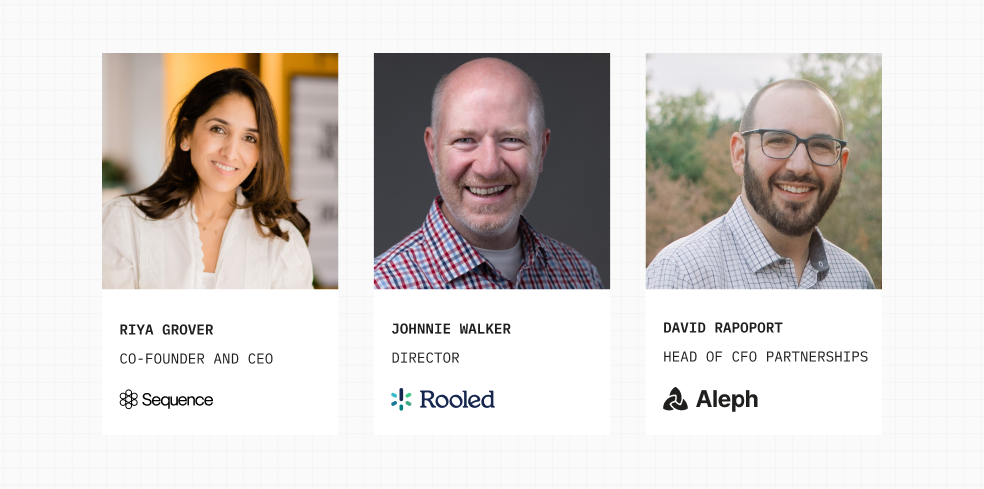
This panel brings together Riya Grover (Co-Founder & CEO at Sequence) on the billing and tracking layer, Johnnie Walker (Director at Rooled) on what he's seeing across growth-stage finance teams adopting it, and David Rapoport (GTM Partnerships at Aleph) on how modern FP&A teams forecast and model usage revenue. Discussion-led, with real examples from the field.
Built for FP&A leads, controllers, and CFOs at AI and infrastructure companies where usage-based pricing is already on the table.
Join in on the discussion to learn:
- Why usage-based pricing is becoming the default in the AI era and what customers now expect
- What auditability looks like under usage-based pricing, and how to set up your stack to support it
- How to forecast variable revenue without breaking your model (or your spreadsheet)
- Why transaction-level visibility is becoming table stakes, and what finance teams should track
- The specific finance challenges metered billing introduces, from revenue volatility to reconciliation
- What "good" looks like when billing, revenue ops, and finance are connected
- Practical first steps for finance teams getting ready to support usage-based pricing
Plus, much more...
Watch the recording
Register to see how finance leaders are handling the shift to usage-based pricing, with live perspectives from Sequence, Rooled, and Aleph.
Chapters
- 00:00 · Welcome and speaker introductions
- 06:40 · Why hybrid and usage-based pricing took off
- 09:58 · Pricing by company stage and frequent change
- 18:54 · Calculating ARR for usage-based revenue
- 23:44 · Internal token costs and valuing usage ARR
- 31:16 · Real-time visibility into usage and AI costs
- 40:52 · Forecasting AI costs by company stage
- 48:26 · Where to start, plus AI costs as COGS or OpEx
Read the transcript
00:13 Hi, everyone. This is David from Aleph. We're going to give people a couple minutes to get settled, join the webinar. But while you're doing that, first welcome. If you can put in the chat just a quick idea of where people are calling in from, that'd be great. We're excited to have you all here. We'll give, probably a minute or two before we get into intros, but feel free to use the chat. Tell us where you're calling in from. Also, if you have questions that you wanna make sure we're covering over the session today, please feel free to drop them in the chat. We'll give them a couple of minutes to do that. And then we'll be back in just a minute or two to start with the intros. Neil, nice to meet you. I'm also in Austin. We've got some nice coverage across the US. Looks like we've got Calgary. India, wow. UK, we've got people from all over the globe calling in awesome. Cleveland, Chicago, a couple of Londons. Awesome. Excited to have you all here. We'll give everyone another minute or so, and then we'll dive right into intros. Got a little bit of the Bay Area coming in. Great.
01:33 I see a Florida in the chat, Ohio. Awesome. Alright. We'll give everyone about thirty more seconds. Another London. Awesome. Alabama. Awesome. Michelle, great to have you here. Another Florida with Doug and Saint Pete. Awesome. Alright, everyone. Let's go ahead and we'll get started with intros. I know we only have about forty five minutes together today. So, first, -oh and I see some questions coming in. Great. I use awesome. So, let's talk a little bit about kind of the structure for today And then we will do some quick intros, and then we'll just dive right into the content. But for context, I'm David Rapoport. I lead the fractional CFO channel here at Aleph. Joining me today are Johnny Walker and Rhea Grover from sequence and enrolled respectively. Today we're going to talk about the usage based pricing in the AI era, which is very top of mind for all of us here today.
02:46 First, thank you all for joining us for the session. We're really excited to have you all. As I mentioned at the top of the call, feel free to use the chat, tell us where you're calling in from. Also, as we're seeing in the chat, feel free to drop some questions in there. Our marketing team is manning the chat and we'll be available to, submit those as we go through the q and a process. But to get us started, what I'd love to do is kick it over to Johnny and Ria to do kind of quick intros of themselves. I'll do kind of an intro of myself, and then we'll get right into the content. Think we're gonna end up with a lot of questions here today. So with that, Johnny, I'll kick it over to you, maybe an intro of kind of who you are, why we're here, and then we'll go to Ria next. Great, thank you. Well, I really appreciate the chance to join the conversation today, both of you, David, and you, Ria. I am one of the directors and cofounders of Rolled. We're an outsourced accounting and finance firm. We used to be called Temp CFO. We've been in the business for a while, and we handle everything accounting all the way up through FP and A and CFO, and we focus exclusively in the venture backed market. I'd say, I think it's commonplace for everybody that would be listening here, but the tools and technology has evolved rapidly in the course of the last three, four, five years, and certainly the last, I might even say, six months.
04:01 So I think it's a particularly exciting time to be part of this. And so, yeah, over to you, Ria. Thanks very much, Johnny. Hi, everyone. I'm Ria. I'm cofounder and CEO at Sequence. We are a billing order to cash platform specifically designed for companies who have more complex pricing structures. Most of our customers have some type of usage based pricing. And so we've really sort of seen this kind of dramatic shift and change in the way companies are pricing from the perspective of being the infrastructure that powers their ability to actually, bill for usage and be able to implement these pricing models. So super happy to share our kind of notes and observations on sort of what we see broadly in the space. I'll try my best not to talk about sequence too much because I think that's less interesting, but rather actually to talk a little bit about some of the aggregate trends we're seeing across our customers, some of challenges with implementing various different types of pricing models. Awesome. Great to be here. John and Maria. Just a quick intro of me, as I mentioned, I'm David, I run our fractional CFO channel here at Aleph. Aleph is an AI powered FP and A tool that's used across companies of all sizes and across fractional CFO and FP and A shops, including Johnny.
05:21 So thanks Johnny for being part of our group here today. My whole background, I've actually been an early stage finance employee at four different startups ranging from pre revenue all the way through kind of like series B and beyond. And so the content here today is really shifted a lot of how at least I've done my work historically working inside of the firm. And it feels like every single day we're experiencing a new development in AI or pricing models. And so just to kind of set the scene of what I'm hoping we accomplish here today and what you as attendees can help get out of this is first, like we wanna talk a little bit about this shift in the market that Ria already mentioned about how seat based pricing used to be the default. Now everyone is talking about usage based, worried about their AI costs, both internally, as well as on the customer side. We'll talk about kind of audibility and how do you use that information in real time and how do you set up your stack to really like think about that prospect. And then what do you do with that? How do you forecast it? How do you think about the variable part of revenue without breaking your model? And really what good and great can start to look like as you're growing and scaling your teams in this world of things that are changing every single day. So with that, just a quick reminder, use the chat.
06:36 Our marketing team is Manny and that we'll do q and a as we kind of get through the process. But, Rio, where I'd like to kind of start with you is you kind of mentioned it at the start of is like, let's talk a little bit about just kind of like the market shift that you guys are seeing that we're seeing kind of in the broader market. And let's just talk about kind of like what's changed and how quickly it's changing and what you're seeing across your customer base. And let's start there. Sounds good. So many, I'm gonna try and pick out kind of some of the more salient ones. But, I think the first thing to say is that definitely sort of hybrid models are what we see most commonly deployed. It's pretty rare that we have somebody that is just usage based or, just subscription based. It's it, these pricing models are often used in conjunction with one another. We very often see kind of platform fee plus usage overage or, even sort of committed kind of package with sort of potential, discounts or sort of overage levels increase. We sometimes also see, yeah, just, quite simple sort of tiered usage based pricing models with minimum commits. I think really what people are trying to achieve with the hybrid pricing structure is enabling capturing upside whilst also mitigating downside and kind of having some predictability in revenue.
07:59 So I think, yeah, hybrid models, that's the first point. I think the reason we're seeing, obviously, so much adoption of usage based pricing in AI, it's actually not just that, obviously, you're paying a usage based charge for the infrastructure layer, right, for the tokens you're using with Anthropic or with OpenAI, etcetera. It's actually, I think, not for that reason. I think it's the fact that in most cases, a lot of AI products are, untested, and it's unclear yet what value is going to be delivered. And so this kind of notion of, well, buyers, you can kind of pay for what you use, it feels kind of inherently fair. And one thing I really believe about pricing is actually the right pricing model is all about what inherently feels fair to customers. And, for a long time, seat based pricing was the default because, well, it kinda feels fair. Like, you have more people in the organization using a product and, well, kinda makes sense. You pay incrementally for each additional person that's using it. And, actually, that used to work really well as a car lit with approximating roughly how large a company is. And so you also had, companies like Workday, etcetera, who didn't quite use a seat based model, but they tied your the amount you pay to the size of company you are.
09:18 Again, inherently feels pretty fair. Right? You're a Fortune five hundred company. You pay a certain amount to use this platform. You're a much bigger company. So, yeah, that I think with AI products, because, value is unproven yet, people don't necessarily yet understand how much value it's gonna create, the idea of enter with this sort of frictionless approach of just, kind of having a pay as you go approach, and this kind of really aligns incentives on both sides. And, ultimately, that low friction entry point is, I think, really attractive for, sellers as well who are trying to get people in the door quickly. Yeah. Super helpful there. I guess maybe, Johnny, especially kinda what you're seeing at early stage and venture backed companies today, going off of what Ria said how are you all partnering with companies? How are they thinking about this like hybrid pricing model that Ria's mentioning? And what are you seeing also in kind of the clients that you guys are working with?
10:23 Yeah. Well, I agree with everything that Rhea just said. I think so that the perspective that I guess we'd bring to it is that we have, I mean, even if I've broken into different categories of clients, and we think that's most easily or defined as size or stage in financing. So series A, series B, and then seed. And so if you look at those clients that are currently at or have been at series a, series b for, six, twelve months plus, well funded, that have an annual subscription type model right now, typically selling to enterprise type clients, I think you're not seeing a great evolution there yet, I mean, from our you know, from what we see in the market. You're seeing some. It's like, I think it's very sort of baby steps almost, but that's a traditional customer, very entrenched in the way that they do things. They're very familiar with kind of, I think, the annual subscription type format. And so these companies are still working, I think, predominantly through that business model and from the clients, something that I have access to or some, visibility of. I think that's a contrast with the smaller clients, smaller companies down at seed stage.
11:39 And, seed stage is naturally a place where there's a lot more noise and variability in that business model evolves, they're sort of to figure out what's that product that's actually got the scalable proposition. And so I think things do just very not always have done. The contract types, the billing models, everything bounces around a lot at the seed stage. And I think that that's right now, there's a lot of AI native companies that are building out that are at that seed. I mean, it's an extremely well funded space right now, AI, venture capital funded AI companies. And so I think there's a proliferation of that and there's a lot of sort of and they're trying to figure out what the right business model is for them. They're trying to be competitive. They're trying to differentiate. And I think that's comparing against the more traditional sort of usage, sort of annual subscription sort of enterprise level. So I think I do break it a little bit into those categories. And I think the Native stuff is, well, actually, I think what Ria said there, it's very true that their cost base is tokens based substantially, and that translates quite neatly or directly to the way that the customer uses the product.
12:47 But I think that all this talk about what the customer really needs is an outcome that you're then pricing for that value. And I think that's where those are really interesting because it's now so transparent, what it costs to actually get that product or service or whatever that result is for the customer, because it directly relates to cost, so you've gotta have that revenue then be matched to it. Then I think you've really got this sort of environment where that outcome is gonna be much more possible and important to price on that outcome, think. I haven't seen that's like, we've seen people get that right yet. I think this is just evolutions or trends in progress. Yeah, that's really interesting. I feel like all of the things you guys both said is really interesting. People understand that now they're incurring tokens and I still think for a lot of end customers buying a product, you don't actually know how many tokens you're using or what is like the most token intensive work or even what models maybe are like supplying the software that you're buying. But I think Johnny and Ria, what you're both saying is people's expectations have changed a lot. And as especially in early and mid stage company, you have to meet the clients and your prospects where they And you're trying to make the sales process as seamless as possible without leaving too much value on the table one way or the other and protecting your cost.
14:14 And so I guess like the thing that I think about a lot is like an early stage company is gonna change their pricing model or change their pricing structure or change the terms or the amount multiple times throughout the course of the journey. And that can create like a pretty large overhead lift in how you manage this process. I guess like Johnny and Ria for either of you, how do you kind of like think about working with companies knowing that what you're proposing today on Wednesday, May twenty seventh, be completely different than what you go to market with next Monday or the following Monday. Like how do you think about setting the structure of these teams up for success knowing that things are gonna change rapidly? Yeah. Yeah. Yeah. Really I'm happy to weigh in a little bit. I mean, I think that the thing is most companies today actually do change pricing quite frequently. So this shouldn't be perceived as this kind of multi month or multi year product. But it but it is important, I think, to know to think about what needs to change if pricing is gonna change and kinda how to implement that well. So, if you're doing any type of variable pricing model, like usage based or outcomes based, you obviously want to know which value metric you're tying, what you're what you're charging to and actually be able to track those events in your own system.
15:35 It's generally the case that if you're thinking about charging for it, you are tracking those events, but, obviously, that's a kind of infrastructure requirement. And then, obviously, you need to use a billing tool or a revenue tool that can handle usage based pricing well and the different flavors of that well to really kind of stress test for your specific model and use case. Can they actually bill for what you're trying to what you're trying to do? Then there's also the people piece. Right? You know, your sales team are kind of going to be changing the structure of the deals that they're selling, and that's gonna have significant implication downstream for finance across, a number of different work streams, including reporting and revenue recognition. And so I think ensuring that alignment is there and we really understand what's on the table when it comes to deal terms that can be utilized and contract structures and optionality around your new pricing model. I think it's really important to have alignment there because otherwise finance get deals thrown over the line, and actually, it kinda creates additional problems downstream. One of the reasons we see a lot of our customers use a unified CPQ and billing engine is for that reason where there can be that sort of closer alignment between the sales and finance.
16:54 Yeah. Yeah. I'd say just in support of that, that, the actual so the protective also that we bring is that usage based pricing is not is not necessarily it's not really new. The concept of actually pricing or having something that the customer pays variable according to the usage of the product, we've done a bunch of healthcare or coaching or mentoring advisory companies where that sort of demand on demand is at the customer's behest, and so they then request the services, and so that has to get passed through, and then there's a cost for the actual variable consulting service, whatever they take advantage of. So those models have always been there, but I think that's sort of granularity or volatility, which is more manageable using the existing kind of like, spreadsheets. Mean, that's what everybody gets into. As they're building out the company, everybody just goes straight into spreadsheets, and you just gotta do the best you can with what you've got as leanly as possible in order to get a result. And I think with those kind of businesses that sort of the granularity of what's happening is kind of being coarse enough where you can manage it. I think here, now that you've got these businesses and there's a lot of different tracks of costs getting incurred in a given customer relationship, the customers are probably gonna expand pretty rapidly.
18:12 That AI usage, that tooling is gonna change in price pretty dramatically too. You're seeing this with open air and anthropic, but they're figuring out what can they do with the pricing in the market. It's a lot more difficult to track this stuff and to do a good job of it. And so, what we've always, it's always been a hard thing is like, what is that point at which you can insert a quality platform or tool that then solves the problem? So I think what's interesting right now is you've then got this ability with tools like Sequence and something with the left, you got that ability to insert them early. And then you they you can really as you evolve your business, you're doing it on top of a toolset that provides that scalable infrastructure, which I think is is critical, we see, for efficiency with clients. There's actually a question in the chat, which might be interesting to touch on here, which is, how do you kind of what's the best practice to calculate the ARR for usage based pricing? We actually wrote a blog on this a while ago, but just to I think what we typically see ultimately, you have you have to make a judgment call about sort of how conservative or, generous you want to be, and I think consistency is really important, so you pick and you, retain with that approach.
19:28 But I think one kind of fairly sensible thing to do is, split out your total ARR between committed ARR, your contractual minimums, your platform fees, etcetera, and your consumption ARR. So make sure it's really clear kind of that those two buckets are separated. And then I think on the consumption piece coming back to this point of you have to make a judgment call. You basically kinda have to pick an annualization approach and stick to it. And, that could be your last month times twelve. That could be trailing three months times four. That could be, some of the last twelve months. Like, you I think there's no one right approach. And I think, generally, what we see people do is kind of align with their board on what the what a sensible and reasonable approach is for that company and what they do and to kind of go from there. Not sure if you have anything to add on that, Johnny, David. No. I think Go, Johnny. I just so would just say that the what I shoot for is transparency. So I think we always report ARR or these recurring metrics and then be transparent about how they're calculated. And I think that the challenging one, I think, in what you're saying there, Bria, is that that whole concept of recurring.
20:40 So something might happen, but then how can you attribute to that something the likelihood that it will happen again? And so that that customer, the way that they're using the toolset, I think you've really got to understand much more in much more detail what they're actually doing with it, what benefit they're getting from it. Yeah. So then you could actually project on recurring. I think the whole Totally. Yeah. Customer success is gonna be, I think, an even more important. I mean, there are some businesses as well where it really depends on the nature of your business. There's some businesses which technically do charge based on usage, but actually have a huge amount of predictability in what their customers are going to consume, almost as if it was a sort of platform fee versus others, which have a ton of seasonality. One interesting observation I've seen from my own board meetings is I think historically, used to view usage based revenue as dirty, unpredictable revenue. Like, contracted recurring revenue is fantastic because you know exactly what it's gonna be, but usage is like, ugh. Like, I don't know. You know? It could just go away. Actually, like, I actually see the opposite now where because we have a usage based component in our pricing, investors are really excited about the potential upside that that can drive for us. And there's more upside opportunity available.
21:56 So I actually think transparency, but also building the right story about why you report your numbers that way and what upside is baked into that pricing model, I think, is is very important. I think finance teams should play a really important part if, obviously framing that for the CEO in the board meeting. Yeah, really good question there, Maddie. And I think the color I would add too is, read kind of what you mentioned is like, things have changed as like how usage based revenue and ARR has been thought about by boards across venture backed companies in particular. And the thing that I've always indexed on kind of what Djani said is we're gonna footnote it. We're gonna clearly define what ARR is. If we ever make a change about what that definition is, like there's a whole special topic at a board meeting to talk about it and the implications and getting input from your investors before you go roll off this change. And also realizing that knowing that you're gonna talk to a bunch of other venture funds and how do you have something that is, defendable, transparent, easily trackable. So that at a moment's notice, it's not this like back of the napkin math of how I got to ARR.
23:06 And then on the revenue side, like making sure that there's really clear accounting policies about how we're gonna recognize certain parts of the contract, not a CPA, not an accountant, but I know from my friends on that side of the house, that that's a really important part of the process too, especially as firms are growing. So I'd say, Maddie, to your question, it's a really complex topic and it feels like there's no one size fits all answer that we're gonna give you today, but it's a really close coordination between your leadership, your investors, if you have any understanding what really kinda like market expectations are to talk about how you define kind of growth level metrics like ARR. And then just to kind of go like maybe one click deeper into Adam's question and add some more complexity. We've talked a lot about the revenue side of usage based models and the token costs and how you pass that along to clients. But Johnny, probably more for you is like, there's also just token costs of now running companies and running teams and an R and D spend. How do you kind of segment the two between what's customer facing versus what's internal and how you're starting to think about forecasting those either like differently or similarly? Just want to like kind of pause there and say like, how do you advise companies in this world where you may not know what your cost structure is?
24:22 I think what Uber said last week that like they spent all their token budget for the entire year of twenty six by May of this year already. And so how do you advise, growth stage companies on this like changing dynamic? Yeah, I'm not really sure. Have a very sort of credible answer to that because I think we're still frankly figuring that piece out. What I what I would say though, is that, you had in the years and whatever up to now, that that ability to cycle on, once you get the financials closed, then you've got this, on a per vendor basis, that vendor is usually quite linked to one activity. And so you then, with that kind of detail in it and especially with tools like Aleph that make that very easy to get, then you can forecast out, and usually you're talking to one person sort of for some perspective on that vendor. And I think now you've really got I think to your point, you've got this very blended usage across different departments or groups in the company that all go into one sort of consolidated vendor. And I think there, we're gonna be looking for, more detailed reporting that comes from that vendor as to where and how and who's actually using the stuff. So I think you're going a next level beyond just what was paid, or what was billed to, what's the underlying components of that.
25:39 We've done that with I mean, that's not this all is very reasonable. We've done it with fintech companies that use sort of FBO type partners, and there's a lot of different transaction costs that get incurred by these platforms. So the whole sort of principle of it is not impossible, but I think you need to get there. And then frankly, what we've seen as an outsourced service, in years past, I think you kind of there's almost there's frequently there's a barrier. There's like your finance as an outsourced provider, you kind of are limited in how much perspective and contact you've got in the firm as a whole. And so you might have sort of a point of contact that's kinda giving you that broad brush strokes in terms of forecasting and whatnot. Now I think we're moving into a world where you have to have that direct linkage into the different departments, into marketing, into product, into r and d. So you've got a much better perception of where that work is happening and what the likelihood is for different, product rollouts, customer success, and marketing and lead gen and whatever. I think it's now in order for us to deliver that sort of elevated service, it kind of behooves us to be in contact with more of the company. And I think the tools the tools necessarily support that.
26:49 That's why we've been a huge supporter of Aleph for, two, three years now because it gives us that framework that gets us into the rest of the company. And we've got those data sources that we can then use to extract information and go and ask the right questions. So I think the tools are there. I just think it's kind of it's an evolving challenge on our part to respond to the market. Yeah, great. And I see a couple of great questions coming in through the chat. Please feel free to keep adding them into the chat. I will try and pull them in at the right part of the conversation. I think, let's see, Taylor had a question about kind of consumption and multiplying by whether it's the last twelve months or last quarter. Ria answered there. So that's great. The last one I'm gonna ask about ARR for right now, and then I wanna move more into kind of Johnny's point, which was around kind of like tracking visualization forecasting, which is I think is why a lot of people are here. So Neil asked, how do investors kind of think about ARR and valuing it on usage based? I think you kind of covered it a little bit is like, do you see from clients and customers that you talk to, is it like similar to car or like the old definition of ARR, which was just simple as like annual recurring revenue or maybe Johnny as your clients are going out and then raising some money or is that usage base getting discounted?
28:08 Like what are you guys kind of seeing in the market and the approach to this like valuation of usage based ARR? Yeah, I mean, think it's a very valid question and I've gotten into two fundraisers now and like obviously had to sit opposite the table as investors have tried to understand how our revenue's made up. Again, I think it really comes down to that narrative. If it makes sense to charge based on usage, given what you do, you can you can bring predictability into that with things like minimum commits or, credit packages that draw down. You know? If you feel predictability in that revenue is really important, but you might just be in a really stable business where, I don't know if you're selling cloud services or you're in the data centers business or something. Actually, do you need to put those minimum permits in if you kind of have a fairly reasonable kind of assumption about what your demand is gonna be? So I think it really does depend on what you're doing and what the right story around it is. And, yeah, usage based pricing doesn't necessarily mean that you have no predictability.
29:19 As I said, they're all of these devices to enable you to have that predictability and spend, but be able to capture that, know, the sort of upside from overage. Yeah. Yeah, I think just the last question, we'll go here and then we'll go into the operational side. Had a quick follow-up. If you see kind of a usage and minimum based on performance metrics over, let's call it like a multi year term, how do you factor this into CAR? And I think, Rhea, maybe what I'm hearing from you and Johnny is it depends. And it really depends about like what your contract structure says. It depends on how predictable the usage is or what the provisions and how you do your billing is. Does that sound kind of fair of what you guys see across your clients? Yeah, I mean, it's a great collab and like it's a leading edge case, obviously. So I think it's a good example of something where you basically have to make you have to you have to make a sensible judgment call and Yeah. And so stick to it. So yeah. Like, I mean, multiyear contract with escalating minimums tied to sort of performance metrics has kind of a contractual floor, I e, the minimum is real and enforceable, and then it kind of has this sort of conditional ceiling where it only steps up, if the customer hits certain milestones.
30:39 So can't really treat that full contract value as CAR because the step ups are uncertain, but you can't ignore the escalation either because it's contractually committed. Yeah. I mean honestly, I think there's, like probably, if you went to Cloak, it's gonna give you five or six different ways you might wanna treat that edge case, and the I don't think there is a right answer. I think there is a judgment call that you have to make. And again, to Johnny's point, be extremely transparent Yeah. With your board and internally with your leadership team about the approach that you've taken and why. Yeah. Yeah. Great. Really great questions. Keep them coming in the chat. I want to shift more to the operational side of the house and Johnny kick it over to you. So you touched on a little bit about like the visibility of token costs, usage costs among kind of like both internal use cases as well as client facing work. And talk a little bit more about kind of the process that you saw this evolution of usage based pricing come across in your clients today. Like what was the kind of the manual workflow between before things like sequence and kind of came to the table and like the work your team was doing, which I'm sure a lot of FP and A teams are doing today.
31:56 And then what does this look like kind of in this next journey where you do have the right stack in place? You have, the your team with the right ability to pull data. So let's kinda go onto how your team and how FP and A teams across this entire call are working today. Yeah. I think I think I'd so I'd say it goes back to this what I call the principle of visibility or the accessibility of the data and information or context within the client organization. And again, in years past before tools like Aleph and Sequence always turned up, we were kind of pretty limited with what was ending up on the cash ledger. And then, the schedules that we were building out, which, of course, would relate to things like customer contracts and whatnot. But you're kind of like your limit, your horizon was really at the finance side. And of course, with some clients, you had a deeper relationship, and so you had a bit more visibility to what was going on, but that was kind of, it was all dependent upon using somebody else's time to get answers to questions. And there was never really very easy access to data. And so I'm talking very broad strokes here. So I think you had it in the first instance, you had the with all the platforms and tools that were just being implemented in the cloud, you had this provision of access to the data through the API.
33:17 So that emergence happened sort of, three, four years ago or whatever. And so you had this ability to get data out of stuff, but then, of course, you needed the tool sets in order to get that and make it easy. And I think that's where Aleph really captured a sort of unique proposition and a way that provides a toolset to us that allows access to that data. And then it's kind of like we can we don't really need always the interaction with the other executives at the firm. Like, we can start to make determinations ourselves based upon the data that we're seeing. You can start to test the sort of the philosophies or conjectures around that to say, Well, are these different tracks or data metrics linked together? Can I make an assumption for them in a financial model, etcetera? And then you can, of course, go and actually test those by talking to the people directly. But you're able you're able kind of to extend the validity of what you're doing, and you're able to do it on a finer sort of timeline too, because you're not just, you're not stuck waiting for the month end. Like you're seeing real time data that I think you can start to really work with and use on a much more interim basis. And so those would be the things I think that have generally changed, and certainly has made our job sort of more, again, you're not just stuck when that month close.
34:27 I think there's a lot you're doing in the course of the month, and then the extent of our visibility or the horizon into company operations is much greater. The challenge is really to take advantage of that. Yeah. I think, Emriel, I'll come to you in a second, but I feel like earlier on in my career, the first thing you kind of logged into was like the bank account to see like the transactions that had posted kind of from the prior day and like do your reconciliation. Now I feel like so many internal FP and A teams have to make sequence their cloud dashboard, OpenAI dashboard to look at the spend from the prior day because things can change so quickly and you can incur massive cost swings kind of from day to day and really having that visibility. It's not just the visibility, but I think also like the so what analysis out of this of was yesterday an anomaly and we had five times x number of new customer signups or did we onboard a new customer and they were going through a large implementation? Like Ria, how do you kind of advise your clients to use this real time monitoring of their token costs, their usage costs, to think about what they do kind of day in and day out? Yeah. It's a great question. And I think we I'm gonna generalize here, but I think generally we see kind of companies sitting in two buckets.
35:50 If they're an AI native company, they started recently. They are selling an agentic product, which entirely leverages, a model under the hood. It's not necessarily that they're cost plus pricing. Like, they might be doing outcomes based pricing, but they recognize that essentially, their biggest cost input is those model costs. And so they're watching them very closely, and they're sort of optimizing for those costs from a dev perspective, and therefore they're tracking them. And they're also obviously thinking about the right pricing structure as those costs move. And what we then see is kind of another camp of companies where they might be a more traditional software business or another business, and they're starting to bring in AI based features and capabilities. The value that their product delivers may or may not be inherently tied to those capabilities. So it's like you're bringing in sort of chat experiences or natural language based ways to be able to take certain actions within the product. And I think there are certainly cases there where actually, you're not charging more for the product because you've enabled those capabilities, or you might be, but very incrementally.
37:04 And there is potential that costs are running away there. And so I think it comes back to this point of usage tracking both on the token side, but also on the customer usage side is is really, really important. Like, it's critical to know how customers are using your AI products, a, because you wanna know whether they're delivering any value or not to your end users, but because you really need to understand how that's correlating then with your cost structures. I think, so, I think there's question there about kind of like as the cost structure changes, what we see a lot as well is that it's not just on the FP and A side of monitoring the costs and understanding what's going on. It's actually now a dialogue back to product and engineering teams about what models are deployed in production, what the cost structure of that model is. Are there other comparable models that can be deployed at maybe a lower cost when the next version comes out? It feels like we're playing like this new version of three d chess in terms of, it's not just what the latest and greatest out there is, but actually what's the right fit for your business and what's the right cost profile. But I do think a finance leader in New York can be an orchestrator of those conversations because everybody's kind of looking at this from a different perspective, right?
38:20 And might not really be triangulating across those things. So to your point, devs are looking at this stuff all the time from an eval's perspective and figuring out which models to switch in and out. And as part of that, they're probably also looking at the cost of those different models. But that isn't necessarily translating into the pricing discussions that are happening because they're looking at it from a different perspective. And so I do think finance have a role to bring this conversation into the into the room and make sure actually all of those different people who have a piece of the information are we're actually kind of pulling that together. Yeah. No. Great point. I think your point about being the orchestrator is really important of bringing the right people together at the right room with the right conversation, not just, hey, our AI usage costs were three x last month. What happened? But actually let's dive in. And also, it's not just a conversation of, what are your AI usage costs? Right? Firstly, it's like, what are what are your AI usage costs across different things, both internal and external? Right? Like and actually figuring out whether that is driving business value or not.
39:34 And actually, even what your internal strategy and policy is on this stuff. You might say, actually, I don't care how much my internal teams are spending right now because we're still in an experimentation phase. I don't want to inhibit use at all. You might actually have a very different strategy because you're driving towards profitability next year and this stuff really matters. And so I do think asking those sorts of questions of, actually what is our philosophy? What is our strategy on this stuff? And similarly, kind of with the use of AI in your own product, I think it's very important to understand now for PMs, but also finance leaders, for a particular not all AI is the same. Right? Like for different parts of different types of agents I'm building, what is actually the consumption cost of those to us as a business? And is that justifiable? Can we actually reflect that in our pricing? Or, can we deliver enough kind of ARR growth to account for that? And this is the sort of stuff where if you're not asking it obviously, this is kind of obvious stuff, but it might just go unsaid. Right? And everybody's building cool AI stuff nobody's actually asking this question. So, yeah, I think that we've talked a lot about how the finance team's role is evolving, but I actually think asking these types of questions can bring a lot of value to a business today.
40:52 I think Johnny, let's come to you and let's talk about like, I think we analyzed a lot of kind of like past spend, the cost structures, all of that. Now let's put it into the kind of practical steps of how do we forecast this? How do we think about costs in the models and understanding growth rates? Like give us the inside scoop of what you and your team are doing today in these AI first companies is, what you go into a forecast with, may change rapidly. Like how do you navigate this new world? Yeah, Well, I mean, think, and it's always a case that you did have, so I wouldn't say different approaches, but the approach subtly varies between different scales of companies. So I think with seed, you're kind of, you could spend a lot of time and effort trying to really hone a very accurate, or else you could say, well, we know we're gonna end up within this sort of realm, this range of what in terms of costs and vendors and whatnot. And you kind of have to give them, or you have to work towards what is a reasonable burn rate. And, overall, as a result, once you've gone through all the expenses and revenue forecasts and everything, you have to get something that's kind of like a good broad bracket sort of estimate on what's gonna happen. And of course, there are assumptions in there. I think a lot of it is about ratios a lot of the time, like what's the proportion of that vendor's cost attributable to something else?
42:10 What number of people do you have on the team, and what's their likely usage on certain tools and vendors? I think those are all pretty standard ways to do it. I think once you once you get and again, because seed companies still are at that point where they are they're iterating almost continually on the business model and the different types of the products, the contract types, the revenue model, what's actually being sold. Like, there's so much variability in what's going on that I don't think it just isn't feasible or sensible to sort of drill everything down to the nearest cent, for example. That changes once a company's got established that product. There's a scalability proposition, and then there's a go to market action that they're really investing in heavily at the series a typically. And I think there, you really are you've developed an understanding for how customers are using the product. And that's where I think perhaps the depth of which people had to go to was here before. Now you've gotta go to that next level down. Really, I mean, to Ria's point, it's really understanding how people are using the product, what value they're getting from it. That's all going to lead to a better understanding of, what that forecast in the short term future and the longer term is gonna look like.
43:22 And you've got to be able to And every time in forecasting, you have to be able to compare what you thought was gonna happen with what actually happened. And so if you've got these assumptions that say, okay, well we attributed this total vendor cost to, this way that customers are gonna use it and this way that internal employees are gonna use it. Well, you have to then have that corresponding data for the actual site to then look at it and say, okay. Well, my assumption is bright because of this, and then you revise the forecast. And you continually go through this iterative cyclical process on a monthly basis, so it's not there's no way of not being monthly. And, that gives you that sort of, oh, we've now tested and validated that assumption structure and then the numbers that we actually have in there. But it does you need the data, and you need that sort of you need to have developed and it needs to have been enough scale of operation of the company for you to do all the model around it and to have the actual data you can then compare against. And I think that's kind of I think we're still we're still, the ink is still drying and all this stuff. It's not, to Ria's points of AI native companies is really a lot of this has emerged in the last, twelve ish months.
44:33 And to the point now, going back to valuation, we really have the way that people raise money two, three, four years ago, is, that's at odds with what, major large investors are seeing in the market opportunity now. Like they can go and fund two people in a garage with AgenTeq AI, and that company can generate a product that's almost equivalent to one that spent, thirty million getting there. And so you really do have a very different, I think a market environment and things are just evolving quickly. So I that valuation principle I think is worth mentioning, but on the forecast side, yeah, it's just next level on everything, I think. So Johnny, what I'm hearing is you're running the most complex transaction level detail AI modeling structure to be able to do this granularity, right? And your workbooks are all thirty megs, and I'm sure your team loves to open them every single month. Right? Yeah. Well, yeah. And I think I think, concurrent with this is the whole, again, to Ria's points about how it's not just tech companies having to sort of absorb this AI opportunity. That the if you read the market, and everybody in this market is targeting service companies, legal, accounting, and everything.
45:53 And so we're having to respond to that internally too, not just on a per client basis, like how can we optimize certain tasks, but how can we really revolutionize our operations to take advantage of this? And I think that's, when you're now running around with AgenTeq AI and MCP and access to the datasets, like the way that you've done modeling, I think, is really going to evolve quite rapidly as well. And I would certainly expect that agents and, are gonna form part of my monthly modeling workflow going forward. They already are to some degree, and I'm having to expand that quickly. So I can take advantage of this extra data and depth, and then I can still deliver something on like what is a requisite timescale. And you kind of, you need to take advantage of this technology to get there. Yeah, think maybe let's go a quick deeper into agents. And then Rhea, I wanna come to you with our last couple minutes together and give the audience some actionable next steps as they think about kind of this evolution if they're not doing this today. So Johnny, let's go back into this agent. Like, tell me, you've got all this AI usage data, like what's an agent doing for you? What are you getting out of it?
47:02 And what are what are you serving your clients with in this information? Yeah. Well, yeah, I mean, I think this is all still pretty I don't have like a full sort of built out answer for that. I think that the, what we're trying to do is figure, like our value, when we think of what we bring in terms of financial expertise, it's knowledge, experience, and skill set in a process, or and be able to react to what is usually insufficient information and make a decision based upon And in working with agents, I think it's about codifying that knowledge in a way that the agent is informed and can give you a recommended answer without you having to go through all the steps to get there. Then you can look at the answer and decide, okay, is that appropriate or not? And so we're looking at a lot of the processes in our firm, a lot everything's pretty much client touching in some shape or form. But we're looking at those to see what where can we optimize, where can we get and to really take advantage of the extra data available. And agents provide that potential. So we are working a lot in it. I don't have an answer for exactly how that's going to look, other than we're evolving as we speak. Yeah, no, that's great. Ria, let's come back over to you. And let's kind of bring it home with our last couple minutes together today.
48:26 So we talked a lot about token costs, changing billing models, internal use cases versus client facing and billing, all of these like fun topics that for an internal finance team, like maybe if you're a lean team, it's just one person and this can be overwhelming. Like give the audience, a place to start to say, if you had to focus on one thing first as a AI focused company, like where do you guide people and clients and prospects on their journey of what's gonna have the biggest impact today? Thing. I think the right place to start is definitely to figure out what the right pricing model is. And then as a finance team, make sure that you can bill for it, make sure that you have a sensible approach to revenue management, reporting, revenue recognition, etcetera. And I think as we've discussed today there are always going to be trade offs if you make a certain decision on how to treat that, but it just basically warrants a sensible discussion internally on, actually, if I take this approach that, how should I then maybe adapt my retention reporting or, what is what is what is my approach to this going to be?
49:44 Because, really, ultimately, it'll everything in revenue kind of stems from what's in that contract upstream and how you design that contract. So, being very intentional about that with the sales org and then, obviously having the tooling or systems in place to be able to kind of make sure that kind of all flows through across the order to cash workflow. I think it really is as simple as that. On the agentic automation piece, just one thing I'll add here is that, we're very excited about the agents that we're building in the kind of quarter to cash domain. And I think there are a lot of places where, there's real work to be taken off someone. You can have that leaner team. You can have a lot more operational leverage. But there are certain things, and I'm sure you guys feel the same way to Aleph, where it's so important that outcomes are deterministic that actually we don't use LLMs, for example, to do billing calculations. You know, we just there's just no room for even one percent error there. There are issues where LLMs can hallucinate when it comes to, board reporting or analysis of numbers. And therefore, this is not a plug for Aleph per se, but I guess really what I'm saying is it's it can sometimes be do dangerous to do these things directly in cold.
51:00 Whereas actually, if you're working with an AI native tool in the space who are leveraging agentic automation, they're also putting in place the right guardrails. They're using agents in the right part of the workflow, but not necessarily but accounting for the fact that actually this is inherently a sort of probabilistic technology. So that's kind of what I would maybe close with. Yeah. No. That's great. Thank you for the plug there. You know, I think the last question we'll close is from Subha in the q and a. Johnny, probably for you how do you advise or how do you work with clients of understanding kind of their AI costs related to like, what is a COGS component versus what's OpEx? Like, how do you think about kind of like that whole forecasting and analysis and ultimately what ends up back in the books? Yeah. Well, it is it is I mean, going back kinda to the discussion we've had before, it is about having an understanding of the way that the product works and how the company or client operates. And I know that's kind of very high level, but the way that we've done it to greatest effect is when we've got that we've been able to have those conversations internally to really understand.
52:12 And with somebody who has that context and knowledge about how the product works inside the inside the client firm, they can say, well, these costs are attributable to that kind of work or that kind of transaction that's happening. And this is the kind of, where we're incurring this work for r and d type purposes, etcetera. And, you really need that sort of superior knowledge to then segment out on the on the resulting cost. And this existed before AI. I mean, AWS or Distillution or whatever. Like, those platforms incurred costs for lots of different types of activity, and some portion of that was then, you need to try and figure out what the cogs thing is. So this kind of gray area where you had to have judgment has always been there. But I and so I don't think the formula for success in that has changed very much. You just have to the company has to know what's going on, and you as the finance people need to know who it is that that has that knowledge. And that I think the tools support that, but they don't really they're not gonna replace that, I don't think. That's a really great analogy, Johnny. You know, companies went through the same transition when AWS and Azure and all these other, services started to spin up and costs became, one of the biggest drivers and understanding what you're doing on your own application versus what ultimately is used to serve clients is probably not any different than what we're talking about today.
53:30 And I think that's a great framing for teams to be able to take back of, well, how did we approach this before knowing that we already solved this once? Or is it time for us to revisit our policies and say, actually this is slightly different and we wanna have a different approach and how do we work through our auditors, whomever to make sure that we have visibility and awareness. So really liked that framing there. For me, like the takeaway that I hear for the audience is it's okay to change things a bunch. Like things are rapidly evolving in the world and it seems like every single day something changes, but investing in the infrastructure and the processes and the visibility will help guide the companies and your all companies into success and at least having that like great conversation starter with finance playing a really important orchestration layer across the organization feels like, the headline of what I had hoped we had covered today and Ria and Johnny, you guys did a great job of making sure we got there.
54:27 And I know we went a little bit over our forty five minutes, I said at the beginning, but we had some really great Q and A. And so I'll just close and say, first, thank you for everyone for joining us today. I think this is an ever evolving topic and we're really excited to have Johnny and Ria have been here today. As Lucas mentioned in the chat, if you wanna continue the conversation with any of us, whether it's FP and A tooling services, usage based billing, please feel free to reach out to Johnny, Ria and myself, on LinkedIn or email. And then we're gonna send this call recording out to everyone that attended as well. So if you have a colleague on your team that wasn't able to make it today or a friend that works in the industry and you think this is relevant content, please feel free to share the recording with them. We're doing a bunch more of these over the course of the next month or so. I just want to say thanks everyone for joining. Thank you, Johnny and Ria for being great panelists today. Hope everyone has a great rest of your day and we will see you all again soon. Thanks so much. Thanks so much, David. Great to be here. Thanks, Ria. Take care. Take Bye.