


Get FP&A best practices, research reports, and more delivered to your inbox.
Yes, increasingly. About one in three US finance job postings (32%) now require the hire to use AI on the job, and 88% of those still ask for at least one core finance skill: forecasting, budgeting, GAAP, month-end close or audit support. That's from Aleph's 2027 Finance Hiring Index, an analysis of 1,032 live US finance job postings from 511 companies.
So AI is being added to finance roles, not replacing the fundamentals. Employers now ask for AI about as often as they ask for budgeting or GAAP, and the roles that require it post higher pay at every level.
Bottom line: AI is now a standard requirement in a third of finance job postings, and in 40% of FP&A roles. Employers want it on top of finance judgment, not instead of it: 88% of AI-requiring postings also name a core finance skill, and Excel still appears in more postings than any other tool.
How often do finance job postings require AI?
In 32% of postings. The Index counts AI as required only when the hire must use it: an AI skill, a named AI tool or building agents. A company blurb that mentions AI doesn't count. On that stricter test, AI shows up about as often as the skills finance has always hired for:
- Forecasting: 39% of postings
- Audit support: 34%
- GAAP: 33%
- Budgeting: 33%
- AI (required): 32%
- Month-end close: 28%
The gap between mentioning AI and requiring it is large in every function. Here's how the two compare:
From Aleph's 2027 Finance Hiring Index: 1,032 US finance job postings from 511 companies on Greenhouse, Ashby and Lever, all live on October 1, 2026. Pay figures are the median midpoint of the posted salary range, across the 781 postings with a usable annual range.
"Mention" includes AI language anywhere in the posting, including the company description. "Require" means the role itself calls for AI skills, AI tools or agent building.
Which finance roles require AI the most?
FP&A and strategic finance, at 40% of postings, followed by accounting and controllership at 30%. FP&A work is already model-heavy and analytical, so it's where AI assistants, agents and code are easiest to put to work. Accounting is close behind, and because accounting makes up 56% of all finance postings, it accounts for more AI-requiring roles in absolute terms than any other function.
Industry and location matter even more than function:
- By industry: 55% of finance postings at AI companies require AI, as do 51% at software and internet companies and 47% at health and life sciences companies. Financial services sits at 28%, consumer and media at 23%, services and real estate at 14%, and hardware and energy at 9%.
- By location: about half of Bay Area finance postings require AI, against roughly a quarter everywhere else.
The requirement isn't just a Bay Area quirk. Outside the Bay Area, software, AI and healthcare companies still require AI in 42% to 49% of their finance postings. If you work at a hardware or industrial company, an AI requirement is still rare, which makes AI skills a differentiator rather than table stakes in those markets.
Do AI skills replace finance fundamentals?
No. 88% of postings that require AI also name at least one of the five core finance skills: forecasting, budgeting, GAAP, month-end close or audit support. Employers are adding AI to the job description, not swapping out the accounting and planning knowledge underneath it.
The reason is practical. AI can get you most of the way to a finished model, reconciliation or variance commentary, but someone still has to judge whether the output makes sense, catch the wrong assumption and answer for the number. Knowing how to get an answer out of Claude or ChatGPT is one skill; knowing which question to ask, whether the answer is right and what the business should do about it is another. The postings reward people who have both. That's also why the Index finds AI fluency acting as an amplifier of finance expertise, not a substitute for it.
Do finance jobs that require AI pay more?
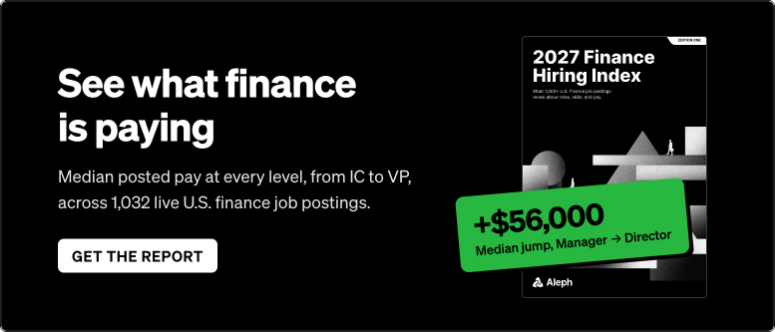
Yes, at every level, though location explains part of the gap. These are the median posted midpoints for AI-requiring roles against the rest:
- IC: $88,750 vs $86,500 (+$2,250)
- Senior IC: $138,200 vs $117,500 (+$20,700)
- Manager / Controller: $165,000 vs $151,500 (+$13,500)
- Director: $230,400 vs $200,000 (+$30,400)
- VP / Head: $302,250 vs $225,000 (+$77,250, on 18 and 21 postings)
Read this as a relationship, not proof that AI skills cause higher pay. AI requirements cluster in technical roles and higher-cost markets, especially the Bay Area. Remove the Bay Area and the gap shrinks, but it doesn't disappear. The pattern also holds within accounting, though it largely fades within FP&A outside the Senior IC level. For the full pay picture by level, see our guide to finance salaries by level.
What AI skills do finance employers actually ask for?
Three things, in the Index's definition: using AI skills in the work, using a named AI tool, or building and running agents. In practice that means drafting variance commentary or board narrative with an assistant, using AI to clean and reconcile data, querying financial data in plain English, and automating recurring workflows.
The tools around AI haven't changed as much as you might think. Excel appears in 52% of postings, more than any other tool by a wide margin, followed by NetSuite (29%), SQL (14%), SAP (10%) and Python (4%). AI is being layered on the spreadsheet, not replacing it, and add-ins that bring Claude into Excel are making the spreadsheet more capable rather than less relevant. Our guide to Claude in Excel for FP&A shows what that looks like day to day.
What is a finance engineer?
A finance engineer is a finance professional who uses AI, automation and systems thinking to redesign how finance work gets done, turning recurring processes into repeatable workflows while keeping the judgment needed to trust the results. The title hasn't caught on yet, but the role is showing up under familiar titles.
The Index found 55 postings, 5.3% of the total, that ask for all three pillars in one hire: finance expertise, ownership of the systems, and SQL or Python or AI tools. 45 of the 55 are in FP&A or strategic finance. We expect the title itself to spread in 2027; our posts on the rise of the finance engineer and meeting the finance engineer cover what the role looks like inside a team.
Do accountants need AI skills?
More and more, yes. 30% of accounting and controllership postings require AI on the job, and 49% mention it somewhere. Accounting is under pressure from both sides: the US labor market for accountants is tight, with the BLS projecting about 115,300 openings for accountants and auditors each year through 2035, and AI is absorbing more of the routine reconciliation and close work that junior accountants used to learn on.
The practical takeaway for accountants is to aim AI at the close: reconciliations, flux analysis and first-draft commentary. Those are the tasks where AI saves the most time, and where your judgment about what's right is what employers are paying for. Our guide to automating month-end close commentary with AI is a good place to start.
What AI tools should finance professionals learn?
Start where the work already is. For most finance teams, that means:
- An AI assistant you use every day, such as Claude or ChatGPT, for analysis, drafting and checking. Our comparison of the best LLMs for finance teams covers the current models and what each does well.
- AI inside your spreadsheet, so you can work on real numbers without copying data out.
- Reusable instructions, such as Claude Skills for finance, so a good prompt becomes a repeatable workflow the whole team can use.
- Basic SQL or Python, if you want to move toward the finance engineer profile. Even 14% of postings naming SQL is a strong signal for analysts who want to stand out.
- Building simple tools, for those ready to go further; our guide to vibe coding for finance teams covers where that helps and where it needs guardrails.
The broader labor market points the same way: the World Economic Forum's Future of Jobs Report 2025 names AI and big data as the fastest-growing skill area through 2030.
Is AI changing entry-level finance hiring?
Possibly, and the posting mix is the clue. Finance hiring skews heavily senior: 79% of postings are for senior individual contributors or above, and only 8% of postings that state an experience requirement ask for two years or less. Even individual contributor postings that specify experience ask for a median three years.
The Index can't prove AI is the cause, but the pattern fits. If AI handles more of the execution work junior analysts used to do, such as pulling data, building first drafts and reconciling accounts, companies will lean toward experienced people who can pair judgment with AI output. For early-career candidates the doors are still widest in accounting, which makes up 61% of individual contributor postings and 42 of the 74 postings that ask for two years or less. Learning to use AI on that close and reconciliation work is the fastest way to look like a more senior hire.
Worked example: writing an AI-ready FP&A manager role
Here's how the Index's hiring checklist turns into a concrete posting for an FP&A manager:
- Outcomes for the first six months: own the rolling forecast, explain the drivers behind performance each month, and lead the monthly business reviews with department heads.
- AI expectation, stated as work: uses an AI assistant to draft variance commentary and prepare review materials, and checks every figure against the model before it goes to leadership.
- Core skills still listed: forecasting, budgeting and a working knowledge of GAAP, the skills 88% of AI-requiring postings keep.
- Work sample in the interview: review an AI-drafted forecast that contains planted errors, then score the candidate on numerical accuracy, assumption quality and the business recommendation.
- Pay and arrangement published: 47% of postings leave out the work arrangement and 23% leave out pay, so stating both makes the role easier to evaluate.
How do you show AI skills in a finance interview?
Bring proof, not adjectives. Prepare one example of AI-assisted finance work, such as a forecast, a variance analysis or a board slide, and walk through how you checked the output, which assumptions you challenged and what recommendation came out of it. Employers want to see that you can spot a wrong number the model produced, not just that you can prompt it.
Have three stories ready: a process you improved, a decision you influenced and an error or bad assumption you caught. Those map directly onto what AI-requiring postings ask for, because 88% of them still want the finance skills behind the work.
How should hiring managers write AI into a finance job posting?
Turn "AI fluency" into a work sample. Give candidates an AI-assisted forecast or variance analysis to review, and ask them to find the errors, challenge the assumptions and explain what the business should do next. Score them on numerical accuracy, assumption quality and the quality of the recommendation. That tests the combination the role needs, rather than filtering on a buzzword.
Also decide what's essential on day one. Most AI tools can be learned quickly by a strong finance hire; forecasting judgment and accounting knowledge take years. If you're redesigning roles around AI, our guide to AI agents in finance and FP&A covers which tasks agents can take on and which still need a person.
Build AI-ready finance workflows with Aleph
Aleph connects your ERP, CRM and HRIS to Excel and Google Sheets and brings AI into the same model, so your team spends its time on analysis rather than pulling and stitching data. See how Aleph's AI works, get the full findings and the hiring and career checklists in the 2027 Finance Hiring Index, or book a demo to see it on your own data.
Get FP&A best practices, research reports, and more delivered to your inbox.


