
Get FP&A best practices, research reports, and more delivered to your inbox.
{callout}
TL;DR
- A finance engineer pairs real finance and accounting judgment with a systems-and-automation mindset.
- The technical execution is getting commoditized by the models; the domain expertise is now the scarce part.
- Most come from within: a finance person who learns to vibe code, not an engineer who learns finance.
- Pairing a deterministic data layer with probabilistic AI is a big part of the job.
{/callout}
Most finance pros are worried about AI taking their job. But an elite few are using it to turbocharge their careers.
Much of the latter camp can be labeled “finance engineers.” It's a new role that describes FP&A pros who are spending less time pulling reports, exporting CSVs, and rebuilding models by hand, and more time designing the systems and workflows that make all of it run automatically.
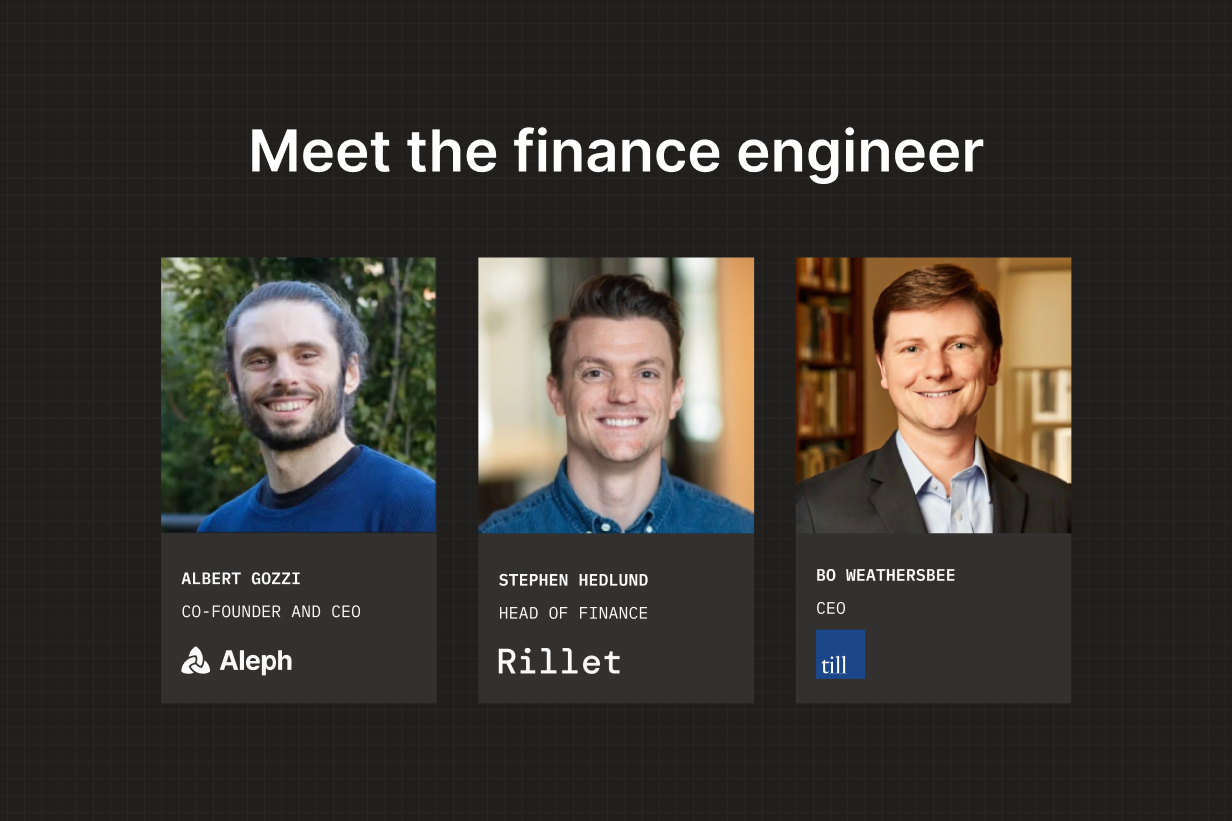
We dug into it in our recent webinar, Meet the Finance Engineer, where Aleph Co-Founder and CEO Albert Gozzi moderated a conversation between Stephen Hedlund (Head of Finance at Rillet) and Bo Weathersbee (CEO and Co-Founder at Till CFO).
The conversation covered what a finance engineer actually is, why the role is emerging now, and how finance people should think about hiring—or becoming—one.
Here are the highlights.
So…what is a finance engineer?
Since the role is still new, the definition depends on who you ask.
But the simplest version is this: a finance engineer is someone who brings an automation and systems mindset to finance work.
The magic comes from pairing finance expertise with engineering capabilities. A software engineer or AI expert who walks into the finance department doesn't know when a number “feels off.” Having the expertise to apply sniff tests to models, plus the ability to leverage increasingly powerful tools like Claude Code, is how finance engineers are 10x-ing their value.
Bo pointed to Boris Cherny, the creator of Claude Code, who's made the same bet out loud—that the people best positioned to write accounting software over the next few years are accountants.
Why is the role emerging now?
The easy answer is “the AI models got really good.” They did.
But that's only half the story. Someone has to hook up those models to your actual systems—ERP, billing, Slack, and the rest—so they can do real finance work.
Bo compared it to the shift from physical to internet businesses: you didn't just buy computers, you re-architected how information flowed. He showed what that looks like when the plumbing is there, and what happens when it isn't.
Same models, opposite outcomes. In one case, the model had access to the right systems, clean data, and auditable workflows. It could do all kinds of useful things, like updating contracts and booking invoices. In the other, it couldn't even get past authentication.
AI is only as useful as the context it can access and the workflow it can safely act inside. Connecting source systems to LLMs, making sure the data is clean, and giving the model the right rails to operate within is becoming a core part of the finance engineer role.
It's also a big piece of the headcount argument, if you need one. As Albert put it, the bar for this role is “automation that lets you keep the finance team flat while the company scales.” That's the ROI case that survives a budget review.
What goes in the job description
Say you've convinced leadership to let you bring on a finance engineer. What are you actually looking for?
A strong financial foundation is a must. Real finance or accounting experience is an indicator that this person has the judgment to know when an output is wrong.
The harder part is finding someone who can pair that judgment with systems thinking. Bo called out two traits that matter most: altitude control and curiosity.
A finance engineer needs to zoom out far enough to see the full system—payroll touching HR, sales, commissions, finance ops, and reporting all at once—then zoom all the way back in to the broken integration that's gumming up the workflow.
Albert's add: don't expect one person to do everything well. Hire the person who's strong in systems thinking and analytical judgment, then pair them with people who are great at partnering across the business. A team that complements each other well is a better bet than searching for unicorns.
The mandate is simple: go automate
If one line captures the job, it's this: the mandate is to automate. Finance engineers need to constantly be on the lookout for manual processes they can take off their team's plate.
To put it another way: look for the low-hanging fruit, automate it, then move on to the next workflow. Rank your team's workflows by how much time they eat, and start at the top.
So you want to become a finance engineer
AI tools are undeniably powerful, but they're also new. They haven't been pressure-tested across the finance department yet. You have to be okay with some bumps along the way.
You also need to carve out time to develop the finance engineering skillset. Both Stephen and Bo protect time to build: Stephen with every-other-Friday build blocks across the company, Bo with a “promote yourself day.”
A few accelerants they mentioned:
- A Claude Code course they built and open-sourced for finance folks that starts at “what is a terminal.”
- An “intent framework” doc that interviews you about your real job and encodes your guardrails into a file the model reads every time.
- Finance communities where people troubleshoot in the open.
Keep the probabilistic layer thin
AI is great at generative, probabilistic work. But finance still needs a trusted, deterministic source of truth: clean data pipelines, governed business logic, auditable calculations, and systems that tie out the same way every time.
That's why a deterministic foundation like Aleph matters so much. It gives AI something solid to work on top of—live finance data, controlled formulas, and logic that finance can inspect and trust. The model can help interpret the work, but the underlying numbers aren't being reinvented from a prompt.
Bo framed the division of labor as a 10-80-10 sandwich: you set the intent up front, the model does the bulk of the work, and finance verifies the output at the end.
How to actually find one, and how to get found
Where do you find these finance engineers, and how do you bring them on board?
In a lot of cases, they're already doing the work in public.
The accountant didn't wait for someone to hand him the perfect finance engineer job description. He started building, posted what he was learning, and made the work visible enough for a CFO to find him.
Two practical moves fall out of that:
- If you're hiring, make vibe coding part of the interview: hand over a messy dataset and watch how someone works through it. Bo has candidates record a Loom of the whole build, and he just hired a controller who'd been posting about using Claude Code on his accounting workflows.
- If you want the job, do the work in public. Post what you build. The receipts are the résumé now.
Make yourself invaluable in the AI age
The role is new, the title is fuzzy, and nobody fully agrees on what to call it yet.
That's where the opportunity lies.
The finance people who figure out what to hire for, or who become the hire themselves, will get a valuable head start.
A few resources to keep going:
Get FP&A best practices, research reports, and more delivered to your inbox.