

Dot grid
Blog
>
Aleph Agent launch

Meet Aleph Agent: AI that answers and acts on your finance data

Finally, AI that knows your finance data inside and out.

Adam Feber
FP&A-obsessed product marketer
Share to
Table of contents
Subscribe to the 10X Finance Blog

Get FP&A best practices, research reports, and more delivered to your inbox.

Thank you! Your submission has been received!
Oops! Something went wrong while submitting the form.

Every finance team runs into some version of the same problem: you have the data, but getting answers from it is a chore.

You’re digging through models, dashboards, and reports trying to find what you need. Sometimes that takes a few minutes. Sometimes much longer. Either way, it pulls your team away from higher-value work.

This is even more frustrating in a world where Claude and ChatGPT can answer questions in seconds.

So teams find themselves stuck in the middle: powerful AI on one side, trusted data on the other, and no clean way to connect them.

Today, we’re bridging that gap.

Meet Aleph Agent

Aleph Agent is AI that sits on top of your financial data. Not a collection of raw data across systems, but the clean, consolidated data layer spanning your ERP, CRM, HRIS, and data warehouse.

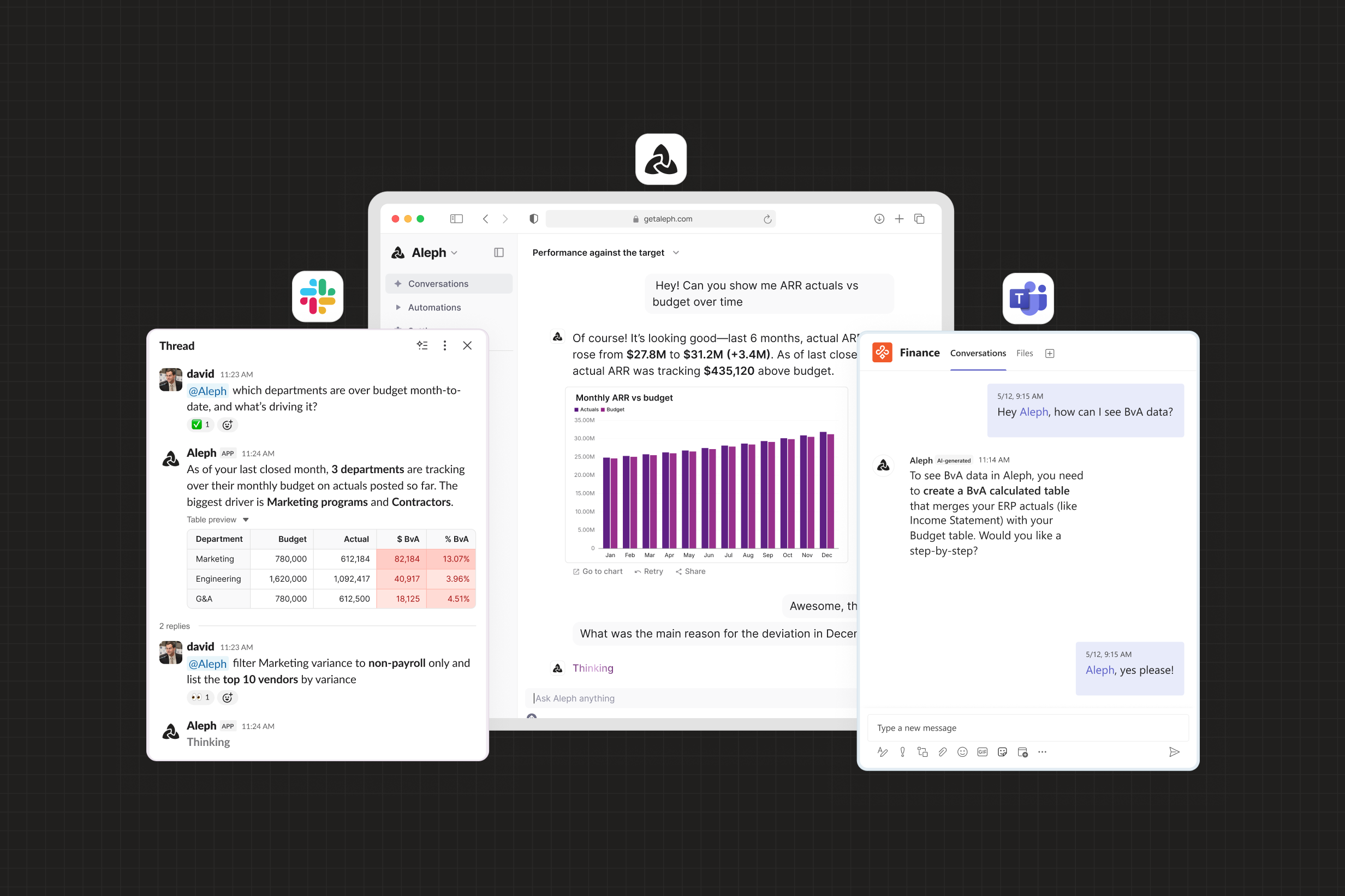
Ask a question in plain language, and it returns a live, governed answer from your connected sources. It’s available in the Aleph web app, in Slack, in Teams…wherever your team already works.

Because it references the same governed data layer your finance team relies on every day, you don’t have to worry about hallucinations. Every answer it gives and action it takes is rooted in your actual data, your definitions, and your chart of accounts.

What can Aleph Agent do?

Give anyone in your organization instant access to financial data

FP&A teams are bombarded with finance questions from across the company—budget check-ins, spend comparisons, forecast updates, etc. Each one pulls them away from the work they were doing.

Stakeholders can ask Aleph Agent many of these questions directly. Just tag @Aleph in Slack or Teams and get a clear, traceable answer in seconds. Ask follow-ups in the same thread, and Aleph Agent keeps the context. It also checks your data permissions before responding so the right people see the right data.

Run quick analysis across multiple data sources

The kind of napkin math that used to mean opening three tabs and a spreadsheet is now a single question:

  • What’s the blended cost per head across departments?
  • How is spend trending vs plan YTD?
  • Summarize headcount changes by department over the last six months

Aleph Agent pulls from your ERP, HRIS, CRM, data warehouse, and billing systems, reasons through the analysis, and returns something you can actually use and trust.

Turn one-off questions into lasting, reusable outputs

When someone asks a question and the answer is useful, it doesn't have to disappear into a Slack black hole. You can save it as a dashboard, a report, or a recurring metric your whole team can access.

Over time, this creates a flywheel: more people asking questions means more verified outputs, fewer repeat asks, and a growing repository of useful management reports.

Stay tuned for more

This is the first in a series of Aleph Agent announcements. There's a lot more coming—stay tuned.

Subscribe to the 10X Finance Blog

Get FP&A best practices, research reports, and more delivered to your inbox.

Thank you! Your submission has been received!
Oops! Something went wrong while submitting the form.

Frequently asked questions

What is Aleph Agent?

Aleph Agent is AI that sits on top of your structured financial data. Instead of working off static exports or disconnected tools, it runs on the same governed data layer your finance team already uses—your models, mappings, definitions, and connected systems. You can ask questions in plain language and get live, traceable answers grounded in your source of truth.

What can Aleph Agent do?

Aleph Agent helps teams get answers and take action on their financial data.

That includes:

  • Answering questions across systems (ERP, CRM, HRIS, data warehouse)
  • Running quick analysis like budget vs. actuals or spend trends
  • Handling follow-ups in context
  • Turning useful outputs into dashboards, reports, or saved metrics

It’s designed to reduce back-and-forth and free up finance teams from repetitive requests.

What makes Aleph Agent different from LLMs like Claude?

LLMs like Claude are powerful, but they don’t understand your company’s financial data out of the box. They don’t know your models, your mappings, or how your metrics are defined—and they don’t have direct access to your governed data. Aleph Agent runs on top of a unified, structured finance data layer, so it can reason with the same context your team uses every day.

Can I trust the answers Aleph Agent gives and the actions it takes?

Yes. Aleph Agent is designed to reduce hallucinations by grounding every response in your actual data and definitions. Because it references your governed data layer, every answer can be traced back to a real source of truth—and every action is based on the same logic your finance team already trusts.

How does Aleph Agent work across multiple systems?

Finance data is typically spread across systems like your ERP, CRM, HRIS, and data warehouse. Aleph brings that data into a single, clean, governed layer. Aleph Agent sits directly on top of that layer—so it can answer questions that span systems without requiring manual exports or stitching data together.

Who can use Aleph Agent?

Aleph Agent is built for the entire organization, not just finance. Department leaders, executives, and operators can ask questions directly, while built-in permissions ensure users only see the data they’re authorized to access.

Discover Aleph today

Contact us and learn how Aleph can help you build your one source of truth for financial data
Screenshot of an income statement spreadsheet comparing revenue, cost of revenue, and operating expenses for Jan 25 and Feb 25, alongside a sidebar menu with options including 'Income Statement,' 'Analyze with AI,' and other budget categories.
Dotted grid