


Get FP&A best practices, research reports, and more delivered to your inbox.
The best cash flow forecasting software for a mid-market company depends on which forecast you own. If cash is forecast inside the planning model, from the P&L, balance sheet and hiring plan, the best picks are FP&A platforms: Aleph, Cube, Datarails and Planful. If you need a weekly, bank-anchored 13-week liquidity forecast, the best picks are cash tools: Agicap, Tesorio and Float, with Kyriba as the enterprise treasury ceiling.
Most mid-market finance teams need the first and occasionally the second. So rank the tools by the job, not by a single score. A platform that wins at runway modeling can still be the wrong buy for clearing payroll on the 15th, and a treasury tool will not hold your three-statement plan. Upper mid-market companies heading toward an enterprise suite can add Workday Adaptive Planning to the planning list.
Bottom line: For cash and runway forecasting inside the plan, start with Aleph if your models live in Excel or Google Sheets, Cube or Datarails if you want a spreadsheet-friendly platform, and Planful if you also need consolidation. For weekly direct-method liquidity, start with Agicap, Tesorio when collections are the real constraint, or Float at the smaller end of mid-market.

The best cash flow forecasting software for mid-market, ranked by job
Pick the list that matches the forecast you have to defend, then shortlist two or three from it.
Cash forecasting inside the planning model (indirect method, monthly, 12 to 24 months):
- Aleph: best for teams that want the cash model to stay in Excel or Google Sheets on live ERP actuals.
- Cube: best for spreadsheet-first teams that want a planning platform around their existing models.
- Datarails (FinanceOS): best for Excel-heavy teams that also want a separate cash module.
- Planful: best for mid-market teams that need planning, reporting and consolidation in one suite.
- Jirav: best for smaller finance teams and accounting firms that need a driver-based three-statement forecast.
- Workday Adaptive Planning: best for upper mid-market companies heading toward an enterprise suite.
Weekly liquidity forecasting (direct method, 13 weeks, bank-anchored):
- Agicap: best for mid-sized companies that want a 13-week forecast from bank and accounting data.
- Tesorio: best when the cash problem is really a collections problem.
- Float: best for the smaller end of mid-market on Xero or QuickBooks Online.
- Kyriba: best as the enterprise ceiling, when treasury, payments and global bank connectivity matter.
If you want the method behind this split, our guide to cash flow and runway forecasting software walks through direct, indirect and runway forecasting in detail. This page is the buyer's shortlist.
What counts as a mid-market company for cash forecasting?
The usual definition is revenue between $10 million and $1 billion. That's the band the National Center for the Middle Market uses for the roughly 200,000 US companies that account for about a third of private-sector GDP and employment.
For a cash forecasting purchase, revenue matters less than the shape of the cash. A typical mid-market profile looks like this:
- One to five legal entities, sometimes in more than one currency.
- Two to six bank accounts, often at more than one bank.
- A few hundred to a few thousand open invoices at any time, on both the AR and AP side.
- An ERP or accounting system such as NetSuite, Sage Intacct, QuickBooks Online, Xero or Dynamics 365 Business Central.
- A finance team of three to fifteen people, with no dedicated treasury function.
That last point drives the decision. Without a treasury team, the cash forecast usually belongs to the controller or the FP&A lead, and it has to fit beside the budget, the reforecast and the board pack rather than living in its own system.
Cash flow forecasting software compared
The single most useful filter is method: direct tools start from bank balances and dated cash events, indirect tools derive cash from the P&L and balance sheet, and only a few do both.
Pricing models are as of November 2026. Most of this category quotes rather than lists, so confirm terms with each vendor.
The tools, one by one
1. Aleph
Aleph keeps the cash model in Excel or Google Sheets and feeds it live ERP actuals, including AR and AP detail from NetSuite, QuickBooks, Xero and Sage Intacct. Forecast versions are stored, so each week's or month's forecast can be compared against what actually landed without rebuilding the file. That makes it a strong fit for indirect cash and runway forecasting inside the same model as the budget and reforecast, and workable for a spreadsheet-built 13-week forecast.
Weak spots: no production bank connectivity yet, because the Plaid connector is in beta, and no collections workflow. If the weekly position has to start from this morning's bank balances automatically, pair it with a cash tool or keep a manual bank refresh.
2. Cube
Cube is a spreadsheet-native planning platform that syncs Excel and Google Sheets models with ERP and other source data. It handles indirect cash forecasting inside the plan well. Weak spots: no direct-method engine or bank feed, so weekly liquidity needs another tool. Our Cube alternatives guide covers who it fits best.
3. Datarails (FinanceOS)
Datarails is the Excel-native FP&A option with the clearest separate cash product. Its Cash module, sold as an add-on, connects bank and ERP data and markets rolling and 13-week forecasts. Weak spots: you're buying a second module, and the core FP&A product still works at a monthly grain. Compare it with Excel-first alternatives on our Datarails alternatives page.
4. Planful
Planful combines planning, reporting and consolidation, which suits mid-market companies with several entities. Cash flow planning in Planful is mostly indirect, built from the three statements. Weak spots: direct-method forecasting depends on the ERP exposing cash movement detail, and implementations take longer than lighter tools. See Planful alternatives for the wider field.
5. Jirav
Jirav offers driver-based three-statement forecasting, a zero-cash date and packaging aimed at accounting firms that serve many small clients. Weak spots: it sits at the smaller end of mid-market, and weekly liquidity isn't its focus. More on the trade-offs in our Jirav alternatives comparison.
6. Workday Adaptive Planning
Workday Adaptive Planning, now branded Adaptive from Workday, is the enterprise-grade planning suite that many upper mid-market companies grow into. Cash planning sits inside a governed, multi-entity model. Weak spots: a direct-method weekly model is a build project rather than a configuration, and cost and implementation time rise with it.
7. Agicap
Agicap positions itself as cash flow management for SMB and mid-market companies, with forecasts up to 13 weeks ahead built from actual bank and accounting data. It says it serves more than 8,000 clients in 12 countries and connects to thousands of banks. Weak spots: its roots and bank coverage are strongest in Europe, so US teams should test their own banks in the trial, and it won't hold your budget or three-statement plan.
8. Tesorio
Tesorio comes at cash from the receivables side. Its AR forecast predicts inflows at the customer level, and its collections agents handle dunning, payment promises and cash application, with pre-built connectors for NetSuite, Sage Intacct, Workday, Salesforce and Stripe. If your forecast keeps missing because customers pay late, this is the most direct fix. For more on predicting payment timing, see our roundup of AI cash flow forecasting tools. Weak spots: it's an order-to-cash platform, not a planning tool.
9. Float
Float is scenario-based cash flow forecasting with published monthly pricing. Its Growth plan targets companies above £2 million in revenue, a Scale plan covers multi-entity teams, and live integrations are Xero and QuickBooks Online, with Sage Intacct listed as coming soon. Weak spots: it fits the smaller end of mid-market, and NetSuite shops are not its core audience today.
10. Kyriba
Kyriba is an enterprise treasury platform: global liquidity, bank connectivity, payments and cash forecasting in one workstation. It's here as the ceiling. Weak spots: for a company without a treasury team, it's more system, and more cost, than the cash forecast needs.
How should a mid-market company choose cash flow forecasting software?
Score each shortlisted tool on the five things that decide whether the forecast survives its first quarter:
- Invoice-level AR and AP detail. A direct forecast needs open items with due dates, not a summarized trial balance. Ask each vendor to show your open AR by customer and due date in the demo.
- Refresh cadence. A forecast rebuilt by hand every Monday gets abandoned. Check how often actuals refresh and whether anyone has to export and paste.
- Versioning against actuals. The value of a cash forecast comes from comparing last period's forecast to what cleared and fixing the assumption that missed. The tool should store every version.
- Bank connectivity. For weekly liquidity, an automatic bank feed matters. For a monthly indirect forecast, it usually doesn't.
- Fit with the rest of the plan. If the CFO wants runway, hiring and cash in one model, a separate cash tool means reconciling two systems. Our guide to budgeting software for mid-market companies covers the planning side of that decision.
Can one tool handle both direct and indirect cash forecasting?
A few can, with trade-offs. Datarails does it with a separate Cash module, Workday Adaptive Planning does it with a build, and Aleph does it in the sheet, on live AR and AP detail but without a production bank feed. Most mid-market teams end up running indirect forecasting in their planning platform and either a spreadsheet or a dedicated cash tool for the weekly view. That's a reasonable setup, as long as both draw from the same actuals.
Is Excel enough for mid-market cash flow forecasting?
Often, yes, if the data arrives on its own. With one or two banks and a few hundred open invoices, a 13-week forecast in Excel works well, provided open AR and AP flow in at line level, actuals refresh on a schedule, and every weekly version is saved. What breaks spreadsheet cash forecasting is the manual export and paste, not the spreadsheet. Our rolling forecast template is a usable structure, and the case for real-time spreadsheet syncing explains how to remove the paste.
Move to a dedicated cash tool when you have more than a handful of banks or currencies, a lender asking for weekly borrowing-base reporting, or collections behavior that needs customer-level modeling.
Worked example: a $60 million company with two needs
Take a $60 million B2B company on NetSuite with three entities, four bank accounts and about 900 open invoices. The board wants an 18-month runway view with hiring scenarios, and the revolver requires a rolling 13-week cash forecast every Monday.
The runway view belongs in the planning model, so the shortlist is Aleph, Cube or Datarails, with Planful if consolidation is also on the list. The 13-week forecast is the open question. With four banks and 900 invoices, a spreadsheet forecast on live AR and AP detail, with a ten-minute manual bank refresh each Monday, is enough. If collections slip and the forecast keeps missing, add Tesorio. If the bank count doubles after an acquisition, add Agicap or move up to a treasury tool. Either way, one planning platform plus one weekly process beats two planning systems.
Common mistakes when buying cash flow forecasting software
- Taking a weekly liquidity requirement into an FP&A demo. The platform will show a monthly cash flow statement and look right. It won't tell you whether you clear payroll on the 15th.
- Buying a treasury workstation for a five-bank company. You pay for global connectivity and payments you don't use.
- Skipping the variance loop. A forecast nobody compares against actuals stops improving after the first month.
- Forgetting runway. For venture-backed companies, the zero-cash date and hiring scenarios matter more than weekly precision. Our Runway alternatives guide covers that use case.
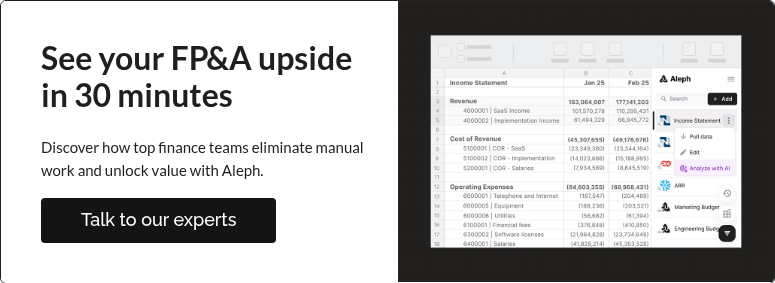
Forecast cash on live data with Aleph
Aleph connects NetSuite, QuickBooks, Xero and Sage Intacct to the Excel and Google Sheets models your team already uses, so the cash forecast, the financial model and the reforecast run on the same live actuals. Every forecast version is saved, so variance against actuals runs without a rebuild. Book a demo to see your own cash model running on live data.
Get FP&A best practices, research reports, and more delivered to your inbox.


