
















FP&A software comparison
Aleph vs. Datarails
Verified G2 reviewers say that Aleph is faster and easier to set up, administer, and use than Datarails.
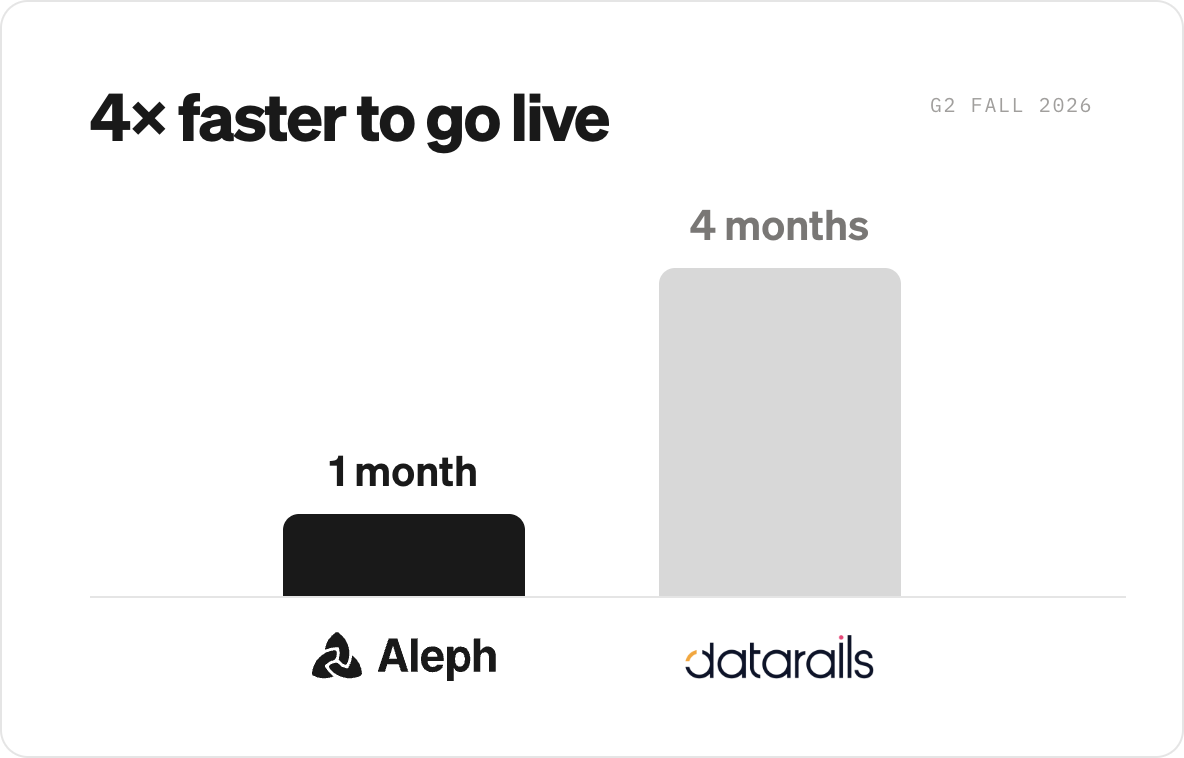
Time to go live on G2: Aleph 1 month versus Datarails 4 months
Trusted by industry-leading finance teams
G2 head-to-head ratings
Aleph vs. Datarails at a glance
Aleph users go live sooner, realize ROI faster, and rate it easier to set up, administer, and use. Every score below comes from verified G2 user reviews.
Aleph
Datarails
Star rating
4.9
4.6
Time to go live
1month
4months
Time to ROI
4months
14months
Ease of Setup
9.3
7.8
Ease of Admin
9.5
8.3
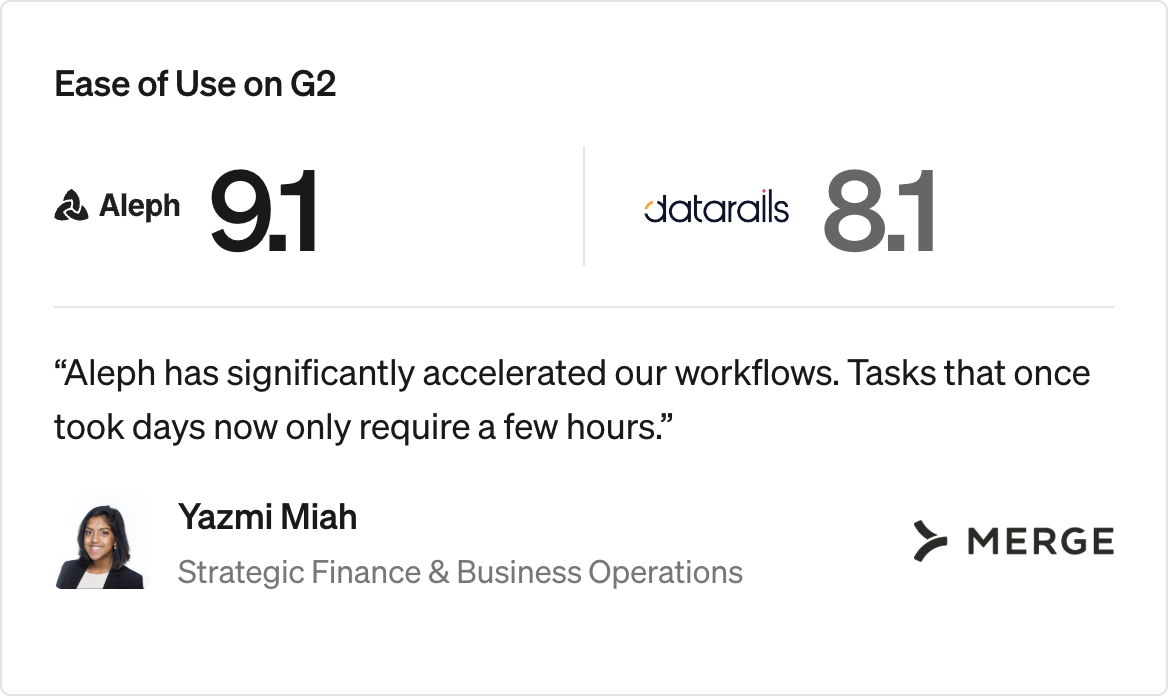
Ease of Use
9.1
8.1
Quality of Support
9.8
9.3
Good partner in business
9.9
9.2
Why Aleph?
Why finance teams choose Aleph over Datarails
No implementation project

Aleph connects to your systems and works on the models you already have. Most teams are up and running in days without the need for costly consultants or scoping engagements.

Google Sheets, not just Excel

Aleph works natively in Excel and Google Sheets. Finance can stay in Excel while the business works in Sheets, with both working from the same live data.

Add a dimension without a rebuild

Aleph reads dimensions directly from your source systems. Add a new entity, brand, or vendor without rebuilding templates or slowing down your models.

Beyond planning
A modern way to run FP&A

Aleph is built around the way finance actually works across spreadsheets, systems, and AI tools.
Watch a full demo
Performance
Dotted grid
Performance

Scale without the growing pains

Aleph gives you multiple ways to pull governed data into Excel and Google Sheets, so you’re not forced into a one-size-fits-all approach as your team grows.

Use pivots, custom functions, tables, or selective syncs to bring in exactly what the model needs. Always available in Excel, Mac, and Google Sheets.
Platform
Dotted grid
Platform

One platform without add-ons

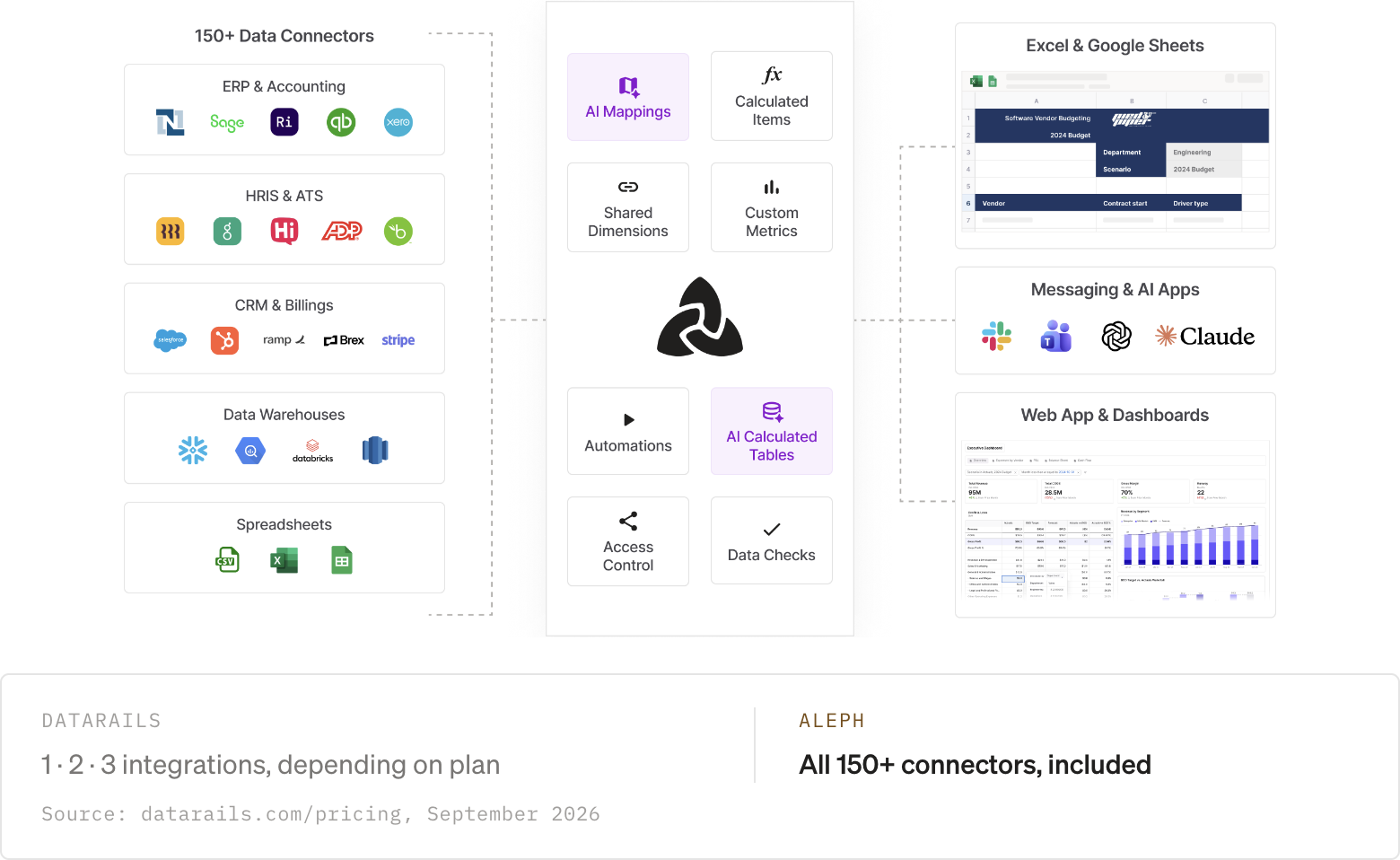
Datarails limits integrations by plan and packages capabilities like cash management, month-end close, and spend control separately.

Aleph brings your core finance workflows together in one platform, with connectors across ERP, HRIS, CRM, billing, banks, and data warehouses, plus unlimited entities, AI usage, implementation, and support included.
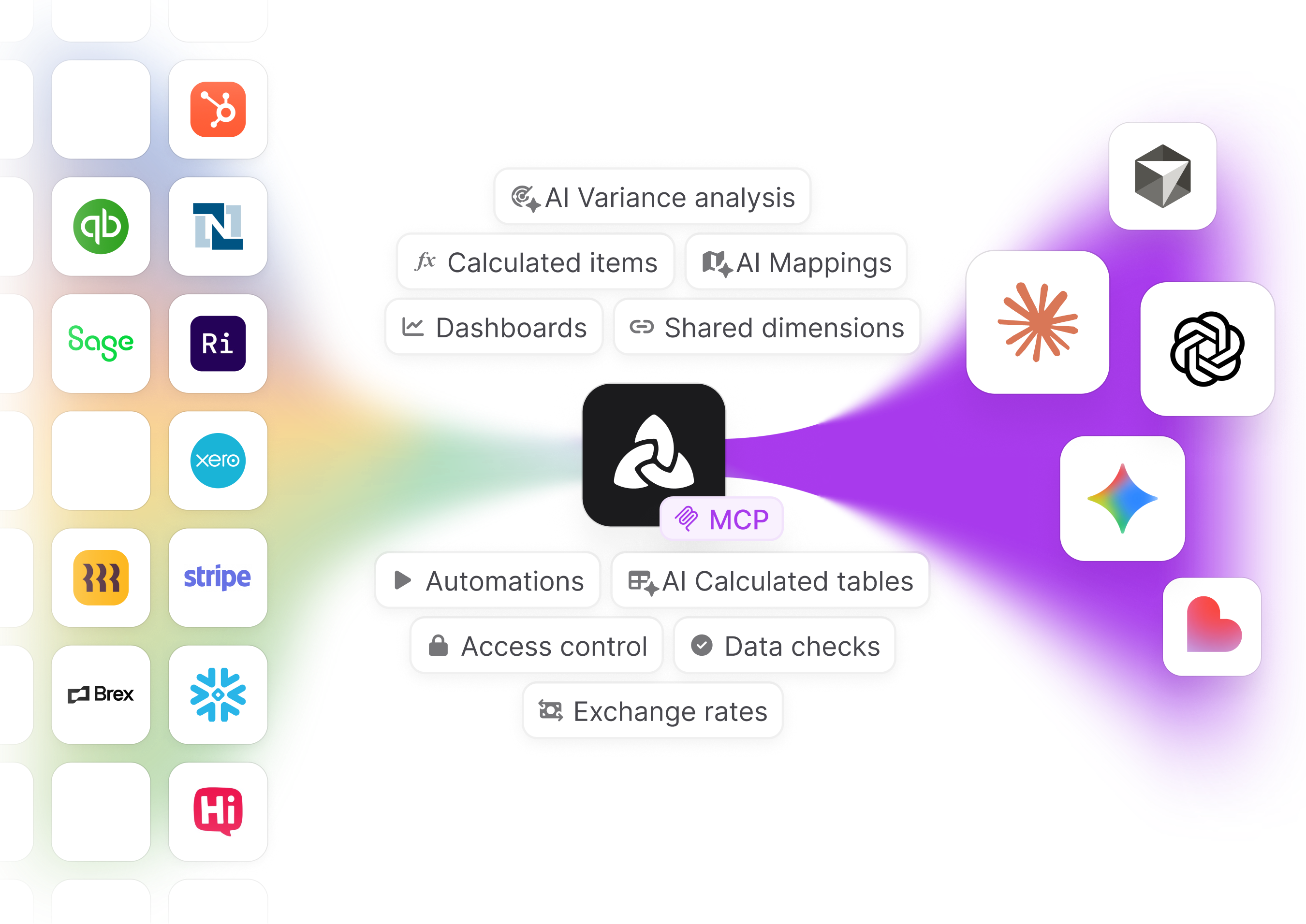
AI
Aleph connected to finance and business app icons, feeding live data to AI tools
Dotted grid
AI

AI that works where your team does

Aleph Agent runs on the same governed data in Excel, Google Sheets, Slack or Teams, the web app, and in Claude or ChatGPT through Aleph MCP.

Ask a question, build a dashboard from a prompt, or run a what-if and push it back into the forecast — every answer traces to the transaction.

Switcher proof
Hear from those who switched
Real quotes from finance teams who evaluated or switched from Datarails to Aleph.
“Datarails seems just way too heavy and getting pretty expensive. Even some of the modules you can add on, cash flow forecasting isn’t even there. And you’re not as close to the data either.”
Real users, real results
Finance teams love Aleph

Join hundreds of industry-leading finance teams that love and trust Aleph.

Don’t just take our word for it; read what they have to say.

“We were live and answering board questions with confidence within two weeks. Aleph lets us see financial data from seven different accounting systems in a uniform way.”

Jonathan Hardy
VP of Finance

“It will genuinely change the hiring needs of your finance team. An insanely ROI-positive investment.”

Peter Brock
Strategic Finance

“Aleph’s flexibility lets us slice and dice data across multiple dimensions faster than our source systems. It’s a game changer for how we collaborate and make decisions. If I were ever to leave Zapier, I’d have to take Aleph with me.”

Miranda Conley
Senior Director of Accounting
Case Study

“Aleph has been a game changer for us. We’ve gone from tracking 10 to 15 drivers of our forecast model to now something like 50.”

Chuck Fisher
CFO
Case Study

“For me, Aleph is an FP&A analyst. It lets me replace a full-time resource I’d otherwise have to hire.”

Mike Russo
VP of Finance
Case Study

“The first two years, finance was seen as a gatekeeper. Now, with Aleph, we’re viewed as trusted partners who bring insights in real time. That’s priceless.”

Omar Asghar
Director of FP&A
Case Study

“It adapts to the way we work, rather than forcing us to adapt to it. I don’t see myself using another FP&A tool ever again.”

Nick Zaharchuck
Head of FP&A

“The only tool I’ve seen that plugs into Excel and Sheets the way it does — and you can self-drive implementation, without consultants.”

Katharine Adame
Director of Strategic Finance

“The Aleph team has gone above and beyond—clearing the bar by a mile. They’ve shown up for us at all hours and treated us the way we’d want to treat ourselves. It’s been a truly great partnership.”

Bryce Heinz
CFO
Case Study

“We started demoing Aleph in nearly every finance pitch, and our win rate went up.”

Chris Mossa
CEO
Case Study

“Having our data and forecasts at our fingertips in Excel was why we loved Aleph. Now that work is shifting to the agentic world, Aleph MCP unlocks a whole new level of productivity — and a new way to operate.”

Axel Amar
SVP of Finance

“We’re not adding headcount just to pull reports or maintain infrastructure. We can lean on Aleph to do that and focus on hiring for value — where we can drive decision-making.”

Chris Brubaker
SVP of Finance
Case Study

“Aleph lets us build data pipelines from NetSuite and Redshift and put that data directly into the hands of our analysts and non-technical staff. It’s flexible and truly self-serve.”

Jonathan Geraci
Senior Director of Finance

“What used to take a day and a half is now automated with Aleph — it now takes maybe 20 minutes. This has been absolutely huge for us.”

Ariana Egli
Senior FP&A Manager
Case Study

“Aleph has totally revolutionized the way that we do FP&A at AllCloud.”

Ryan Freudenburg
Director of FP&A
Case Study

“You weren’t kidding when you said it’s plug-and-play and you immediately play. We were up and running in the same week.”

Connie Ho
Sr. Finance Manager
Case Study

“Aleph changed our processes from messy, tedious, and error-prone to smooth and streamlined. We can get answers immediately.”

Ani Kochiashvili
Finance Technology Lead
Case Study

“We moved all our financial reporting to Aleph. Our Excel reports now update in seconds. There’s a before and after in the way we work.”

Sergio Prada
FP&A Director
Case Study

“Our ability to access, analyze, and model our data has dramatically improved. Tasks that once took days now take a few hours.”

Yazmi Miah
Strategic Finance & Business Operations
Case Study

“On the spectrum of FP&A tools out there, Aleph is the most user-friendly one I’ve come across.”

Jon Gross
CFO
Case Study

“What was our process before Aleph? I don’t even like to think about that anymore. It gives me the shakes.”

Johnnie Walker
Director
Case Study

“I’ve been born and bred in FP&A for almost 20 years, and kudos to Aleph for building the tool I’ve always wanted.”

Brandon Sullivan
CFO
Case Study

“Aleph ties our whole finance stack together — financial data, headcount, and hiring pipeline all flow into one place automatically. It’s fast to set up and genuinely changes how you work day to day.”

Shane Crowley
Strategic Finance
Questions
Aleph vs. Datarails FAQs
Implementation, spreadsheets, dashboards, drill-downs, support, and what it actually takes to switch.
Aleph is an AI-native FP&A platform. It connects to your ERP, HRIS, CRM, data warehouse, and spreadsheets — over 150 integrations — then cleans, maps, and consolidates that data and pushes it back into the tools your team already uses: native add-ins for Excel and Google Sheets, a web app with dashboards, and AI assistants like Claude and ChatGPT via MCP. You keep your existing models; Aleph keeps them fed with live, drillable data.
On G2, Aleph customers report going live in an average of 1 month vs. 4 months for Datarails, and reaching ROI in 4 months vs. 14. Aleph connects to your existing systems and works on the models you already have, so most teams self-serve setup in days — no consultants, no dev resources, and no separate implementation fee.
Yes. Aleph’s add-ins are native in both Excel and Google Sheets, on any machine, so finance can keep its Excel models while the rest of the business collaborates in Sheets. Datarails is built around Excel — teams who work in Google Sheets tell us they end up running reports in Excel and moving them into Sheets by hand.
Aleph dashboards run on the same governed data as your spreadsheets, so business partners can answer their own questions instead of queueing behind finance — and every chart drills down to the underlying transaction. Reporting and dashboarding is one of the more common gaps teams mention when they outgrow Datarails.
Yes, across any dimension. Every number traces to the transactional level, and you can pivot by vendor, department, customer, or any dimension you’ve mapped, then run cause of change on the spot. Teams switching from Datarails often cite drill-downs that only go one level deep, or that stop short of vendor-level detail.
The person who builds your setup is the one who answers when you Slack a year later — no handoff to a support desk that has never seen your model. Every Aleph customer gets a dedicated Slack or Teams channel and answers in hours. On G2, Aleph scores 9.8 for quality of support vs. 9.3 for Datarails.
The next era of FP&A
Get the FP&A layer, skip the implementation
Aleph connects to the systems and models your team already uses, so most teams are live in about a month — no consultants, no separate implementation fee.
Screenshot of an income statement spreadsheet comparing revenue, cost of revenue, and operating expenses for Jan 25 and Feb 25, alongside a sidebar menu with options including 'Income Statement,' 'Analyze with AI,' and other budget categories.
Dotted grid