
Get FP&A best practices, research reports, and more delivered to your inbox.
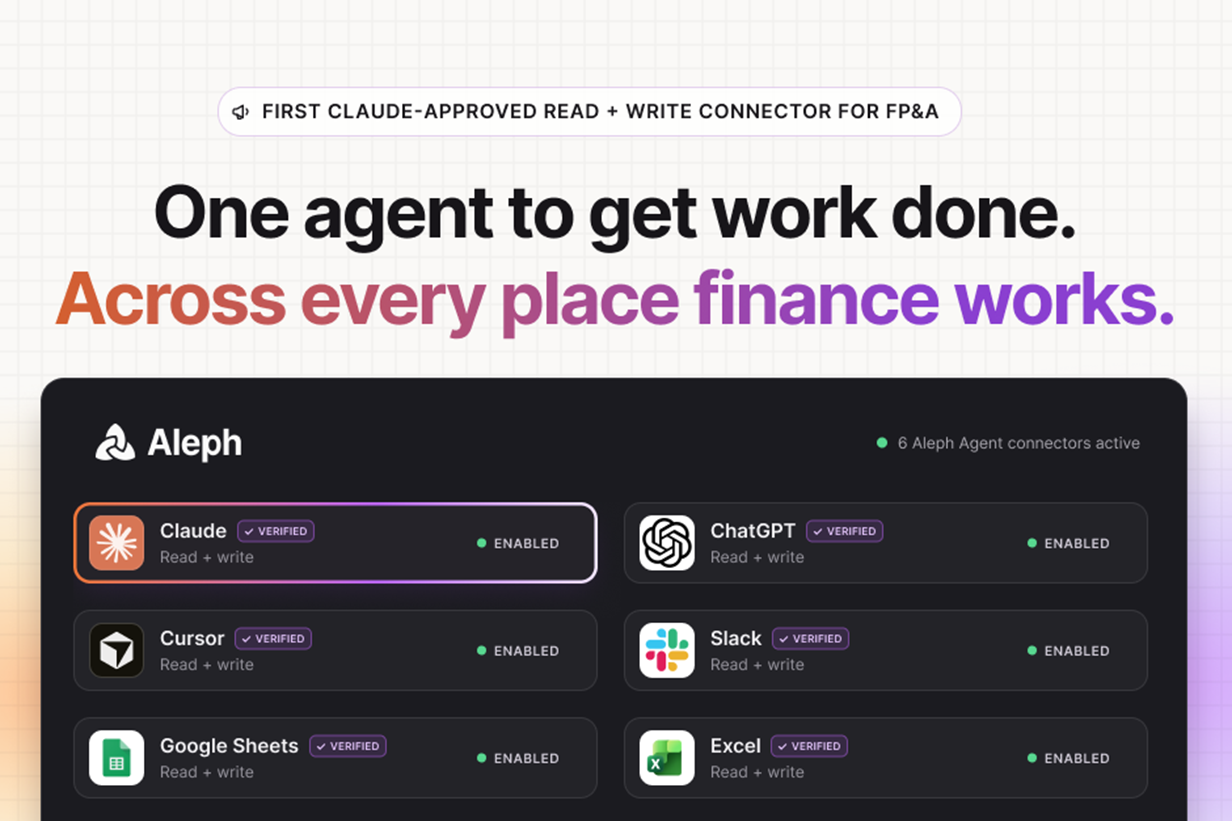
Last week, Aleph’s Claude connector was approved in the Claude Connectors Directory, making Aleph the first official FP&A platform with read/write access for Claude—and the only vendor verified across both Claude and ChatGPT. And Cursor, if you’re keeping score.
But the listings are simply milestones, not the story.
Every software platform claims to be AI-native now. The term has lost much of its meaning. So here’s a better test: What can the AI actually build for you?
Most finance AI can read your numbers, summarize them, and hand the work back to you—or to a dashboard.
Helpful, yes. But transformational? Not quite.
Aleph is agent-native. Aleph Agent can answer questions and run analyses, but it can also complete the work end to end: analyze, build, update, verify, and maintain. Aleph Agent operates. You supervise.
Here’s what that looks like in practice.
Aleph customers are deploying agents to build
In a single week, one finance leader used Aleph through Claude to:
- Run an FY expense review against plan and the 3+9 forecast, down to the top vendors in each category
- Build a multi-currency functional P&L on a newly connected data feed, applying spot and average FX rates by account type
- Classify revenue and costs using existing ERP mappings and reclassify certain marketing expenses into cost of revenue
- Wired consolidated tables into a live reporting pack
- Kick off a balance sheet roll-forward
Together, those prompts produced a working consolidation pipeline. Aleph and Claude coordinated more than 100 tool calls without requiring the finance leader to orchestrate each step.
We announced the Aleph Agent and MCP in May. In the first week of early access, customers made 1,157 MCP tool calls. Three months later, customers made 20,310 MCP tool calls in a single week.
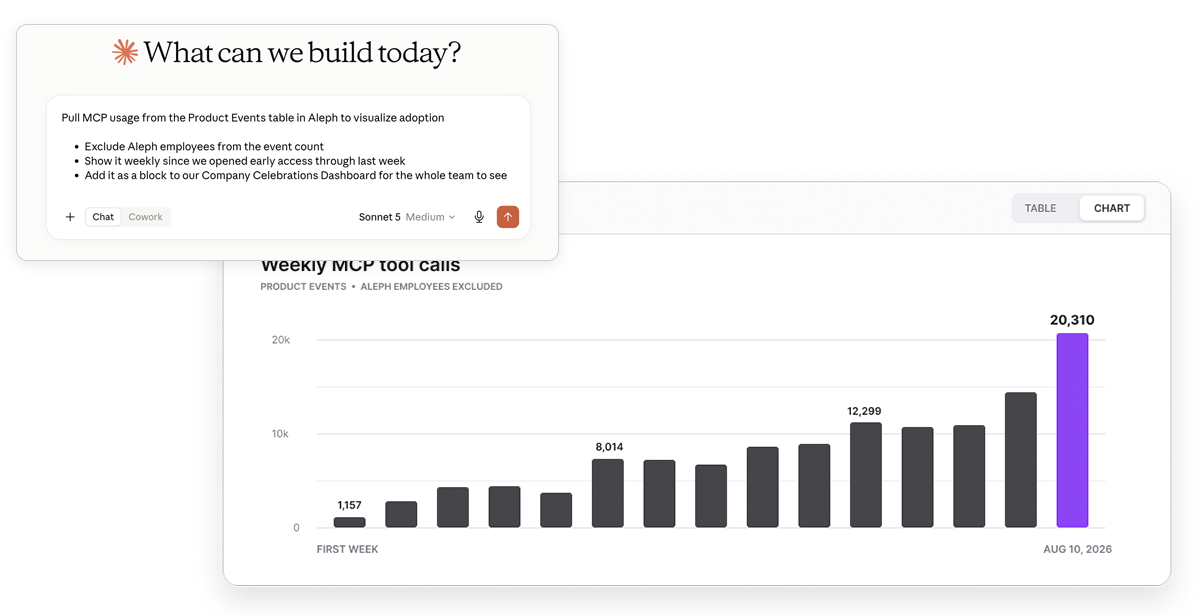
MCP tool calls aren’t business outcomes on their own. The more important signal is what customers are producing with them:
{{quote-1}}
{{quote-2}}
What does “agent-native” mean?
Software engineering reached this shift first.
In tools like Cursor and Claude Code, agents write code, run tests, and open pull requests. Engineers review, correct, and decide what ships.
Finance can now work the same way. In traditional software, humans operate the tool at every step. In agent-native software, humans set the objective, supply judgment, and supervise execution.
Finance judgment becomes even more important in this environment. It's now the constraint—when there's no cap on how many analyses a team can build, the bottleneck becomes whether it knows which questions to ask, how to evaluate the answers, and when to intervene.
For us, agent-native software has to pass four tests:
- It has feature parity with the user. If a user can perform a task in the product, the agent can perform it too—under the same permissions and approval controls.
- It can complete multi-step work. It can move from analysis through implementation without requiring the user to coordinate every intermediate action.
- It's built for supervision. Material changes are previewed, approved, recorded, and recoverable.
- It operates with business context. The agent works against the organization’s governed data model, mappings, metrics, and permissions.
A handful of write actions does not make a product agent-native. The system underneath has to make those actions reliable, governable, and useful.
How agent-native capacity compounds
Every useful finance answer creates more work behind it. Someone still has to build the analysis, verify the logic, update the model, maintain the output, and own whatever comes next. Read-only AI can speed up the first step; the rest still lands on finance.
Agent-native software changes that. In Aleph, the agent doesn’t stop at finding and explaining the answer. It can carry the work forward: build on the governed data model, update tables and mappings, wire reports, manage access, and maintain what it creates.
That’s where capacity starts to compound.
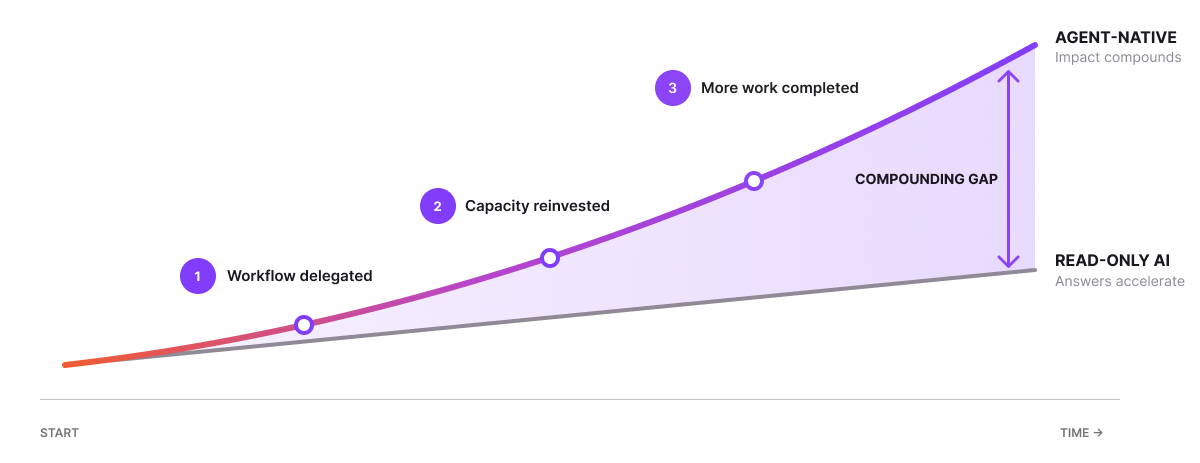
Each successfully delegated workflow releases capacity for the next. More work gets completed, the someday list gets shorter, and the impact compounds.
{{quote-3}}
What supervision actually looks like
Write access to financial data should make finance leaders cautious. It makes us cautious too.
That’s why consequential actions in Aleph follow a preview-and-confirm flow. When an agent proposes building a calculated table, pushing data, adding a column, deleting rows, linking a dimension, or changing permissions, it stages the change and shows the user what will happen before executing.
More destructive actions require additional, explicit confirmation. An overwrite identifies the exact slice it will replace. A deletion must be approved directly.
The checks continue after the preview. If the underlying table changes while a data push is being reviewed, Aleph rejects the push and re-stages it against the current data.
Committed changes carry a record:
- Versions identify the initiating user and whether the change came through Aleph or an external agent surface
- Commit messages and row-level differences show what changed
- Logs and version history provide a path to roll back prior work
- Existing workspace permissions determine which data and actions are available to each user
Finance can keep their judgment in the loop while moving at agent speed.
Verified where your team already works
Agent-native software shouldn’t be confined to one interface. It should meet finance teams wherever they already work.
Aleph is the only FP&A platform verified across Claude, ChatGPT, and Cursor—and the first verified connector with read/write access for Claude.
Those are only three of the places Aleph Agent can run. The same foundation also supports the Aleph web app, Slack, Teams, Excel, and Google Sheets.
- A budget owner can ask in Slack why spend is over and get an answer grounded in live numbers and business context.
- An analyst can replace hardcoded spreadsheet cells with dynamic values tied to live source data.
- A finance leader can use Claude to merge and transform two source tables into a production table for a new workflow, all without leaving the conversation.
The interface changes. The governed data, business logic, and permissions underneath remain consistent.
Wherever the work starts, Aleph’s agents are ready to answer, act, and automate.
The model isn’t the moat
Intelligence isn't the differentiator anymore. Frontier models are already remarkably capable of finance reasoning, and will continue to improve.
What matters now is what your AI can do with that intelligence. Does it have a durable infrastructure underneath: clean mappings, defined metrics, enforced permissions, operational tools, and a complete history of what changed? Does it show up where your team works? Do you trust it?
That's what agent-native finance looks like: AI that can take on real finance work, not just talk about it.
Schedule a demo to see what the Aleph Agent can build for you.
Get FP&A best practices, research reports, and more delivered to your inbox.