Get FP&A best practices, research reports, and more delivered to your inbox.
Thanks — check your inbox.
Something went wrong. Please try again.
Every FP&A team wants to be great. But "great" means different things at different stages.
For a 5-person finance team, top-tier performance is a clean P&L and trusted actuals. But if that's all you can provide as a VP of Finance at one of the Fortune 500, your days are likely numbered.
The vital signs that matter most, the capabilities that are table stakes vs. aspirational, the friction points that trip teams up...all of it shifts as the business scales.
This post walks through what FP&A excellence realistically looks like at three major inflection points: what’s expected, common pitfalls, and the path to peak FP&A performance.
Seed/Series A: Keep it simple, move fast, don’t break trust
One FP&A hire—maybe. Could be the CFO doing everything.
Limited tooling, limited process, and limited time are your reality. A world-class finance function is unrealistic at this stage. Instead, aim to provide the business with enough solid data to make good decisions.
Great FP&A at Seed/Series A
Vital sign
The standard
Complexity
• Single entity, one product, one currency
• The business fits in your head
Foundation & actuals
• 1–3 day close (the business is simple enough that this should be fast)
• A single trusted source for actuals (even just a well-maintained spreadsheet)
• KPIs may live in one person’s head, but board deck numbers are trustworthy
Data quality & governance
• Reactive is normal
• Version control = file naming
• Can we trust what’s going out the door?
Planning & modeling
• Annual budget, built in weeks (the business is small enough that it shouldn't take longer)
• Rev/HC/opex in separate spreadsheets
• Quarterly forecast updates
• Directionally right > perfectly integrated.
Agility & decision velocity
• Often your biggest strength—one person, one model, minimal red tape
• Scenarios happen on the fly
Cross-functional collaboration
• Natural—you’re two seats from the CEO
• Influence comes from proximity, not process
• The whole company is in one Slack channel
Reporting & influence
• Numbers with minimal narrative
• Stakeholders know the context because they were in the room
• A clean P&L with a few callouts is plenty
Two to five people. $20M–$100M+ in revenue. Complexity creeping in everywhere.
Board expectations have ratcheted up. You may have new investors, new products, and maybe even international expansion. You're at a key inflection point—FP&A teams either level up or stall out at this stage. Those that push through realize early on that the things that worked at Series A start breaking down under the weight of a more complex business.
Great FP&A at Series B/C
Vital sign
The standard
Complexity
• Multi-product likely, maybe multi-entity
• Revenue 2x'd, but the close is 3x harder
Foundation & actuals
• Close in 5–7 business days
• Centralized, governed source of truth for finance and operational data
• KPI library with clear ownership—defined and adopted
Data quality & governance
• Shift from reactive to proactive
• Automated data feeds replacing CSV exports
• Real version control with change tracking
• Chart of accounts designed to scale across entities
Planning & modeling
• Integration becomes critical—rev, HC, and opex models talk to each other
• Monthly forecast cadence with driver-based inputs for key areas
• Budget cycle under 3 months
Agility & decision velocity
• The hardest vital sign to maintain
• More stakeholders = more sign-offs = slower
• Invest in pre-built scenario templates and self-serve reporting to keep speed from eroding
Cross-functional collaboration
• Proximity no longer does the work
• Need structured intake and explicit strategy-to-plan linkage
• FP&A fighting for its seat at the strategic table, not waiting to be invited
Reporting & influence
• One-size-fits-all stops working
• Start automating recurring reports so FP&A time shifts from building decks to analyzing them
Series D+: Automate reporting & focus on the story
Five-plus on the FP&A team. Revenue north of $100M. You're in the big leagues now.
Capabilities that were aspirational at Series B are now table stakes. The question isn’t whether you have governance or integrated planning—it’s whether they'll hold up at the next phase, whether that’s IPO, exit, or continued scale.
Great FP&A at Series D+
Vital sign
The standard
Complexity
• Multi-entity, multi-currency, possibly post-M&A
• Consolidation is a real workstream, not a spreadsheet exercise
Foundation & actuals
• Close in under 10 business days with full consolidation and audit readiness
• Real-time visibility into key operational metrics between closes
• Fully governed data with access controls and audit readiness
Data quality & governance
• Automated monitoring with SLAs and escalation
• Full audit trails with rollback
• Formal governance process for CoA changes
• Data treated as infrastructure
Planning & modeling
• Continuous reforecasting between formal cycles
• Budget cycle in 2–4 months across all functions
• Fully integrated across all functions—including capacity, pipeline, and strategic initiatives
• Driver-based models with forecast-vs-actual feedback loops
Agility & decision velocity
• Maintaining speed within the controls you’ve built
• Pre-built scenario templates on demand
• Self-serve dashboards
Cross-functional collaboration
• FP&A co-owns resource allocation
• Strategic portfolio management with capacity planning
• Formal intake with SLAs
• The test: is FP&A part of strategic convos?
Reporting & influence
• Recurring reporting fully automated
• Time goes to exceptions and strategic storytelling
• Proactive risk flagging with predictive elements
• Audience-aware narratives with recommended actions
One pattern across these stages: the companies that punch above their weight aren’t the ones with the biggest teams or the fanciest tools. They’re the ones that invest in the right capabilities at the right time.
An early-stage company that builds a clean data foundation and protects its agility can score like a team a stage or two ahead. A growth-stage company that automates the right things and invests in storytelling can operate with the precision of a public company without the bureaucracy.
The point isn’t to be perfect for your stage. It’s to know what matters most right now and focus there.
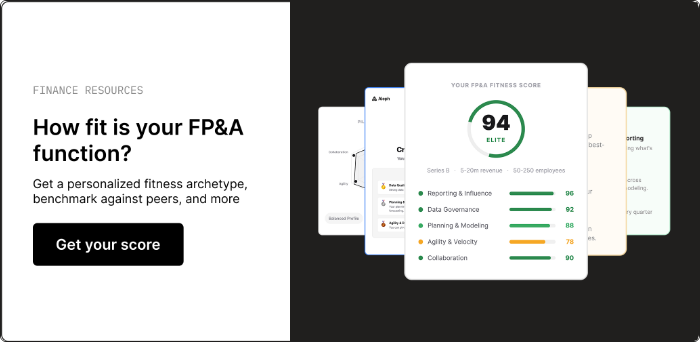
See how your team stacks up. The FP&A Fitness Test scores you across all six vital signs and gives you a tailored training plan.
Subscribe to the 10X Finance Blog
Get FP&A best practices, research reports, and more delivered to your inbox.
Thanks — check your inbox.
Something went wrong. Please try again.
Frequently asked questions
What does good FP&A look like at a seed-stage company?
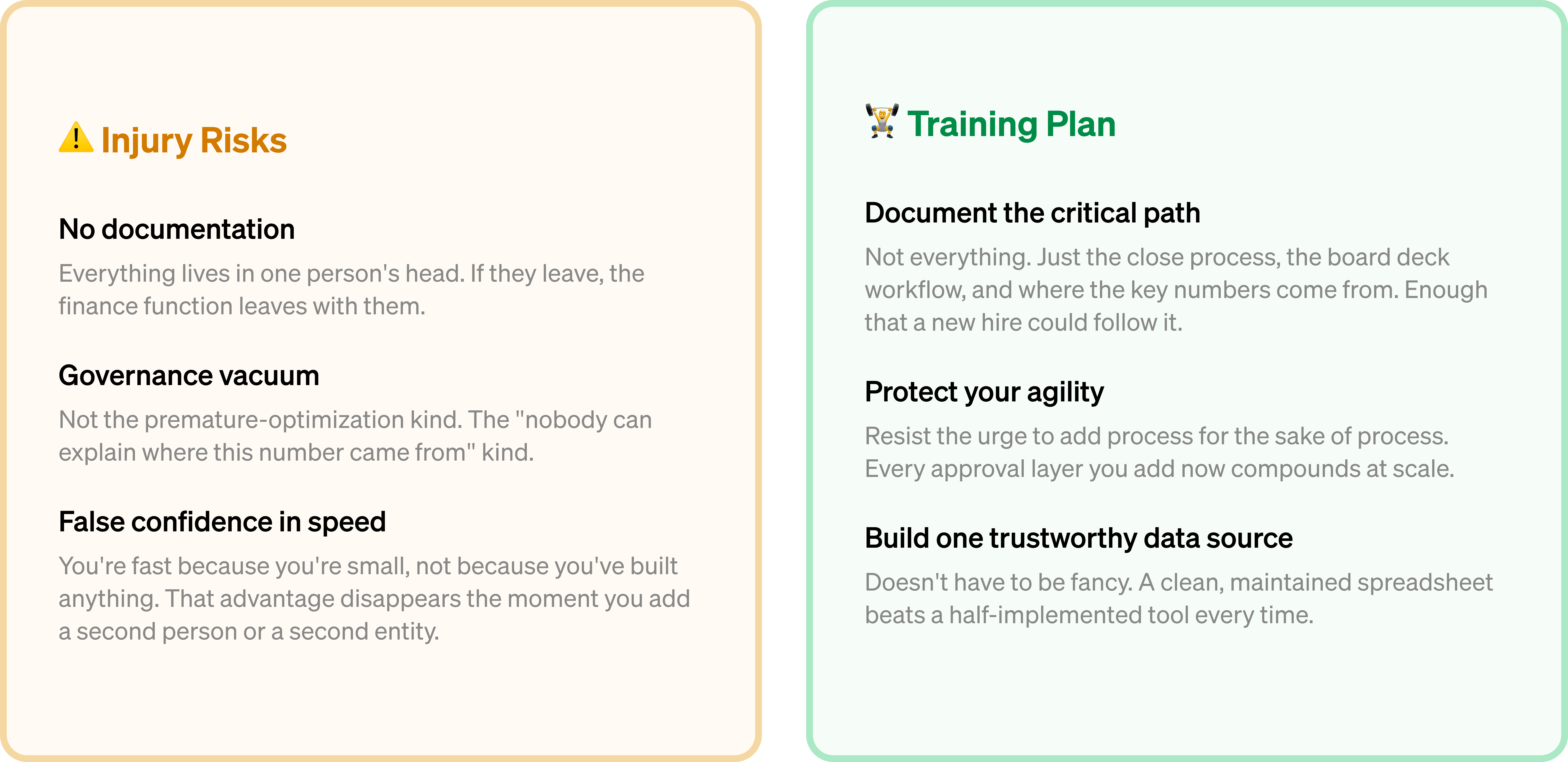
At seed stage, the bar is simplicity and trust. A 1–3 day close is typical — the business is simple enough that this should be fast. Agility is often the biggest strength: one person, one model, minimal red tape. The job is to give the business enough visibility to make good decisions without slowing anything down.
What should a Series B finance team be focused on?
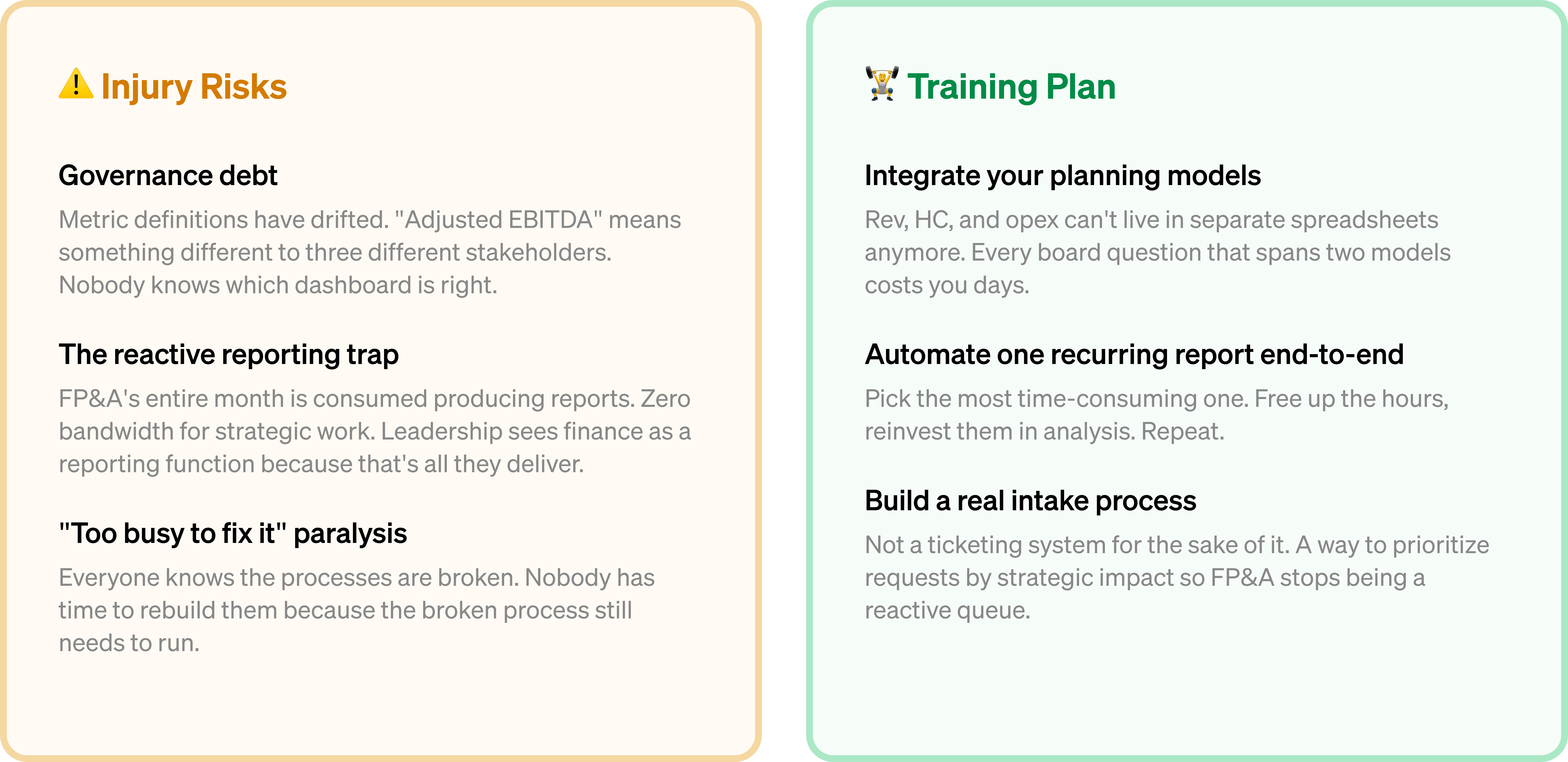
The priority at Series B/C is professionalizing without killing speed. That means closing in 5-7 business days, integrating planning models across revenue, headcount, and opex, shifting from reactive to proactive data governance, and building structured intake for FP&A requests. The hardest part is maintaining agility as more stakeholders require more sign-offs.
What are common FP&A problems at high-growth companies?
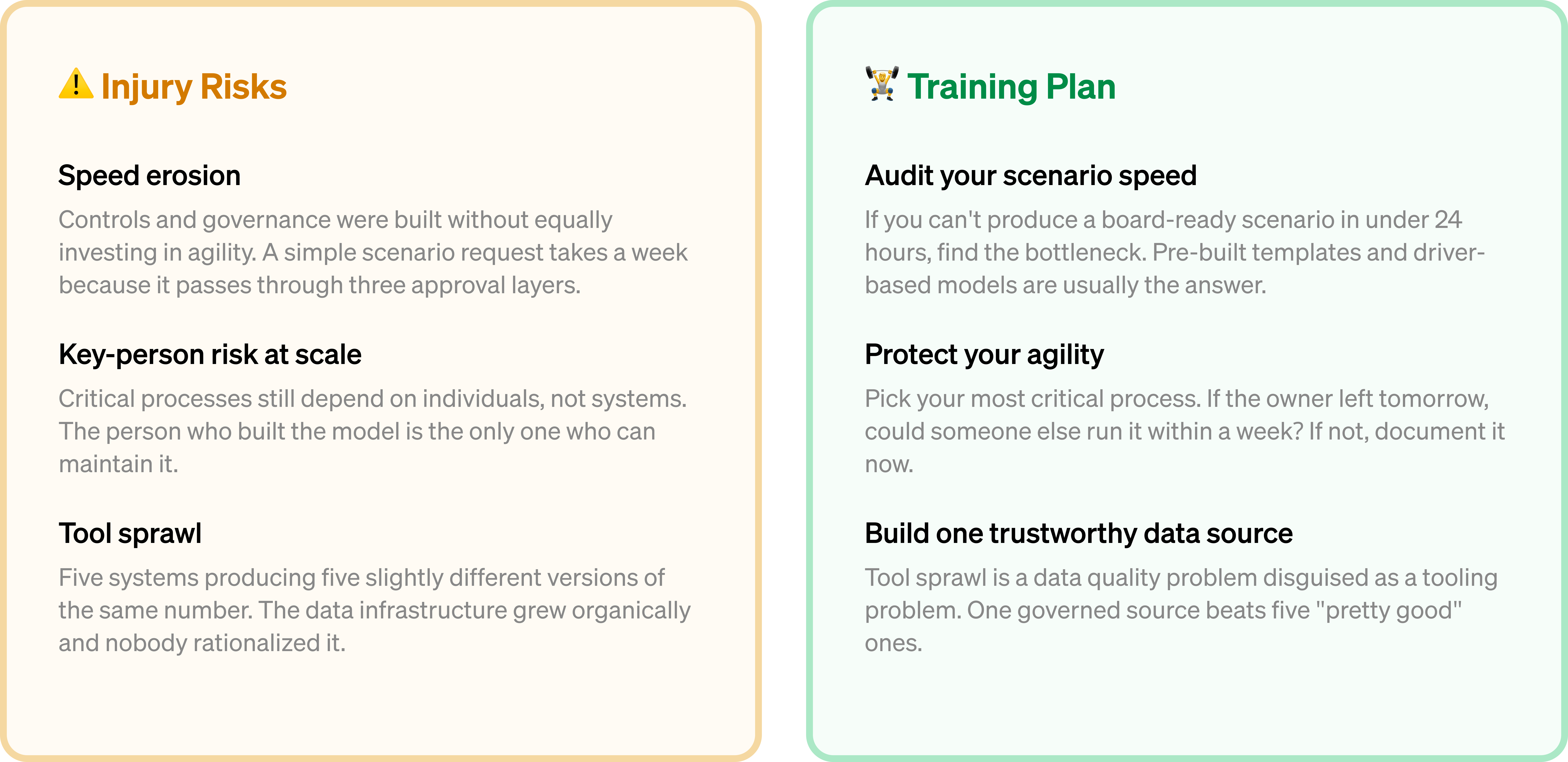
The most common issues at growth and late stage are speed erosion (governance built without equally investing in agility), key-person risk (critical processes depending on individuals instead of systems), and tool sprawl (multiple systems producing slightly different versions of the same numbers). These tend to emerge when capabilities that were functional at earlier stages aren't robust enough for IPO, exit, or due diligence scrutiny.
How do I benchmark my FP&A team against peers?
The FP&A Fitness Test is a free, 24-question diagnostic that scores your team across six dimensions — foundation & actuals, data quality & governance, planning & modeling, agility & decision velocity, cross-functional collaboration, and reporting & influence — calibrated to your company's stage, size, and complexity. It takes about 5 minutes and returns a fitness score, injury risks, and a personalized training plan.
When should a finance team invest in FP&A tooling and process?
The right time depends on stage. Early-stage teams should resist premature optimization and focus on protecting agility and building one trustworthy data source. Series B/C is when integration, automation, and structured processes become critical. By Series D+, the focus shifts to enterprise-grade governance, continuous planning, and ensuring systems are robust enough to support IPO or exit scrutiny.