


Get FP&A best practices, research reports, and more delivered to your inbox.
Benchmarks reflect full-year 2025 data
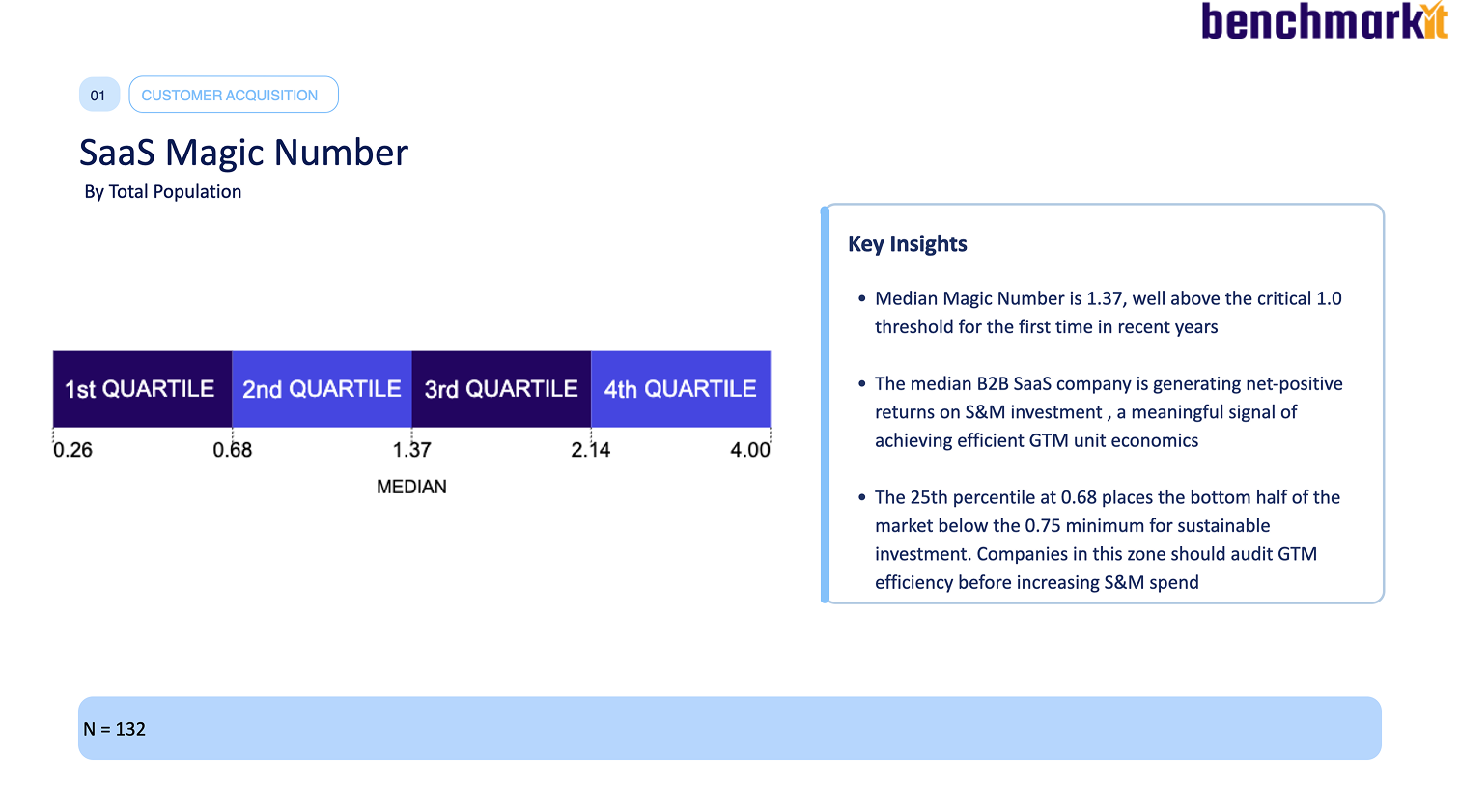
The median B2B SaaS company has a Magic Number of 1.37 — above the critical 1.0 threshold for the first time in years. The minimum for sustainable GTM investment is 0.75, and the bottom quartile sits below it at 0.68. These figures come from full-year 2025 data across 342 SaaS and AI-native companies in the 2026 Aleph × Benchmarkit SaaS & AI Performance Benchmarks.
The Magic Number measures how much new ARR each dollar of sales and marketing generates. At 1.37, the median company now earns $1.37 of annualized new ARR for every $1 of S&M — net-positive returns on GTM, and a clear signal that 2025's efficiency push worked.
{callout}
Bottom line: Above 1.0 is strong, 0.75–1.0 is the acceptable investment zone, and below 0.75 means audit GTM before spending more. The 2025 median of 1.37 crossed 1.0 for the first time in the four-year trend — but the bottom quartile (0.68) is still below the floor.
{/callout}

What's a good SaaS Magic Number?
A good SaaS Magic Number is above 1.0, with 0.75 the minimum that justifies continued GTM investment. The 2025 distribution:
- Above 1.0 — strong. Each S&M dollar returns more than a dollar of new ARR; lean into growth.
- 0.75–1.0 — acceptable. Efficient enough to keep investing, with room to improve.
- Below 0.75 — audit first. The bottom quartile (0.68) is here: spending S&M without proportional return.
The median of 1.37 means the typical company is now comfortably in “invest” territory — a meaningful shift from recent years.
How do you calculate the SaaS Magic Number?
Magic Number = (New ARR added in the period) ÷ (Sales & Marketing expense in the prior period)
Often expressed using quarterly revenue: the annualized increase in revenue (current quarter minus prior quarter, times four) divided by prior-quarter S&M. Two conventions matter: lag the S&M (the spend that generated this period's new ARR happened in the prior period), and be consistent on ARR vs revenue (use one basis throughout; mixing them makes period comparisons meaningless).
Is the SaaS Magic Number improving?
Yes — sharply. The median rose from 0.94 in 2024 to 1.37 in 2025, crossing the 1.0 line for the first time in the four-year trend. And the top is pulling away: the 75th percentile climbed steadily from 1.27 in 2022 to 2.14 in 2025. That widening spread points to a bifurcating market — a top tier with compounding GTM advantages, and a bottom tier that still has not reached the 0.75–1.0 floor.

How does the Magic Number vary by growth rate?
GTM efficiency and growth move together, and the fastest growers have a clear efficiency floor:
Companies growing above 50% post a 2.40 median, and even the bottom of that high-growth cohort clears the 0.75 floor. Meanwhile, mid-growth companies (11–30%) often sit below 0.75 — spending S&M without proportional operating-profit expansion. For that group, the report's guidance is blunt: a GTM model reset, not incremental optimization.
What does a Magic Number below 0.75 mean?
A Magic Number below 0.75 means your sales and marketing spend is not generating enough new ARR to justify itself — you are investing ahead of returns the model is not producing. The report's prescription is to audit GTM efficiency before increasing S&M: more spend on an inefficient motion compounds the problem. Companies in this zone should look at targeting, conversion, and sales productivity before adding budget.
How does the Magic Number relate to CAC payback and the Rule of 40?
The Magic Number is one of the five GTM efficiency metrics that moved together in 2025, and it is roughly the inverse of CAC payback: a high Magic Number means a short payback. The report's practical rule: when your Magic Number, CAC payback, NRR, and GRR are all top-quartile, accelerating GTM investment lifts growth and the Rule of 40. When they are not, more spend mostly erodes both. For a related SaaS benchmark, see LTV:CAC ratio.
How should finance teams benchmark and improve their own Magic Number?
- Lag the S&M correctly. The most common error is dividing this period's new ARR by this period's spend, which flatters a ramping business and penalizes one that just cut.
- Read it as a trend, not a single quarter. New-ARR timing is lumpy; the Magic Number is most useful as a rolling signal of GTM health.
- Pair it with payback before acting. A high Magic Number with a slow payback can still strain cash; use both to decide whether to invest.
Calculating it cleanly means having new ARR and S&M spend in one model with consistent period logic; for the spend-to-pipeline side, a sales capacity model ties S&M to ramp. Aleph connects the CRM and GL so the Magic Number — and the CAC payback and retention metrics it travels with — update as actuals land, instead of being stitched together by hand each quarter.
See how finance teams track the Magic Number and GTM efficiency in Aleph → Book a demo.
Methodology and sources
These benchmarks come from the 2026 SaaS & AI Performance Benchmarks report, published jointly by Aleph and Benchmarkit on June 1, 2026. The report draws on 342 B2B SaaS and AI-native software companies; Magic Number figures are based on the 132 participants that reported the metric. Figures reflect full-year 2025 (CY-2025) actuals. The underlying metrics are explorable in Benchmarkit's interactive benchmarks.
{callout}
A note on the year: This report was published in 2026, but the benchmarks reflect full-year 2025 results — the latest complete data. Where this page says “2025,” it means the data year. “2026” refers to the report edition and the current planning year.
{/callout}
This page is reviewed against each new edition of the benchmark data.
Get FP&A best practices, research reports, and more delivered to your inbox.